
手性选择性电子鼻:用于手性气味立体选择性传感的纳米多孔同手性 MOF 薄膜阵列。
An Enantioselective e-Nose: An Array of Nanoporous Homochiral MOF Films for Stereospecific Sensing of Chiral Odors.
机构信息
Karlsruhe Institute of Technology (KIT), Light Technology Institute (LTI), Engesserstrasse 13, 76131, Karlsruhe, Germany.
Karlsruhe Institute of Technology (KIT), Institute of Functional Interfaces (IFG), Hermann-von-Helmholtz-Platz 1, 76344, Eggenstein-Leopoldshafen, Germany.
出版信息
Angew Chem Int Ed Engl. 2021 Feb 15;60(7):3566-3571. doi: 10.1002/anie.202013227. Epub 2020 Dec 15.
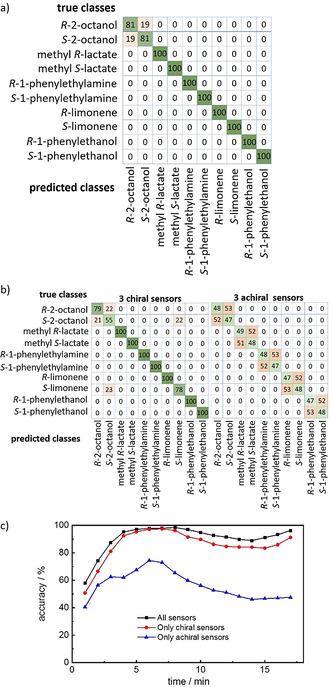
Chirality is essential in nature and often pivotal for biological information transfer, for example, via odor messenger molecules. While the human nose can distinguish the enantiomers of many chiral odors, the technical realization by an artificial sensor or an electronic nose, e-nose, remains a challenge. Herein, we present an array of six sensors coated with nanoporous metal-organic framework (MOF) films of different homochiral and achiral structures, working as an enantioselective e-nose. While the achiral-MOF-film sensors show identical responses for both isomers of one chiral odor molecule, the responses of the homochiral MOF films differ for different enantiomers. By machine learning algorithms, the combined array data allow the stereoselective identification of all compounds, here tested for five pairs of chiral odor molecules. We foresee the chiral-MOF-e-nose, able to enantioselectively detect and discriminate chiral odors, to be a powerful approach towards advanced odor sensing.
手性在自然界中至关重要,通常是生物信息传递的关键,例如通过气味信使分子。虽然人类的鼻子可以区分许多手性气味的对映异构体,但人工传感器或电子鼻(e-nose)的技术实现仍然是一个挑战。在这里,我们展示了由具有不同同手性和非手性结构的纳米多孔金属有机骨架(MOF)薄膜涂覆的 6 个传感器组成的阵列,作为对映选择性的 e-nose。虽然非手性-MOF 薄膜传感器对一种手性气味分子的两种对映异构体表现出相同的响应,但同手性 MOF 薄膜的响应则不同。通过机器学习算法,组合的阵列数据允许对所有化合物进行立体选择性识别,这里对 5 对手性气味分子进行了测试。我们预计,能够对手性气味进行选择性检测和区分的手性-MOF-e-nose 将成为先进气味传感的有力方法。


 Zotero 插件