Biophysics Program, Stanford University, Stanford, California, United States of America.
Department of Bioengineering, Stanford University, Stanford, California, United States of America.
PLoS Biol. 2020 Nov 6;18(11):e3000786. doi: 10.1371/journal.pbio.3000786. eCollection 2020 Nov.
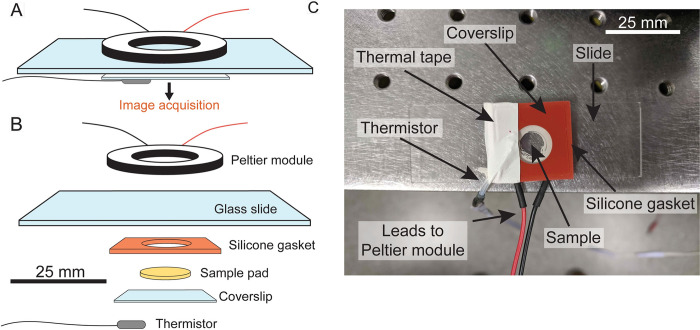
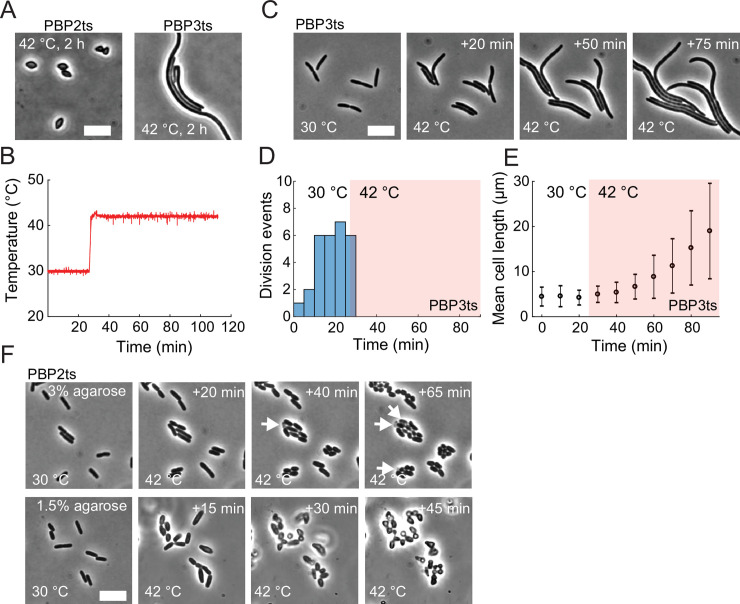
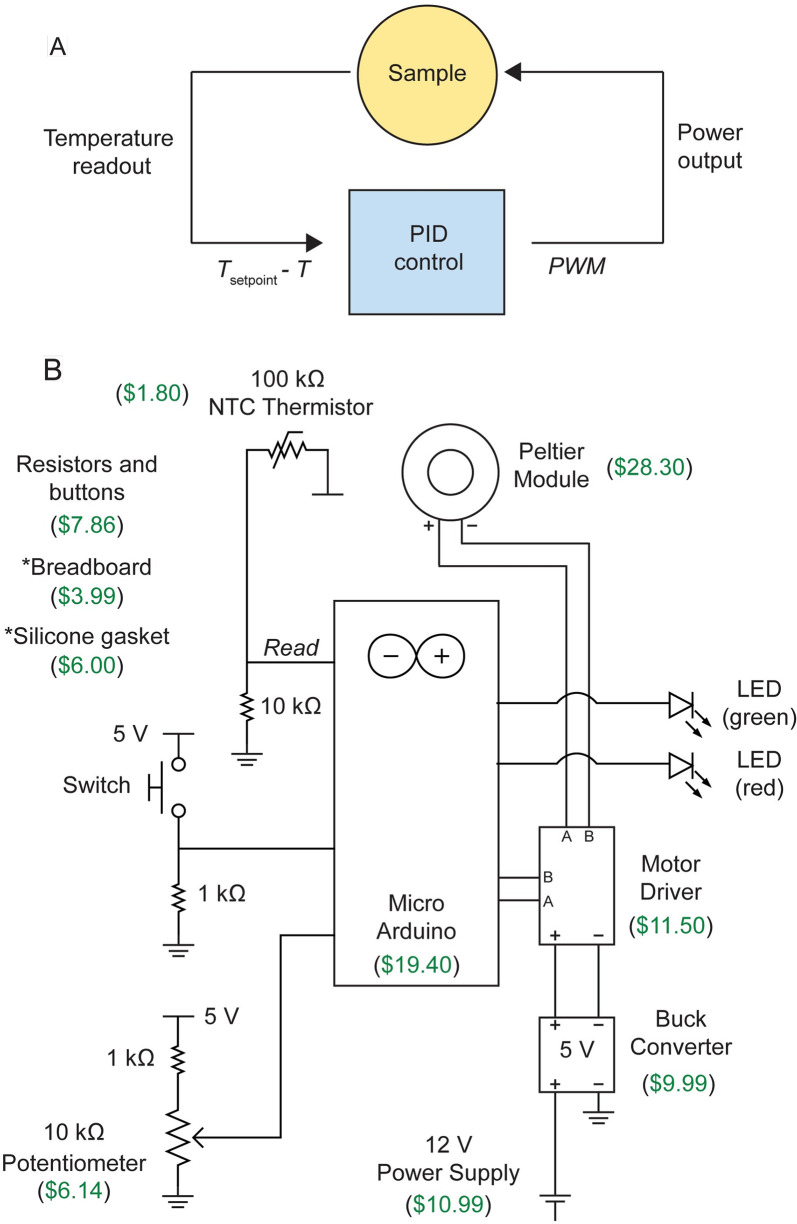
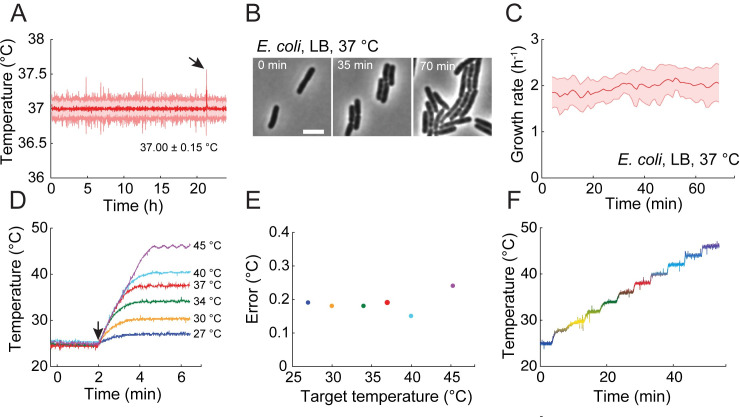
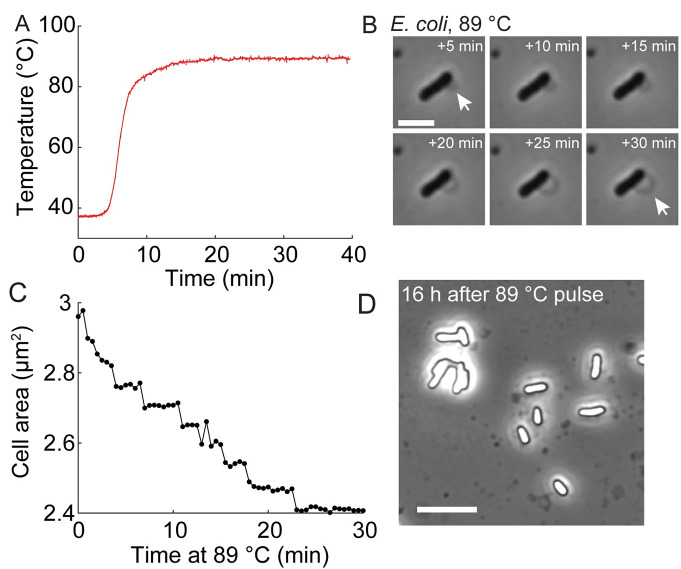
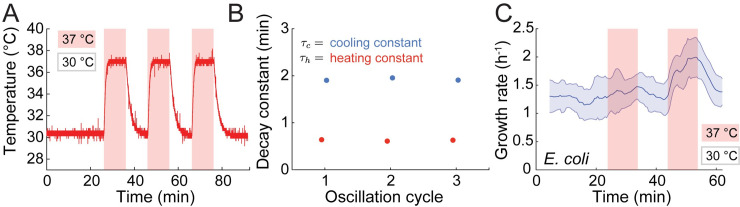
Single-cell imaging, combined with recent advances in image analysis and microfluidic technologies, have enabled fundamental discoveries of cellular responses to chemical perturbations that are often obscured by traditional liquid-culture experiments. Temperature is an environmental variable well known to impact growth and to elicit specific stress responses at extreme values; it is often used as a genetic tool to interrogate essential genes. However, the dynamic effects of temperature shifts have remained mostly unstudied at the single-cell level, due largely to engineering challenges related to sample stability, heatsink considerations, and temperature measurement and feedback. Additionally, the few commercially available temperature-control platforms are costly. Here, we report an inexpensive (<$110) and modular Single-Cell Temperature Controller (SiCTeC) device for microbial imaging-based on straightforward modifications of the typical slide-sample-coverslip approach to microbial imaging-that controls temperature using a ring-shaped Peltier module and microcontroller feedback. Through stable and precise (±0.15°C) temperature control, SiCTeC achieves reproducible and fast (1-2 min) temperature transitions with programmable waveforms between room temperature and 45°C with an air objective. At the device's maximum temperature of 89°C, SiCTeC revealed that Escherichia coli cells progressively shrink and lose cellular contents. During oscillations between 30°C and 37°C, cells rapidly adapted their response to temperature upshifts. Furthermore, SiCTeC enabled the discovery of rapid morphological changes and enhanced sensitivity to substrate stiffness during upshifts to nonpermissive temperatures in temperature-sensitive mutants of cell-wall synthesis enzymes. Overall, the simplicity and affordability of SiCTeC empowers future studies of the temperature dependence of single-cell physiology.
单细胞成像技术,结合最近在图像分析和微流控技术方面的进展,使我们能够深入了解细胞对化学干扰的反应,而这些反应在传统的液体培养实验中常常被掩盖。温度是一个众所周知的环境变量,它会影响生长,并在极端值下引起特定的应激反应;它通常被用作遗传工具来探究必需基因。然而,由于与样品稳定性、散热器考虑因素以及温度测量和反馈相关的工程挑战,温度变化的动态效应在单细胞水平上仍在很大程度上未被研究。此外,少数商业上可用的温度控制平台成本高昂。在这里,我们报告了一种廉价(<$110)且模块化的单细胞温度控制器(SiCTeC),用于基于微生物成像的研究-通过对典型的载玻片-样品-盖玻片方法进行简单的修改来实现微生物成像,该方法使用环形珀耳帖模块和微控制器反馈来控制温度。通过稳定且精确(±0.15°C)的温度控制,SiCTeC 实现了在室温到 45°C 之间具有可编程波形的可重复且快速(1-2 分钟)的温度转换,使用空气物镜。在设备的最高温度 89°C 下,SiCTeC 揭示了大肠杆菌细胞逐渐收缩并失去细胞内容物。在 30°C 和 37°C 之间的振荡过程中,细胞对温度的快速上升做出了快速的适应。此外,SiCTeC 还使我们能够发现快速的形态变化,并在细胞壁合成酶的温度敏感突变体中,在非许可温度下,对底物刚度的敏感性增强。总的来说,SiCTeC 的简单性和可负担性为未来研究单细胞生理学对温度的依赖性提供了支持。