Faculty of Agriculture, Food and Environment, Institute of Biochemistry, Food Science and Nutrition, School of Nutritional Sciences, Hebrew University of Jerusalem, Rehovot 7600001, Israel.
Peres Academic Center, School of Nutritional Sciences, Rehovot 7610202, Israel.
Nutrients. 2020 Nov 4;12(11):3385. doi: 10.3390/nu12113385.
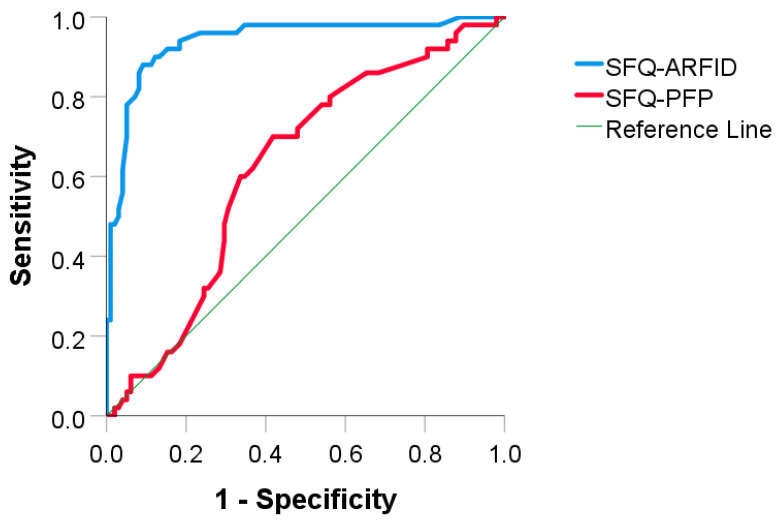
Avoidant/restrictive food intake disorder (ARFID) is a relatively new diagnostic category. We sought to determine whether the Stanford Feeding Questionnaire (SFQ), an instrument for assessing picky eating, can differentiate children with ARFID from control children, and whether children with ARFID would show more nonfeeding/eating emotional problems than controls. Fifty children with ARFID were compared to 98 controls. Parents completed the SFQ, Screen for Child Anxiety Related Emotional Disorders (SCARED), Strength and Difficulties Questionnaire (SDQ), and Sensory Responsiveness Questionnaire (SRQ). On the SFQ, 12 items represented child ARFID behaviors (SFQ-ARFID Scale), and another 15 items represented parental feeding problems (SFQ-PFP Scale). We found that the SFQ-ARFID and SFQ-PFP Scale scores were significantly higher in children with ARFID vs. controls. Children with ARFID demonstrated higher SDQ-Total-Difficulties, higher SDQ-Internalizing-Difficulties and lower SRQ-Hedonic scores compared with controls. Of all parameters, the SFQ-ARFID Scale best differentiated children with ARFID from control children (area under receiver operating characteristics curve = 0.939, 95% CI, 0.895-0.983, < 0.001). These findings suggest that parental reports show more eating problems and emotional disturbances in children with ARFID vs. controls, and more parental feeding problems. Further research is required to determine whether the SFQ-ARFID Scale may serve as an effective screening tool for the identification of ARFID.
回避/限制型食物摄入障碍(ARFID)是一个相对较新的诊断类别。我们旨在确定斯坦福喂养问卷(SFQ),一种用于评估挑食的工具,是否可以将 ARFID 患儿与对照组儿童区分开来,以及 ARFID 患儿是否会表现出比对照组更多的非喂养/进食情绪问题。我们将 50 名 ARFID 患儿与 98 名对照组儿童进行了比较。父母完成了 SFQ、儿童焦虑相关情绪障碍筛查(SCARED)、长处和困难问卷(SDQ)和感觉反应问卷(SRQ)。在 SFQ 上,有 12 项代表儿童 ARFID 行为(SFQ-ARFID 量表),另外 15 项代表父母喂养问题(SFQ-PFP 量表)。我们发现,与对照组相比,ARFID 患儿的 SFQ-ARFID 和 SFQ-PFP 量表得分显著更高。与对照组相比,ARFID 患儿的 SDQ-总困难度、SDQ-内化困难度更高,而 SRQ-愉悦度更低。在所有参数中,SFQ-ARFID 量表最佳地区分了 ARFID 患儿和对照组儿童(受试者工作特征曲线下面积=0.939,95%置信区间,0.895-0.983,<0.001)。这些发现表明,与对照组相比,父母报告显示 ARFID 患儿存在更多的进食问题和情绪障碍,以及更多的父母喂养问题。需要进一步的研究来确定 SFQ-ARFID 量表是否可以作为识别 ARFID 的有效筛查工具。