Jiangsu Cancer Hospital & Jiangsu Institute of Cancer Research & The Affiliated Cancer Hospital of Nanjing Medical University, Nanjing 210009, China.
State Key Laboratory of Natural Medicines, Jiangsu Key Laboratory of Carcinogenesis and Intervention, Key Laboratory of Drug Quality Control and Pharmacovigilance, Ministry of Education, Jiangsu Key Laboratory of Drug Design and Optimization, China Pharmaceutical University, Nanjing 210009, China.
Genes (Basel). 2020 Nov 4;11(11):1309. doi: 10.3390/genes11111309.
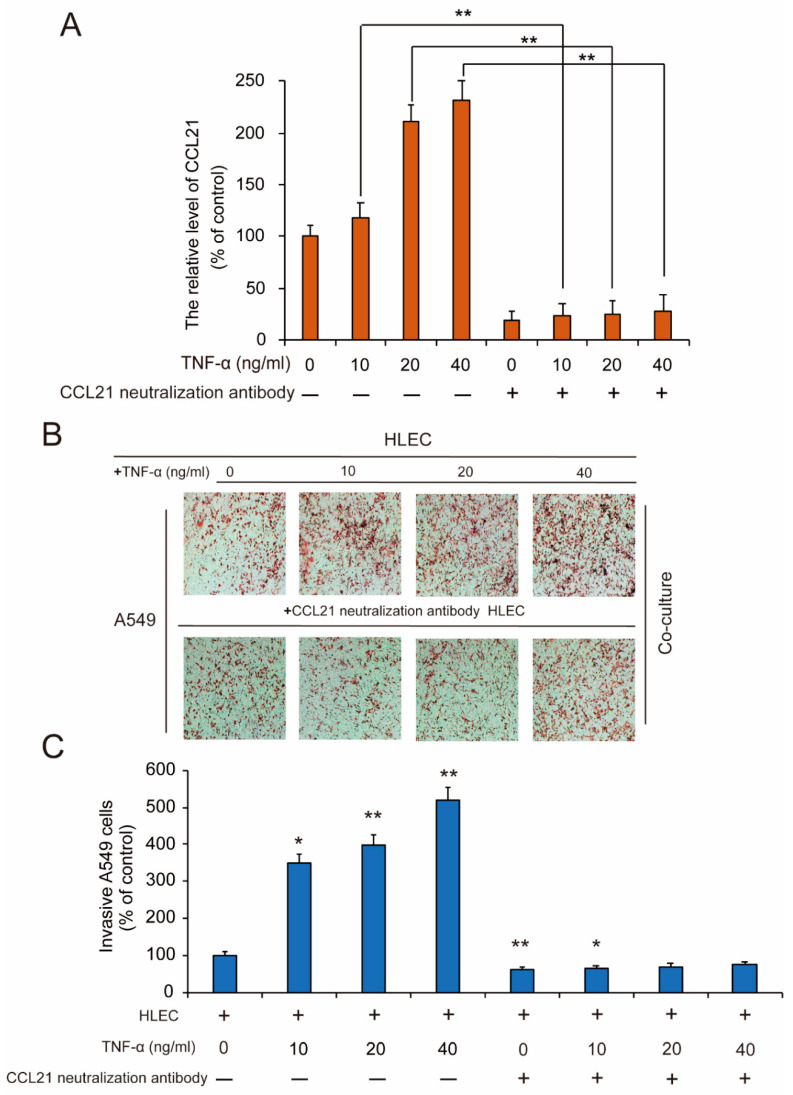
Metastasis and recurrence are the main causes of lung adenocarcinoma patients' death. Lymphatic metastasis is the main way of non-small cell lung cancer (NSCLC) metastasis. C-C chemokine receptor type 7 (CCR7) overexpression has been demonstrated to mediate occurrence and progression of NSCLC. Moreover, Chemokine ligand 21 (CCL21) was used to activate CCR7. The CCR7-CCL21 axis is one of the most common "chemokine-receptor" modes of action in the development and metastasis of multiple tumors. However, the role of the CCR7-CCL21 axis in lymphatic metastasis of NSCLC is poorly understood. The study was conducted to investigate the molecular mechanism underlying CCR7-CCL21 axis-mediated lymphatic metastasis of NSCLC A549 cells. Tumor necrosis factor α (TNF-α) could regulate the tumor microenvironment balance by promoting chemokine secretion. Our study demonstrated that TNF-α promoted CCL21 production in human lymphatic endothelial cells (HLEC). Results further showed that TNF-α significantly activated the NF-κB pathway in HLEC. NF-κB pathway inhibition with ammonium pyrrolidinedithiocarbamate (PDTC) caused a significant decrease in CCL21 secretion, suggesting that TNF-α-induced CCL21 secretion in HLEC was through NF-κB pathway. Co-culture of A549 cells and TNF-α-treated HLEC confirmed that the metastasis of A549 cells was enhanced, meanwhile, apoptosis-related proteins were hardly affected. The data proved that a co-culture system prevented cell apoptosis while inducing the lymphatic metastasis of A549 cells. However, the situation was reversed after neutralizing CCL21 expression, suggesting that TNF-α-induced CCL21 secretion in HLEC is involved in A549 cells metastasis. Collectively, our finding demonstrated that NF-κB pathway-controlled CCL21 secretion of HLEC contributing to the lymphatic metastasis of A549 cells via the CCR7-CCL21 axis, validating the CCR7-CCL21 axis as a potential target to inhibit metastasis of NSCLC.
转移和复发是肺腺癌患者死亡的主要原因。淋巴转移是非小细胞肺癌(NSCLC)转移的主要途径。C-C 趋化因子受体 7(CCR7)过表达已被证明介导 NSCLC 的发生和进展。此外,趋化因子配体 21(CCL21)用于激活 CCR7。CCR7-CCL21 轴是多种肿瘤发生和转移中最常见的“趋化因子-受体”作用模式之一。然而,CCR7-CCL21 轴在 NSCLC 淋巴转移中的作用尚不清楚。本研究旨在探讨 CCR7-CCL21 轴介导 NSCLC A549 细胞淋巴转移的分子机制。肿瘤坏死因子-α(TNF-α)可通过促进趋化因子分泌来调节肿瘤微环境平衡。我们的研究表明,TNF-α可促进人淋巴管内皮细胞(HLEC)中 CCL21 的产生。结果进一步表明,TNF-α可显著激活 HLEC 中的 NF-κB 途径。用氨乙基吡咯烷二硫代氨基甲酸盐(PDTC)抑制 NF-κB 途径可导致 CCL21 分泌显著减少,表明 TNF-α诱导 HLEC 中 CCL21 的分泌是通过 NF-κB 途径。A549 细胞与 TNF-α 处理的 HLEC 共培养证实,A549 细胞的转移增强,同时凋亡相关蛋白几乎不受影响。数据证明,共培养系统在诱导 A549 细胞淋巴转移的同时阻止了细胞凋亡。然而,中和 CCL21 表达后情况发生逆转,表明 TNF-α诱导 HLEC 中 CCL21 的分泌参与了 A549 细胞的转移。总之,我们的研究结果表明,NF-κB 途径控制 HLEC 中 CCL21 的分泌,通过 CCR7-CCL21 轴促进 A549 细胞的淋巴转移,验证了 CCR7-CCL21 轴作为抑制 NSCLC 转移的潜在靶点。