Department of Rehabilitation Sciences, Research Group for Neurorehabilitation, KU Leuven, Leuven, Belgium.
Leuven Autism Research (LAuRes), KU Leuven, Leuven, Belgium.
Transl Psychiatry. 2020 Nov 6;10(1):383. doi: 10.1038/s41398-020-01069-w.
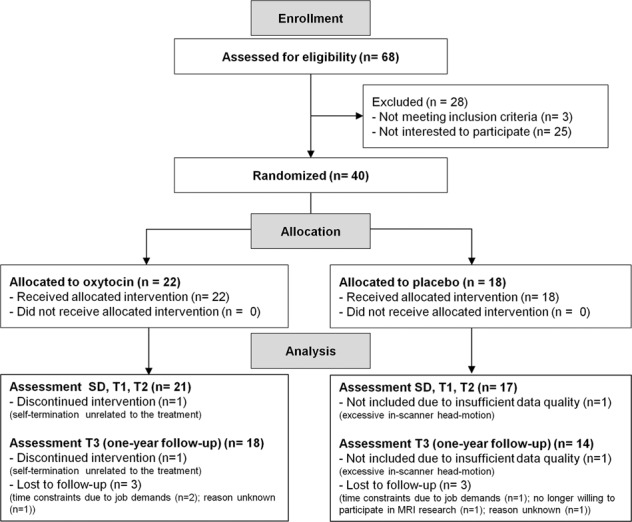
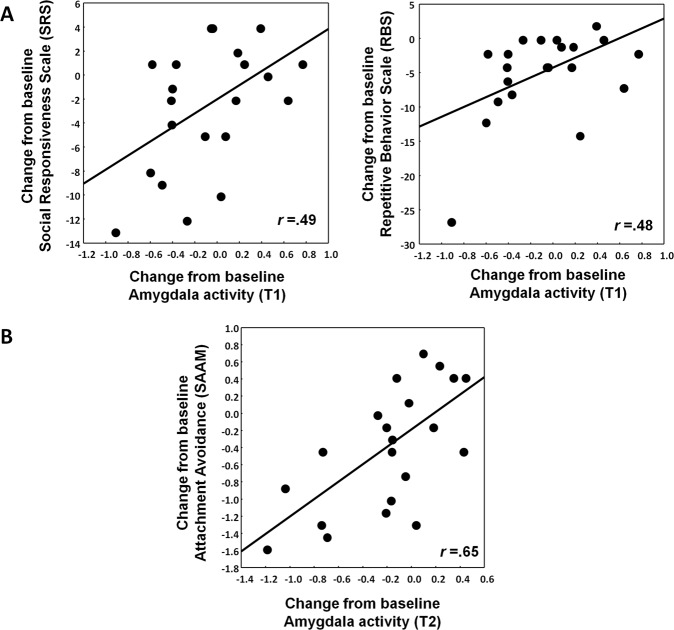
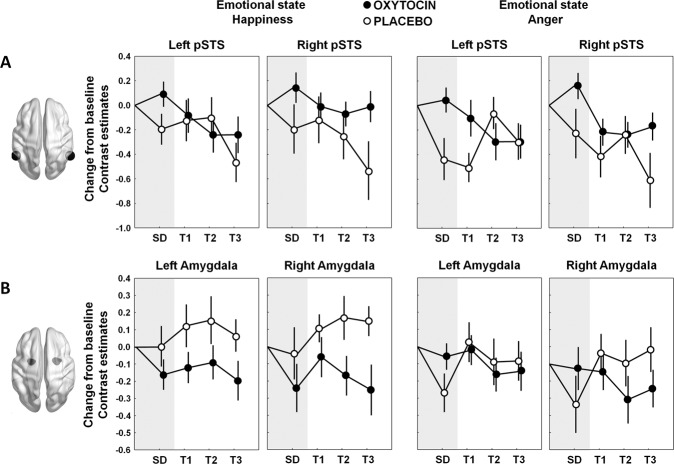
Intranasal administration of the neuropeptide oxytocin (IN-OT) is increasingly considered as a potential treatment for targeting the core symptoms of autism spectrum disorder (ASD), but the effects of continual use on neural substrates are fairly unexplored and long-term effects are unknown. In this double-blind, randomized, placebo-controlled study, we investigated the effects of single-dose and multiple-dose IN-OT treatment (4 weeks of daily (24 IU) administrations) on brain activity related to processing emotional states. Thirty-eight adult men with ASD (aged between 18 and 35 years) underwent functional magnetic resonance imaging of the posterior superior temporal gyrus (pSTS) and amygdala regions while processing emotional states from point-light biological motion. In line with prior research, a single dose of IN-OT induced a reliable increase in pSTS brain activity during the processing of point-light biological motion, but no consistent long-term changes in pSTS activity were induced after the multiple-dose treatment. In terms of bilateral amygdala, the multiple-dose treatment induced a consistent attenuation in brain activity, which outlasted the period of actual administrations until four weeks and one year post-treatment. Critically, participants with stronger attenuations in amygdala-activity showed greater behavioral improvements, particularly in terms of self-reported feelings of avoidant attachment and social functioning. Together, these observations provide initial insights into the long-lasting neural consequences of chronic IN-OT use on amygdala functioning and provide first indications that the acute versus chronic effects of IN-OT administration may be qualitatively different. Larger studies are however warranted to further elucidate the long-term impact of IN-OT treatment on human neural substrates and its behavioral consequences.
鼻腔给予神经肽催产素(IN-OT)越来越被认为是一种针对自闭症谱系障碍(ASD)核心症状的潜在治疗方法,但持续使用对神经基质的影响尚未得到充分研究,长期效果也未知。在这项双盲、随机、安慰剂对照研究中,我们研究了单次和多次 IN-OT 治疗(4 周每日(24IU)给药)对处理情绪状态相关的大脑活动的影响。38 名成年 ASD 男性(年龄在 18 至 35 岁之间)接受了功能性磁共振成像(fMRI),以研究后上颞叶(pSTS)和杏仁核区域对光点生物运动的情绪处理。与之前的研究一致,单次 IN-OT 给药可在处理光点生物运动时可靠地增加 pSTS 大脑活动,但多次给药后并未引起 pSTS 活动的一致长期变化。就双侧杏仁核而言,多次给药治疗可一致减弱大脑活动,这种减弱持续到实际给药期结束后 4 周和 1 年。关键的是,杏仁核活动减弱幅度较大的参与者在行为上表现出更大的改善,特别是在回避依恋和社交功能方面的自我报告感觉方面。总之,这些观察结果初步揭示了慢性 IN-OT 使用对杏仁核功能的长期神经后果,并首次表明 IN-OT 给药的急性与慢性作用可能在性质上有所不同。然而,需要更大规模的研究来进一步阐明 IN-OT 治疗对人类神经基质及其行为后果的长期影响。