Institute of Molecular Biomedicine, Faculty of Medicine, Comenius University, Bratislava, Slovakia.
Institute of Physiology, Faculty of Medicine, Comenius University, Bratislava, Slovakia.
Mol Psychiatry. 2024 Feb;29(2):342-347. doi: 10.1038/s41380-023-02330-6. Epub 2023 Dec 15.
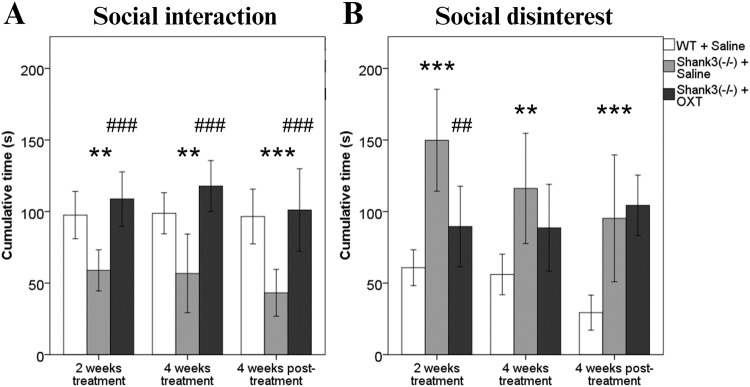
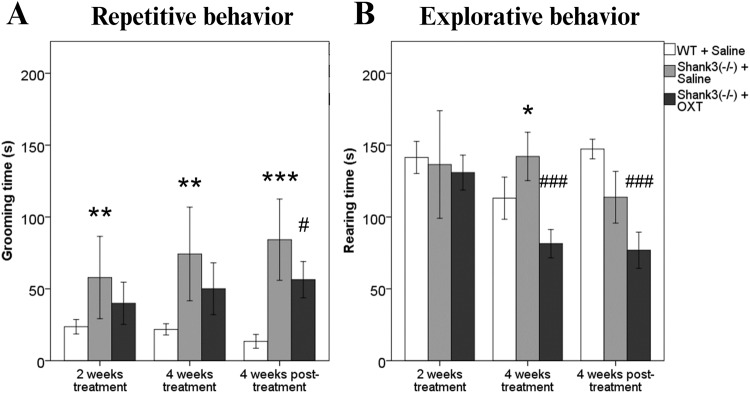
Autism spectrum disorder (ASD) is a group of neurodevelopmental disorders mainly characterized by deficient sociability and repetitive behaviors. Effective treatment for the core symptoms of ASD is still lacking. Behavioral interventions show limited effectiveness, while pharmacotherapy focuses on the amelioration of secondary symptomatology. Oxytocin (OXT) is a neuropeptide known for its prosocial impact, making it a candidate drug for ASD treatment. Its alleviating effect has been and still is widely researched, but outcomes reported by clinical studies are ambiguous. We examined the effect of daily intranasal OXT (0.8 IU/kg) administration for 4 weeks on the ASD-like phenotype in Shank3 adult mice. Animals treated with OXT spent twice as much time interacting with the social partner as early as after 2 weeks of treatment. Furthermore, OXT-treated mice exhibited reduced explorative behavior by 50%, after 4 weeks of treatment, and a 30% reduction in repetitive behavior, 4 weeks after treatment termination. One-fold higher sociability and 30% reduced exploration due to OXT lasted up to 4 weeks following the treatment termination. However, social disinterest was elevated by roughly 10% as well, indicating a form of social ambivalence. Obtained results support the therapeutic potential of intranasally administered OXT in alleviating social shortfalls in a genetic model of ASD. Subsequent research is necessary to elucidate the benefits and risks of the long-term OXT administration, as well as its applicability in other ASD models and the potential treatment effect on social communication, which was not measured in the present study.
自闭症谱系障碍(ASD)是一组神经发育障碍,主要表现为社交能力缺陷和重复行为。目前针对 ASD 核心症状的有效治疗方法仍较为缺乏。行为干预的效果有限,而药物治疗则侧重于改善次要症状。催产素(OXT)是一种具有亲社会作用的神经肽,因此被认为是 ASD 治疗的候选药物。其缓解作用已被广泛研究,但临床研究报告的结果并不明确。我们研究了连续 4 周每天鼻腔内给予 Shank3 成年小鼠 0.8IU/kg 催产素对 ASD 样表型的影响。接受 OXT 治疗的动物早在治疗 2 周后,与社交伙伴互动的时间就增加了一倍。此外,经过 4 周的治疗,OXT 治疗组的探索行为减少了 50%,而在治疗结束后 4 周,重复行为减少了 30%。OXT 治疗后,社交能力提高了一倍,探索行为减少了 30%,这种情况持续了 4 周。然而,社交兴趣也增加了约 10%,表明存在一种社交矛盾。这些结果支持了鼻腔给予催产素在缓解 ASD 遗传模型中社交缺陷方面的治疗潜力。需要进一步的研究来阐明长期给予 OXT 的益处和风险,以及其在其他 ASD 模型中的适用性,以及对本研究未测量的社交沟通的潜在治疗效果。