Division of Oncology, Department of Medicine 1, Medical University of Vienna, Waehringer Guertel 18-20, 1090, Vienna, Austria.
Support Care Cancer. 2021 Jul;29(7):3585-3592. doi: 10.1007/s00520-020-05826-x. Epub 2020 Nov 7.
Misconceptions regarding activity and toxicity of therapeutic interventions are common among cancer patients. There is little knowledge about the factors that contribute to a more realistic perception by patients.
This pilot study was designed as a prospective questionnaire survey and included 101 therapy-naïve patients treated at the Division of Oncology, Medical University of Vienna. After obtaining written informed consent, patients' expectations about treatment aims, side effects and the satisfaction with their oncologic consultation were interrogated before the first treatment cycle by questionnaires.
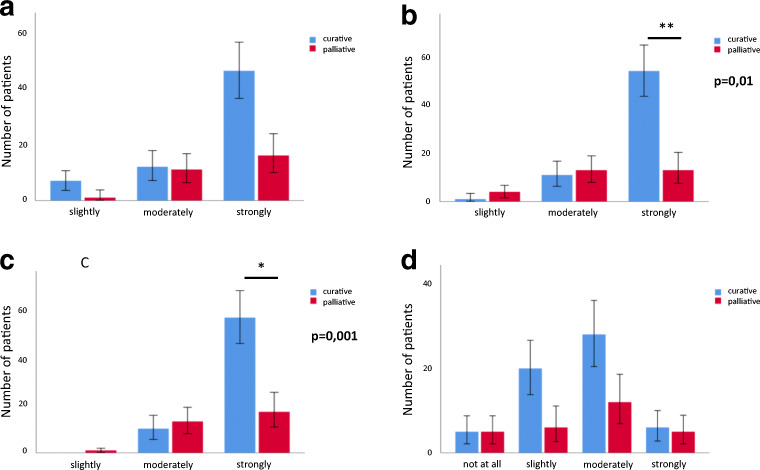
Of 101 patients, 53 (53%) were female and 67/101 (66%) were treated with curative attempt in an adjuvant or neo-adjuvant setting. The most common diagnoses were lung cancer (31%) and breast cancer (30%). Although 92% of patients were satisfied with the information given by their oncologist, palliative patients were more likely to declare that not everything was explained in an intelligible manner (p = 0.01). Patients with a first language other than German stated more often that their physician did not listen carefully enough (p = 0.02). Of 30 patients, 26 (87%) receiving chemotherapy with palliative intent believed that their disease was curable. Concerning adverse events, female patients anticipated more frequently hair loss (p = 0.003) and changes in taste (p = 0.001) compared to men. Patients under curative treatment were more likely to expect weight loss (p = 0.02) and lack of appetite (p = 0.01) compared to patients with palliative treatment intent.
In conclusion, cancer patients were satisfied with the patient-doctor communication. This prospective study aggregated patients' concerns on side effects and the perception of therapeutic goals in therapy-naïve patients. Of note, the majority of patients treated in the palliative setting expected their treatment to cure the disease.
癌症患者对治疗干预的活动和毒性存在误解,这很常见。对于导致患者更现实地认识的因素,我们知之甚少。
本研究为前瞻性问卷调查,纳入了维也纳医科大学肿瘤科的 101 例初治患者。在获得书面知情同意后,在首个治疗周期前通过问卷询问患者对治疗目的、副作用和对肿瘤咨询的满意度的预期。
101 例患者中,53 例(53%)为女性,67/101 例(66%)接受根治性辅助或新辅助治疗。最常见的诊断为肺癌(31%)和乳腺癌(30%)。尽管 92%的患者对肿瘤医生提供的信息感到满意,但姑息治疗患者更有可能表示并非所有内容都以易懂的方式解释(p=0.01)。母语非德语的患者更常表示医生没有仔细倾听(p=0.02)。在接受姑息性化疗的 30 例患者中,26 例(87%)患者认为他们的疾病可以治愈。关于不良反应,女性患者比男性患者更常预期脱发(p=0.003)和味觉改变(p=0.001)。与姑息治疗意向的患者相比,接受根治性治疗的患者更有可能预期体重减轻(p=0.02)和食欲不振(p=0.01)。
总之,癌症患者对医患沟通感到满意。本前瞻性研究总结了初治患者对副作用和治疗目标感知的关注。值得注意的是,大多数接受姑息治疗的患者期望他们的治疗能治愈疾病。