Department of Neurology, University of Washington School of Medicine, Seattle, WA 98109-8055, USA; Senator Paul D. Wellstone Muscular Dystrophy Specialized Research Center, University of Washington School of Medicine, Seattle, WA 98109-8055, USA.
Department of Neurology, University of Washington School of Medicine, Seattle, WA 98109-8055, USA; Senator Paul D. Wellstone Muscular Dystrophy Specialized Research Center, University of Washington School of Medicine, Seattle, WA 98109-8055, USA.
Mol Ther. 2021 Mar 3;29(3):1070-1085. doi: 10.1016/j.ymthe.2020.11.003. Epub 2020 Nov 5.
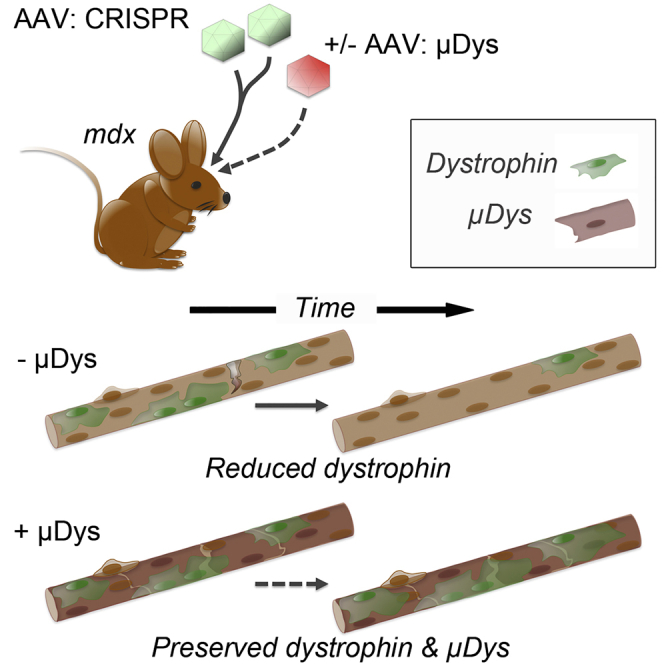
Gene editing is often touted as a permanent method for correcting mutations, but its long-term benefits in Duchenne muscular dystrophy (DMD) may depend on sufficiently high editing efficiencies to halt muscle degeneration. Here, we explored the persistence of dystrophin expression following recombinant adeno-associated virus serotype 6 (rAAV6):CRISPR-Cas9-mediated multi-exon deletion/reframing in systemically injected 2- and 11-week-old dystrophic mice and show that induction of low dystrophin levels persists for several months in cardiomyocytes but not in skeletal muscles, where myofibers remain susceptible to necrosis and regeneration. Whereas gene-correction efficiency in both muscle types was enhanced with increased ratios of guide RNA (gRNA)-to-nuclease vectors, obtaining high dystrophin levels in skeletal muscles via multi-exon deletion remained challenging. In contrast, when AAV-microdystrophin was codelivered with editing components, long-term gene-edited dystrophins persisted in both muscle types. These results suggest that the high rate of necrosis and regeneration in skeletal muscles, compared with the relative stability of dystrophic cardiomyocytes, caused the rapid loss of edited genomes. Consequently, stable dystrophin expression in DMD skeletal muscles will require either highly efficient gene editing or the use of cotreatments that decrease skeletal muscle degeneration.
基因编辑常被吹捧为一种纠正突变的永久方法,但它在杜氏肌营养不良症(DMD)中的长期益处可能取决于足够高的编辑效率,以阻止肌肉退化。在这里,我们研究了重组腺相关病毒血清型 6(rAAV6):CRISPR-Cas9 介导的多外显子缺失/重排后,在系统性注射的 2 周和 11 周龄肌营养不良小鼠中的肌营养不良蛋白表达的持久性,并表明在心肌细胞中诱导低水平的肌营养不良蛋白可持续数月,但在骨骼肌中则不然,骨骼肌中的肌纤维仍然容易发生坏死和再生。虽然两种肌肉类型的基因校正效率都随着向导 RNA(gRNA)-到核酸酶载体比的增加而提高,但通过多外显子缺失获得骨骼肌中的高肌营养不良蛋白水平仍然具有挑战性。相比之下,当 AAV-微肌营养不良蛋白与编辑成分共同递送时,长期基因编辑的肌营养不良蛋白在两种肌肉类型中都能持续存在。这些结果表明,与相对稳定的肌营养不良型心肌细胞相比,骨骼肌中坏死和再生的高速度导致了编辑基因组的迅速丢失。因此,DMD 骨骼肌中稳定的肌营养不良蛋白表达将需要高效的基因编辑,或使用减少骨骼肌退化的联合治疗。