Department of Clinical Psychology and Epidemiology, University of Basel, 4055, Basel, Switzerland.
Institute of Work and Organizational Psychology, University of Neuchâtel, 2000 Neuchâtel, Switzerland.
BMC Psychol. 2020 Nov 7;8(1):119. doi: 10.1186/s40359-020-00486-2.
Cognitive enhancement (CE) refers to the voluntary improvement of human cognitive capabilities. Few studies have examined the general attitude of the public towards CE. Such studies have suggested that the use of CE is considered largely unacceptable by the public. In parallel, past research indicates that individuals scoring high on the Dark Triad of personality (Machiavellianism, narcissism, and psychopathy) and competitiveness have atypical views of ethical questions. In this study, we examined (a) whether attitudes towards CE are associated with individual differences in the Dark Triad of personality as well as in trait and contextual competitiveness and (b) whether the Dark Triad moderates the effect of trait and contextual competitiveness on attitudes towards CE.
US employees (N = 326) were recruited using Mechanical Turk. Participants completed a web survey. Data were analyzed by means of (robust) hierarchical regression and (robust) ANCOVAs.
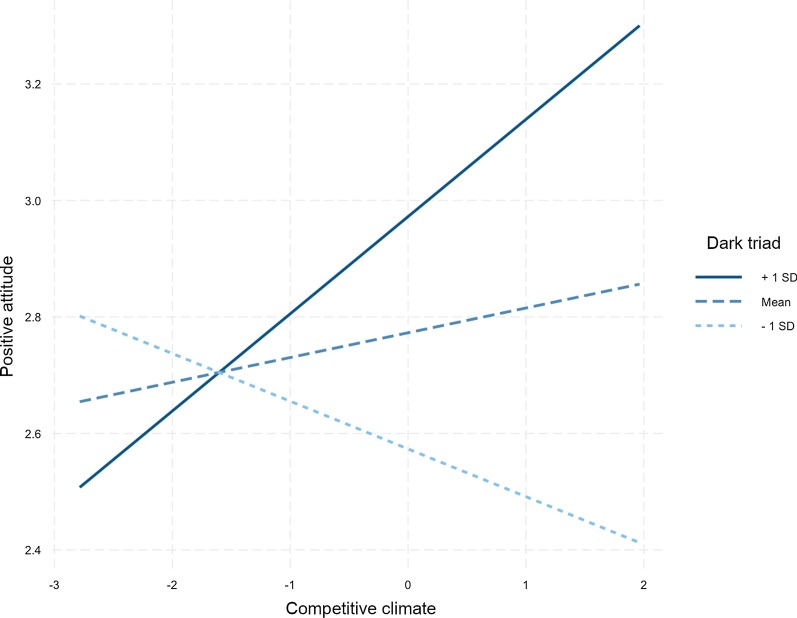
The Dark Triad of personality and one of its subscales, Machiavellianism, predicted positive attitudes towards CE. Neither trait competitiveness nor contextual competitiveness were linked to general attitudes towards CE, but the DT was a positive moderator of the association between contextual competitiveness and positive attitudes.
Our findings extend the incipient knowledge about the factors relating to favourable views of CE by highlighting the role of dark personality traits in shaping such views. Our study further shows contextual factors can play a differentiated role with respect to such attitudes depending upon dark personality traits. Implications for policy-making are discussed.
认知增强(CE)是指自愿提高人类认知能力。很少有研究调查公众对 CE 的总体态度。这些研究表明,公众普遍认为使用 CE 是不可接受的。与此同时,过去的研究表明,人格的黑暗三因素(马基雅维利主义、自恋和精神病态)和竞争得分较高的个体对道德问题有非典型的看法。在这项研究中,我们考察了:(a)对 CE 的态度是否与人格的黑暗三因素以及特质和情境竞争有关;(b)黑暗三因素是否调节了特质和情境竞争对 CE 态度的影响。
使用 Mechanical Turk 招募了美国员工(N=326)。参与者完成了一项网络调查。通过(稳健)分层回归和(稳健)协方差分析对数据进行了分析。
人格的黑暗三因素及其子量表马基雅维利主义,预测了对 CE 的积极态度。特质竞争和情境竞争都与对 CE 的总体态度无关,但 DT 是情境竞争与积极态度之间关系的积极调节者。
我们的研究结果通过强调黑暗人格特质在塑造这种观点方面的作用,扩展了关于与 CE 有利观点相关的因素的初步知识。我们的研究还表明,情境因素根据黑暗人格特质对这种态度可能起到不同的作用。讨论了政策制定的影响。