Institute of Physiological Chemistry, University Medical Center of the Johannes Gutenberg University, Mainz, Germany.
Dialogues Clin Neurosci. 2020 Sep;22(3):207-222. doi: 10.31887/DCNS.2020.22.3/blutz.
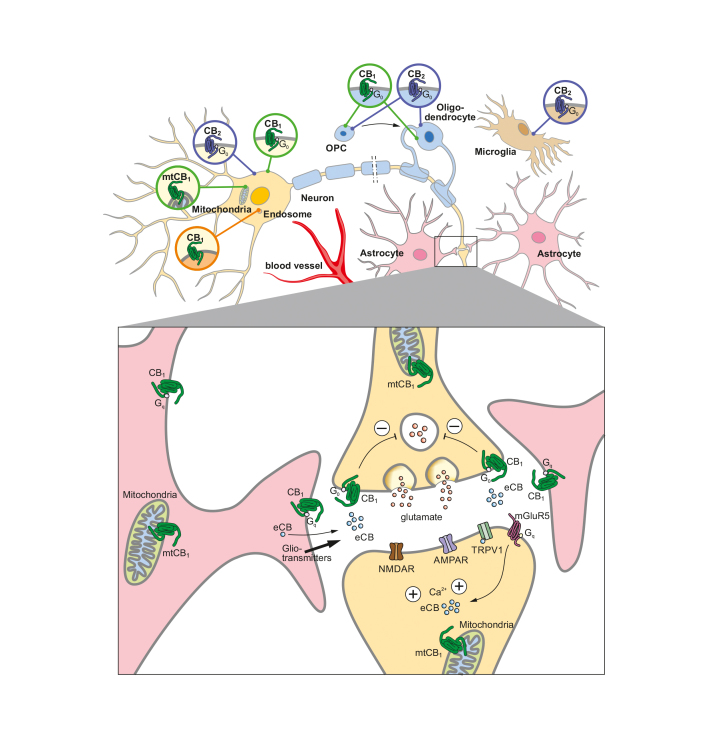
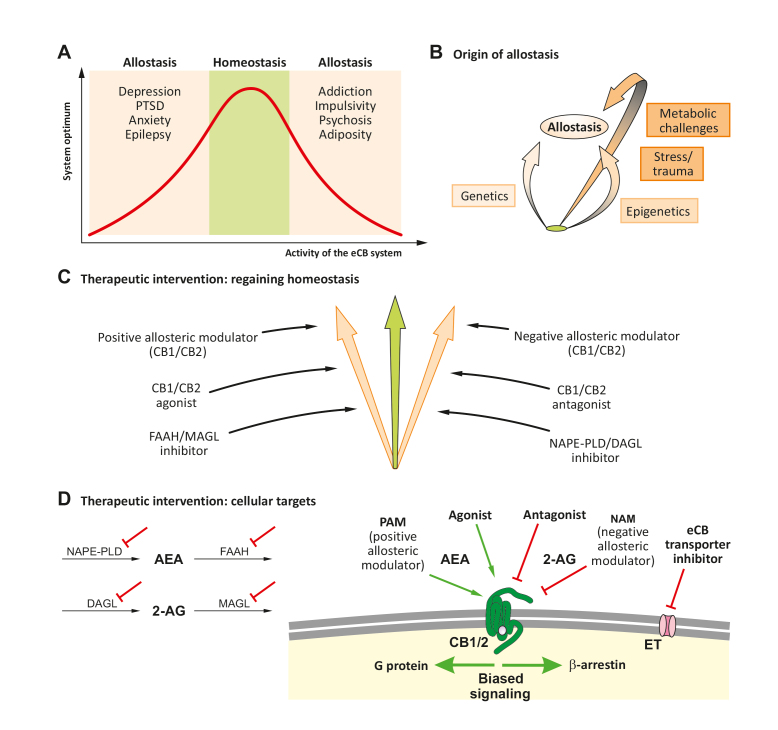
The endocannabinoid system (ECS) is a highly versatile signaling system within the nervous system. Despite its widespread localization, its functions within the context of distinct neural processes are very well discernable and specific. This is remarkable, and the question remains as to how such specificity is achieved. One key player in the ECS is the cannabinoid type 1 receptor (CB), a G protein-coupled receptor characterized by the complexity of its cell-specific expression, cellular and subcellular localization, and its adaptable regulation of intracellular signaling cascades. CB receptors are involved in different synaptic and cellular plasticity processes and in the brain's bioenergetics in a context-specific manner. CB receptors are also important in several processes in neurons, glial cells, and immune cells of the brain. As polymorphisms in ECS components, as well as external impacts such as stress and metabolic challenges, can both lead to dysregulated ECS activity and subsequently to possible neuropsychiatric disorders, pharmacological intervention targeting the ECS is a promising therapeutic approach. Understanding the neurobiology of cannabinoid receptor signaling in depth will aid optimal design of therapeutic interventions, minimizing unwanted side effects. .
内源性大麻素系统 (ECS) 是神经系统内一种高度多样化的信号转导系统。尽管其广泛定位,但在不同神经过程的背景下,其功能非常明显且具有特异性。这是非常显著的,问题仍然是如何实现这种特异性。ECS 中的一个关键参与者是大麻素 1 型受体 (CB),它是一种 G 蛋白偶联受体,其特征是细胞特异性表达、细胞和亚细胞定位以及其对细胞内信号级联的适应性调节的复杂性。CB 受体参与不同的突触和细胞可塑性过程,并以特定于上下文的方式参与大脑的生物能量学。CB 受体在神经元、神经胶质细胞和大脑免疫细胞中的几个过程中也很重要。由于 ECS 成分的多态性以及应激和代谢挑战等外部影响都可能导致 ECS 活性失调,进而导致可能的神经精神疾病,因此针对 ECS 的药物干预是一种有前途的治疗方法。深入了解大麻素受体信号的神经生物学将有助于优化治疗干预措施的设计,最大限度地减少不良反应。