Li Zhen, Yuan Wensu, Lin Zhi
School of Life Sciences, Tianjin University, Tianjin 300072, PR China.
Tianjin Key Laboratory of Function and Application of Biological Macromolecular Structures, School of Life Sciences, Tianjin University, Tianjin 300072, PR China.
Comput Struct Biotechnol J. 2020 Oct 16;18:2867-2876. doi: 10.1016/j.csbj.2020.10.008. eCollection 2020.
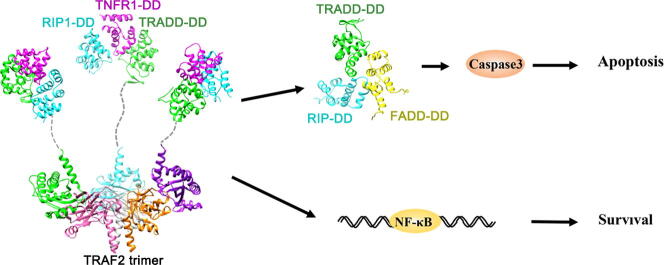
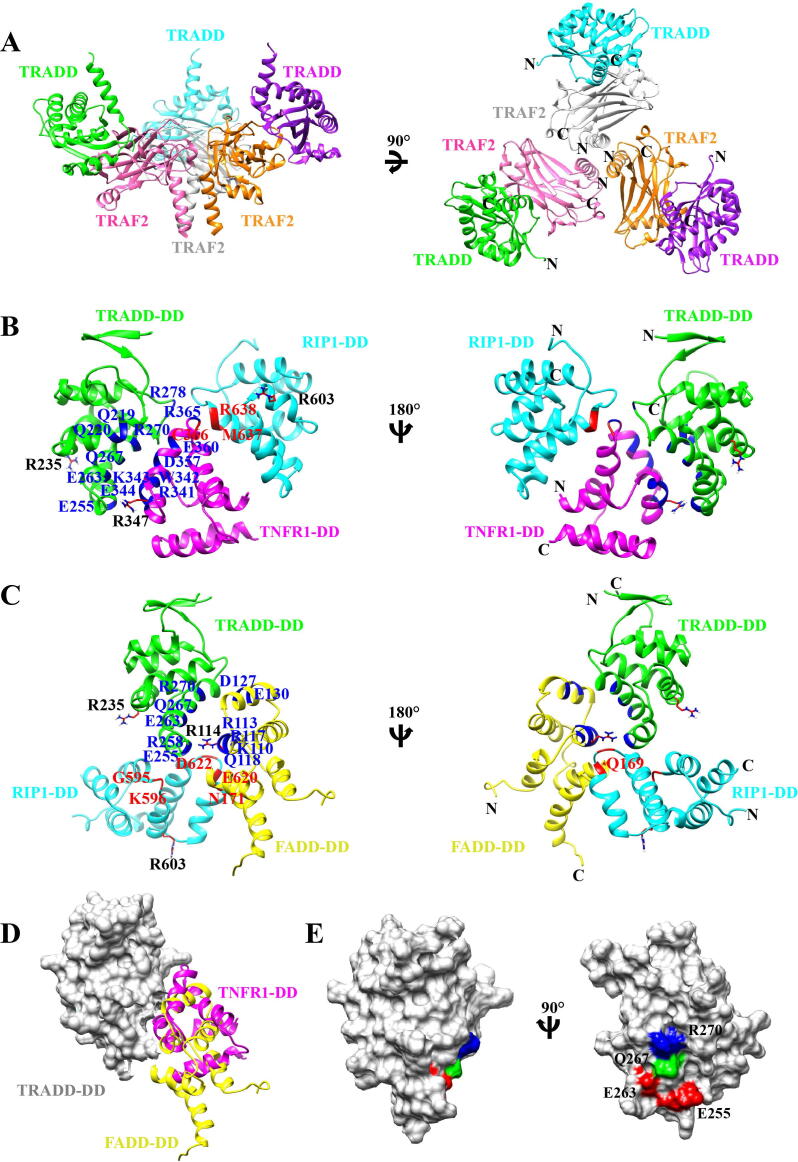
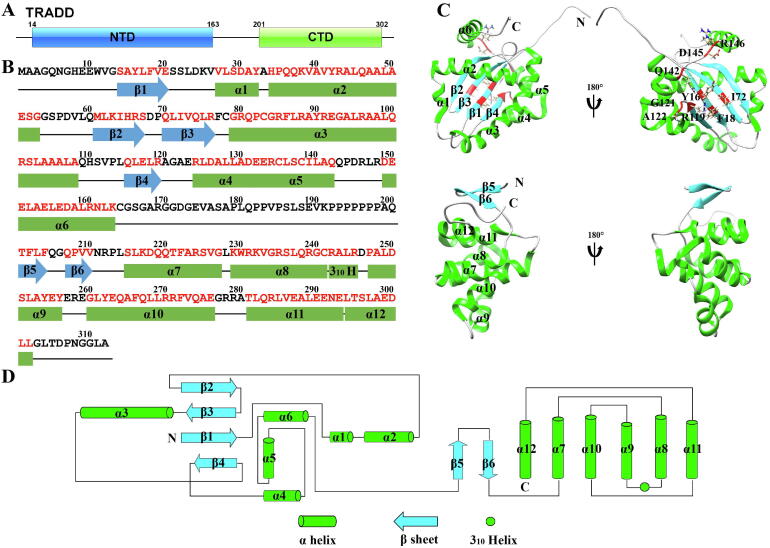
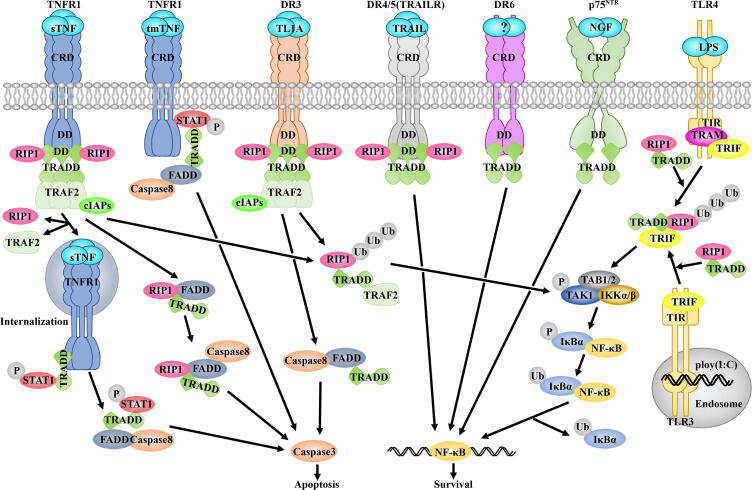
TRADD participates in various receptor signaling pathways and plays vital roles in many biological activities, including cell survival and apoptosis, in different cellular contexts. TRADD has two distinct functional domains, a TRAF-binding domain at the N-terminus and a death domain (DD) at the C-terminus. The TRAF binding domain of TRADD folds into an α-β plait topology and is mainly responsible for binding TRAF2, while the TRADD-DD can interact with a variety of DD-containing proteins, including receptors and intracellular signaling molecules. After activation of specific receptors such as TNFR1 and DR3, TRADD can bind to the receptor through DD-DD interaction, creating a membrane-proximal platform for the recruitment of downstream molecules to propagate cellular signals. In this review, we highlight recent advances in the studies of the structural mechanism of TRADD adaptor functions for NF-κB activation and apoptosis induction. We also provide suggestions for future structure research related to TRADD-mediated signaling pathways.
TRADD参与多种受体信号通路,并在不同细胞环境中的许多生物活性中发挥重要作用,包括细胞存活和凋亡。TRADD有两个不同的功能域,N端的TRAF结合域和C端的死亡结构域(DD)。TRADD的TRAF结合域折叠成α-β褶拓扑结构,主要负责结合TRAF2,而TRADD-DD可与多种含DD的蛋白质相互作用,包括受体和细胞内信号分子。在TNFR1和DR3等特定受体激活后,TRADD可通过DD-DD相互作用与受体结合,形成一个膜近端平台,用于招募下游分子以传播细胞信号。在本综述中,我们重点介绍了TRADD衔接子功能在NF-κB激活和凋亡诱导方面的结构机制研究的最新进展。我们还为未来与TRADD介导的信号通路相关的结构研究提供了建议。