Huo Xiao, Sun Hengzi, Qian Qiuhong, Ma Xiangwen, Peng Peng, Yu Mei, Zhang Ying, Yang Jiaxin, Cao Dongyan, Gui Ting, Shen Keng
Department of Obstetrics and Gynecology, Peking Union Medical College Hospital, Chinese Academy of Medical Sciences and Peking Union Medical College, Beijing, China.
Department of Obstetrics and Gynecology, Beijing Chao-Yang Hospital, Capital Medical University, Beijing, China.
Front Cell Dev Biol. 2020 Oct 14;8:561804. doi: 10.3389/fcell.2020.561804. eCollection 2020.
Ovarian cancer has the highest mortality rate among gynecologic cancers, and most patients are diagnosed in advanced stages. Enhancer of zeste homolog 2 (EZH2) is a major tumor marker and an effective therapeutic target for ovarian cancer, but the underlying molecular mechanism remains unclear. The present study investigated the biological effects of EZH2 knockout in SKOV3 cells and and explored the molecular mechanism by integrated analysis of messenger RNA sequencing (mRNA-seq) and chromatin immunoprecipitation sequencing (ChIP-seq) data.
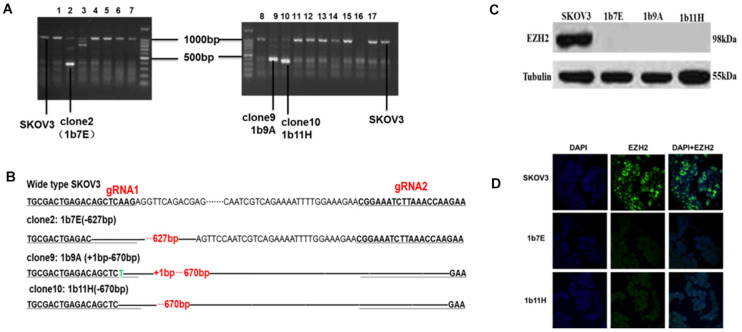
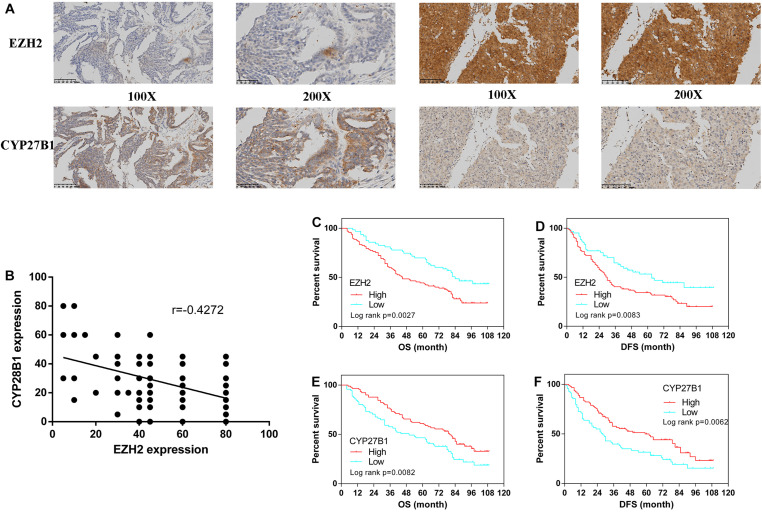
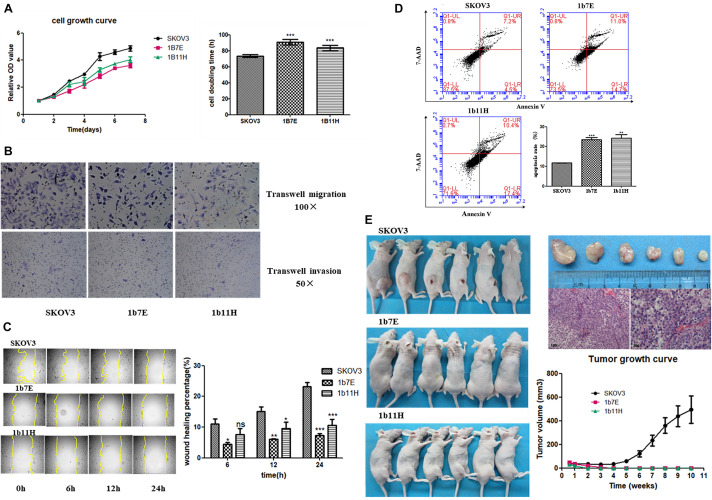
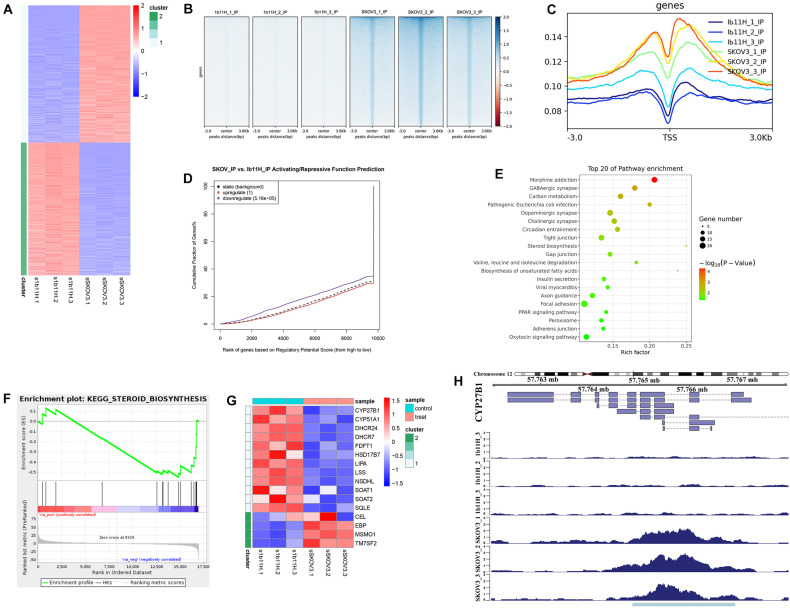
The CRISPR/Cas9 system was used to establish EZH2 knockout SKOV3 cells. Protein expression was evaluated by Western blotting. The effect of EZH2 on ovarian cancer was evaluated with MTT, wound healing, Transwell, and apoptosis assays and with a xenograft model. mRNA-seq and ChIP-seq were performed to explore the molecular mechanism underlying the biological function of EZH2. Immunohistochemical staining (IHC) of tissue arrays was used to analyze the correlations among EZH2 and CYP27B1 expressions and prognosis.
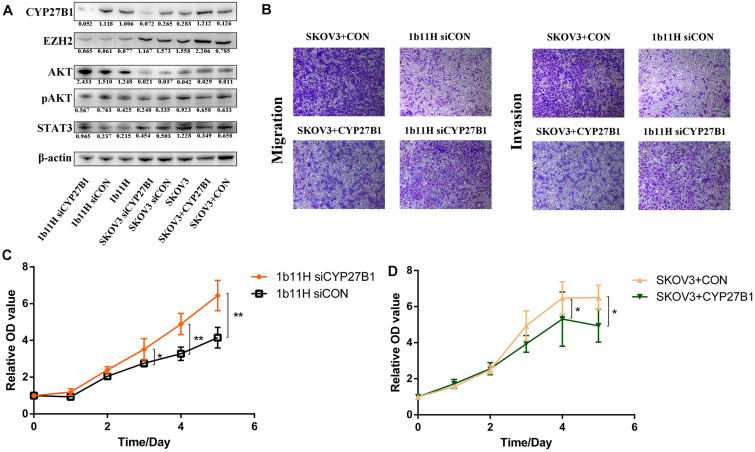
We obtained three EZH2 knockout subclones. EZH2 knockout SKOV3 cells exhibited significantly suppressed proliferation, migration, and invasion and a significantly increased apoptosis rate. The subcutaneous tumor formation rate decreased from 100 to 0% in the EZH2 knockout group. Integrated analysis of the mRNA-seq and ChIP-seq data identified 1,455 significantly upregulated genes with matching downregulated trimethylation of histone H3 lysine 27 (H3K27me3) methylation binding sites in 1b11H cells compared to SKOV3 cells. The set of downregulated genes in EZH2 knockout cells was highly enriched in genes regulating the activation of steroid biosynthesis; the top-ranked hub gene was CYP27B1. The EZH2 and CYP27B1 expression levels showed a statistically significant inverse correlation, which was also associated with unfavorable prognosis. The experiment demonstrated that CYP27B1 can suppress the proliferation, migration, and invasion of ovarian cancer cells. Moreover, the levels of AKT and p-AKT were significantly increased, whereas STAT3 was downregulated, in 1b11H cells compared to SKOV3 cells. Moreover, STAT3 and AKT overexpression was observed in 1b11H siRNA for CYP27B1 (siCYP27B1) cells.
EZH2 plays an important role in promoting cell proliferation, migration, and invasion in ovarian cancer by regulating the core steroid biosynthesis gene H3K27me3 methylation. Moreover, CYP27B1, the steroid biosynthesis hub gene, might be a novel therapeutic target for ovarian cancer.
卵巢癌在妇科癌症中死亡率最高,大多数患者在晚期被诊断出来。zeste同源物2增强子(EZH2)是卵巢癌的主要肿瘤标志物和有效的治疗靶点,但其潜在的分子机制仍不清楚。本研究调查了EZH2基因敲除对SKOV3细胞的生物学影响,并通过信使核糖核酸测序(mRNA-seq)和染色质免疫沉淀测序(ChIP-seq)数据的综合分析探索其分子机制。
使用CRISPR/Cas9系统建立EZH2基因敲除的SKOV3细胞。通过蛋白质免疫印迹法评估蛋白质表达。通过MTT、伤口愈合、Transwell和凋亡试验以及异种移植模型评估EZH2对卵巢癌的影响。进行mRNA-seq和ChIP-seq以探索EZH2生物学功能的潜在分子机制。使用组织芯片的免疫组织化学染色(IHC)分析EZH2与CYP27B1表达及预后之间的相关性。
我们获得了三个EZH2基因敲除亚克隆。EZH2基因敲除的SKOV3细胞表现出增殖、迁移和侵袭显著受抑制,凋亡率显著增加。EZH2基因敲除组皮下肿瘤形成率从100%降至0%。与SKOV3细胞相比,对mRNA-seq和ChIP-seq数据的综合分析在1b11H细胞中鉴定出1455个显著上调的基因,其组蛋白H3赖氨酸27(H3K27me3)甲基化结合位点的三甲基化下调与之匹配。EZH2基因敲除细胞中下调的基因集在调节类固醇生物合成激活的基因中高度富集;排名第一的枢纽基因是CYP27B1。EZH2和CYP27B1的表达水平呈统计学显著负相关,这也与不良预后相关。实验表明,CYP27B1可抑制卵巢癌细胞的增殖、迁移和侵袭。此外,与SKOV3细胞相比,1b11H细胞中AKT和p-AKT水平显著升高,而STAT3下调。此外,在CYP27B1的1b11H小干扰RNA(siCYP27B1)细胞中观察到STAT3和AKT过表达。
EZH2通过调节核心类固醇生物合成基因H3K27me3甲基化在促进卵巢癌细胞增殖、迁移和侵袭中起重要作用。此外,类固醇生物合成枢纽基因CYP27B1可能是卵巢癌新的治疗靶点。