Department of Pediatrics, University of Alabama at Birmingham, Birmingham, AL, USA.
Department of Pathology, University of Alabama at Birmingham, Birmingham, AL, USA.
Redox Biol. 2021 Jan;38:101782. doi: 10.1016/j.redox.2020.101782. Epub 2020 Nov 3.
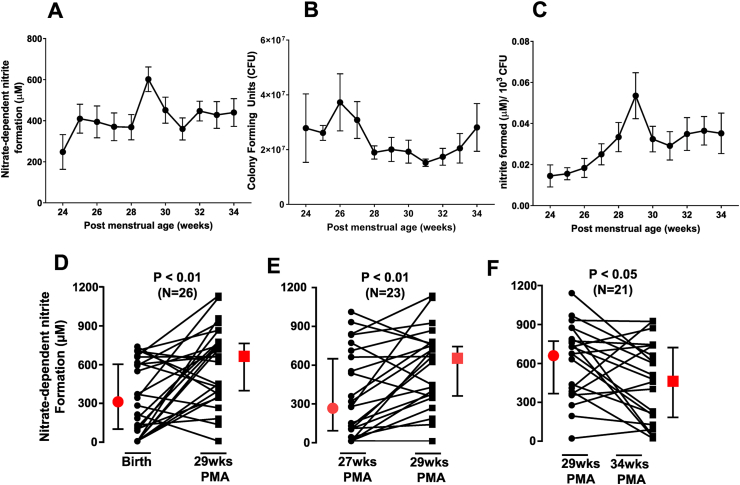
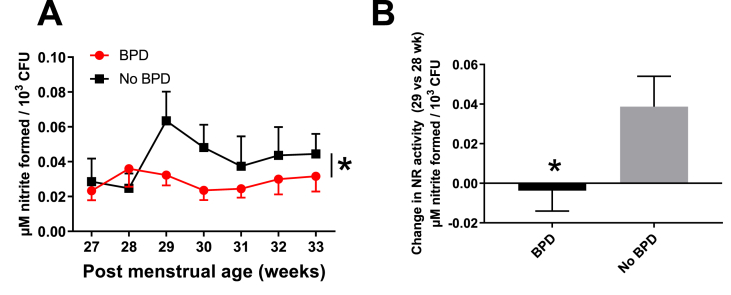
Oral microbiome mediated nitrate reductase (NR) activity regulates nitric oxide (NO) bioavailability and signaling. While deficits in NO-bioavailability impact several morbidities of extreme prematurity including bronchopulmonary dysplasia (BPD), whether oral NR activity is associated with morbidities of prematurity is not known. We characterized NR activity in extremely preterm infants from birth until 34 weeks' post menstrual age (PMA), determined whether changes in the oral microbiome contribute to changes in NR activity, and determined whether changes in NR activity correlated with disease. In this single center prospective cohort study (n = 28), we observed two surprising findings: (1) NR activity unexpectedly peaked at 29 weeks' PMA (p < 0.05) and (2) when infants were stratified for BPD status, infants who developed BPD had significantly less NR activity at 29 weeks' PMA compared to infants who did not develop BPD. Oral microbiota and NR activity may play a role in BPD development in extremely preterm infants, indicating potential for disease prediction and therapeutic targeting.
口腔微生物组介导的硝酸盐还原酶 (NR) 活性调节一氧化氮 (NO) 的生物利用度和信号转导。虽然 NO 生物利用度不足会影响到早产儿的多种疾病,包括支气管肺发育不良 (BPD),但口腔 NR 活性是否与早产儿的疾病有关尚不清楚。我们从出生到 34 周的胎龄 (PMA) 对极度早产儿的 NR 活性进行了特征描述,确定了口腔微生物组的变化是否会导致 NR 活性的变化,以及 NR 活性的变化是否与疾病有关。在这项单中心前瞻性队列研究中(n=28),我们观察到两个令人惊讶的发现:(1)NR 活性出人意料地在 29 周的 PMA 时达到峰值(p<0.05);(2)当根据 BPD 状态对婴儿进行分层时,与没有发生 BPD 的婴儿相比,患有 BPD 的婴儿在 29 周的 PMA 时 NR 活性明显较低。口腔微生物组和 NR 活性可能在极早产儿的 BPD 发展中起作用,表明有用于疾病预测和治疗靶向的潜力。