Pasman Thijs, Baptista Danielle, van Riet Sander, Truckenmüller Roman K, Hiemstra Pieter S, Rottier Robbert J, Stamatialis Dimitrios, Poot André A
Department of Biomaterials Science and Technology, Technical Medical (TechMed) Centre, Faculty of Science and Technology, University of Twente, 7522 NB Enschede, The Netherlands.
Department of Instructive Biomaterials Engineering, MERLN Institute for Technology-Inspired Regenerative Medicine, Maastricht University, 6229 ER Maastricht, The Netherlands.
Membranes (Basel). 2020 Nov 5;10(11):330. doi: 10.3390/membranes10110330.
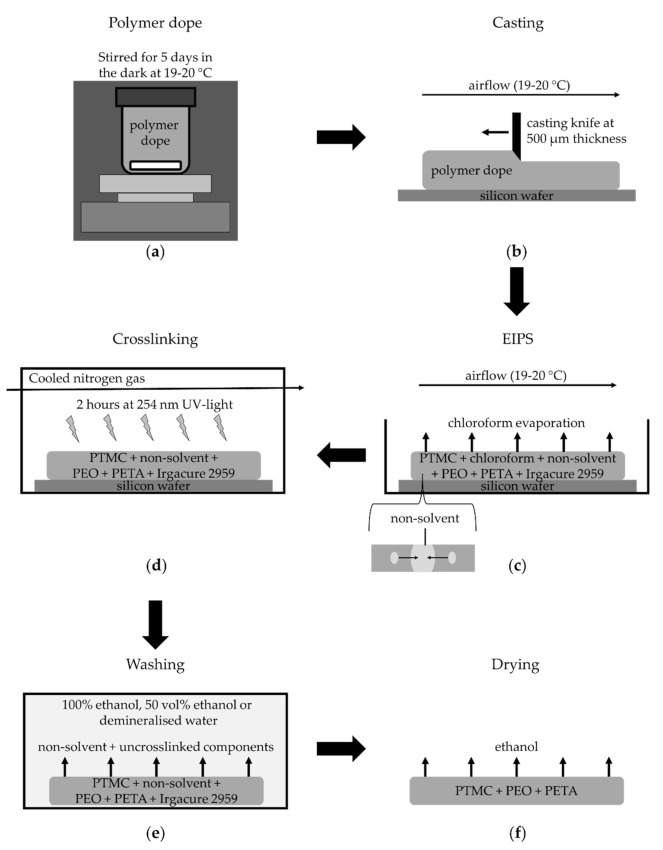
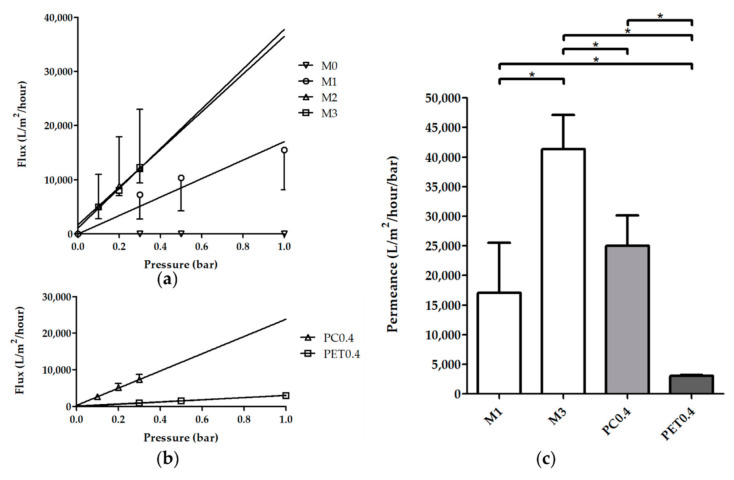
Polymeric membranes are widely applied in biomedical applications, including in vitro organ models. In such models, they are mostly used as supports on which cells are cultured to create functional tissue units of the desired organ. To this end, the membrane properties, e.g., morphology and porosity, should match the tissue properties. Organ models of dynamic (barrier) tissues, e.g., lung, require flexible, elastic and porous membranes. Thus, membranes based on poly (dimethyl siloxane) (PDMS) are often applied, which are flexible and elastic. However, PDMS has low cell adhesive properties and displays small molecule ad- and absorption. Furthermore, the introduction of porosity in these membranes requires elaborate methods. In this work, we aim to develop porous membranes for organ models based on poly(trimethylene carbonate) (PTMC): a flexible polymer with good cell adhesive properties which has been used for tissue engineering scaffolds, but not in in vitro organ models. For developing these membranes, we applied evaporation-induced phase separation (EIPS), a new method in this field based on solvent evaporation initiating phase separation, followed by membrane photo-crosslinking. We optimised various processing variables for obtaining form-stable PTMC membranes with average pore sizes between 5 to 8 µm and water permeance in the microfiltration range (17,000-41,000 L/m/h/bar). Importantly, the membranes are flexible and are suitable for implementation in in vitro organ models.
聚合物膜广泛应用于生物医学领域,包括体外器官模型。在这类模型中,它们主要用作细胞培养的支撑物,以创建所需器官的功能性组织单元。为此,膜的性质,如形态和孔隙率,应与组织性质相匹配。动态(屏障)组织的器官模型,如肺,需要柔性、弹性和多孔的膜。因此,基于聚二甲基硅氧烷(PDMS)的膜经常被应用,其具有柔性和弹性。然而,PDMS的细胞粘附性能较低,且表现出小分子吸附。此外,在这些膜中引入孔隙率需要复杂的方法。在这项工作中,我们旨在开发基于聚碳酸三亚甲基酯(PTMC)的用于器官模型的多孔膜:一种具有良好细胞粘附性能的柔性聚合物,已用于组织工程支架,但未用于体外器官模型。为了开发这些膜,我们应用了蒸发诱导相分离(EIPS),这是该领域基于溶剂蒸发引发相分离,随后进行膜光交联的一种新方法。我们优化了各种加工变量,以获得平均孔径在5至8 µm之间且水渗透率在微滤范围内(17,000 - 41,000 L/m/h/bar)的形状稳定的PTMC膜。重要的是,这些膜是柔性的,适用于体外器官模型。