Experimental Laboratory of Immunological and Rheumatologic Researches, IRCCS Istituto Auxologico Italiano, Via Zucchi 18, Cusano Milanino, 20095, Milan, Italy.
Department of Clinical Sciences and Community Health, University of Milan, Via Festa del Perdono 7, 20122, Milan, Italy.
Arthritis Res Ther. 2020 Nov 9;22(1):265. doi: 10.1186/s13075-020-02360-3.
Consistently with their diagnostic and prognostic value, autoantibodies specific for systemic sclerosis (SSc) embedded in immune complexes (ICs) elicited a pro-inflammatory and pro-fibrotic cascade in healthy skin fibroblasts, engaging Toll-like receptors (TLRs) via their nucleic acid components. The objective of this study was to investigate the pathogenicity of SSc-ICs in endothelial cells.
ICs were purified from the sera of SSc patients bearing different autoantibody specificities (antibodies against DNA topoisomerase I, centromeric proteins, RNA polymerase, and Th/To), patients with systemic lupus erythematosus (SLE) and primary anti-phospholipid syndrome (PAPS), or healthy controls (NHS) using polyethylene glycol precipitation. Human umbilical vein endothelial cells (HUVECs) were incubated with ICs, positive and negative controls. mRNA levels of endothelin-1 (et-1), collagenIα1 (colIα1), interferon (IFN)-α, and IFN-β were investigated by real-time PCR; et-1 and il-6 mRNA levels were assessed after pre-treatment with bafilomycin. ICAM-1 expression was evaluated by cell ELISA; secretion of IL-6, IL-8, and transforming growth factor (TGF)-β1 in culture supernatants was measured by ELISA. The expression of Fcγ receptors (CD64, CD32, and CD16) was assessed in endothelial cells at FACS analysis. Intracellular signaling pathways culminating with NFκB, p38MAPK, SAPK-JNK, and Akt were assessed by Western blotting. Healthy skin fibroblasts were stimulated with supernatants from HUVECs incubated with ICs, and TGF-β1 secretion and mRNA levels of colIα1 and matrix metalloproteinase (mmp)-1, protein expression of α smooth muscle actin (α-SMA), and IL-6 were evaluated by Western blotting; et-1 mRNA levels were assessed in fibroblasts pre-treated with IL-6 and TGF-β inhibitors and stimulated with ATA-ICs.
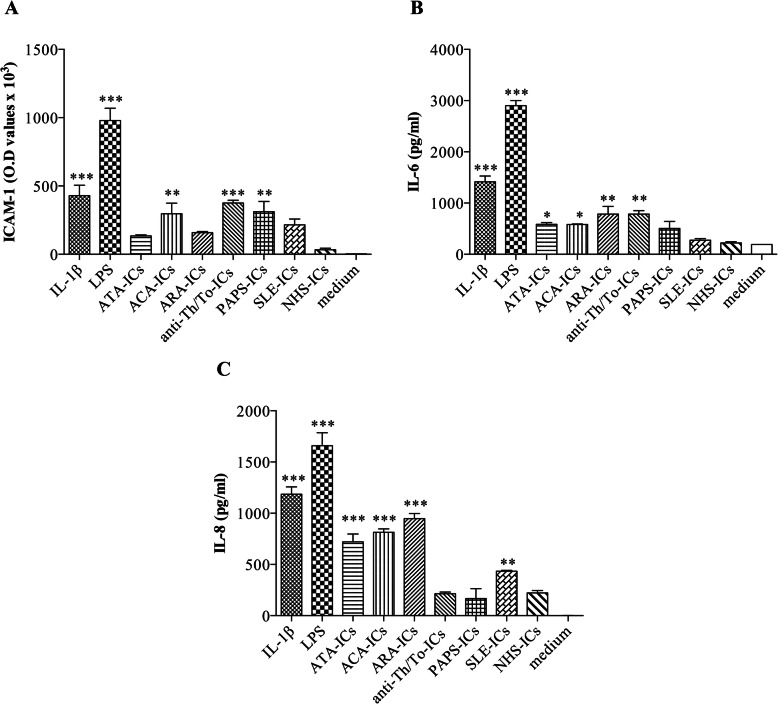
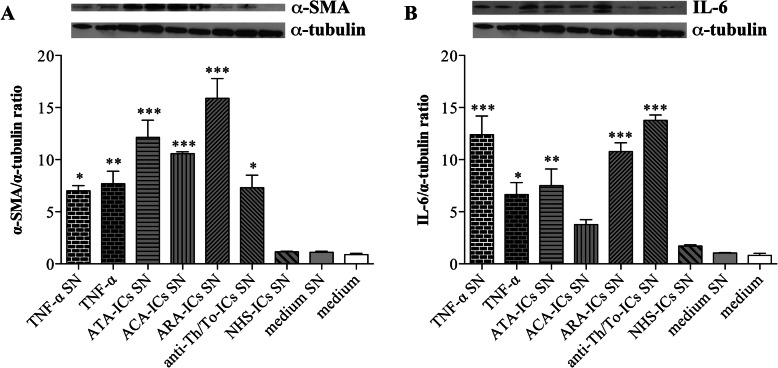
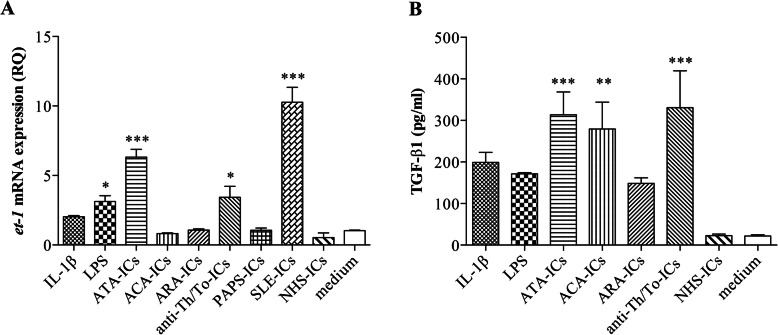
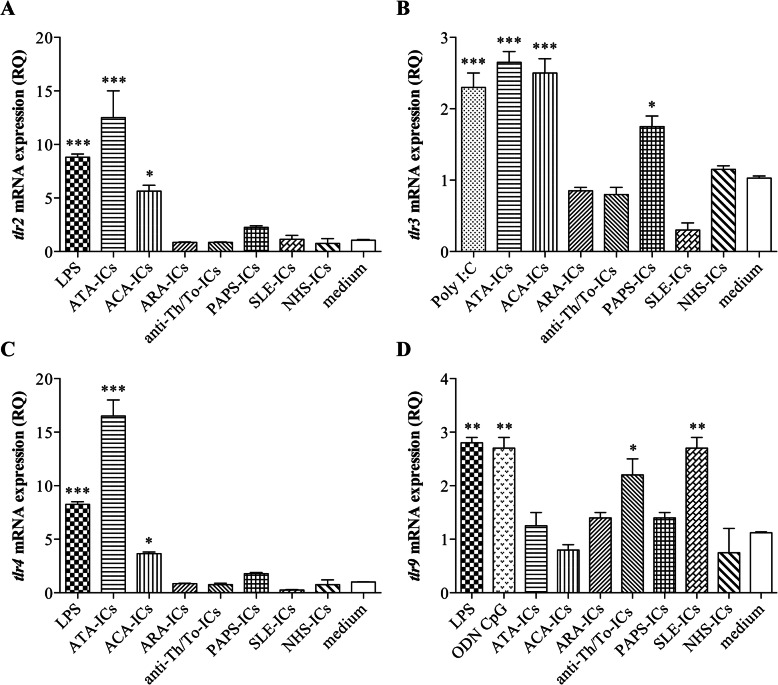
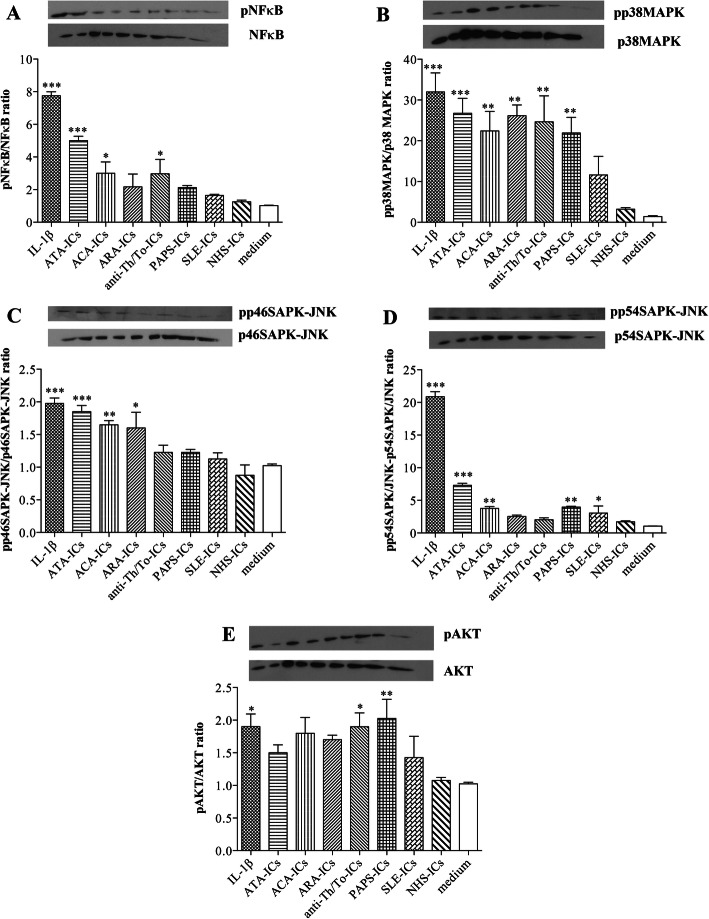
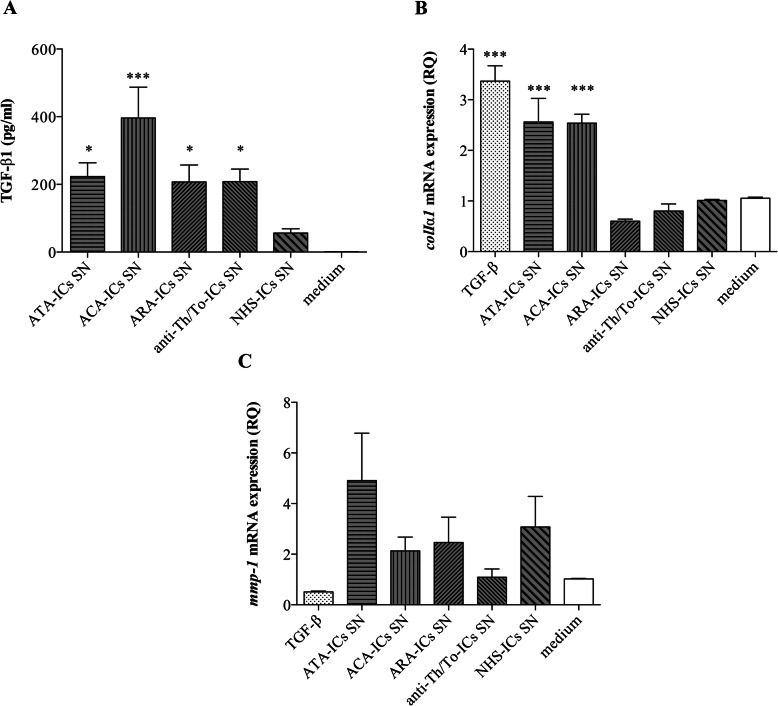
All SSc stimulated IL-6 secretion; ACA-ICs and anti-Th/To-ICs increased ICAM-1 expression; all SSc-ICs but anti-Th/To-ICs augmented IL-8 levels; all SSc-ICs but ACA-ICs and ARA-ICs upregulated et-1, and all SSc-ICs but ARA-ICs affected TGF-β1 secretion. colIα1, IFN-α, and IFN-β mRNA levels were not affected by any SSc-IC. FcγRII (CD32) and FcγRIII (CD16) were not detectable on HUVECs, while FcγRI (CD64) was minimally expressed. A differential modulation of tlr expression was observed: tlr2, tlr3, and tlr4 were upregulated by ATA-ICs and ACA-ICs, while anti-Th/To-ICs resulted in tlr9 upregulation. Pre-treatment with bafilomycin did not affect the upregulation of et-1 and il-6 induced by ATA-ICs, ACA-ICs, and anti-Th/To-ICs; a 23% reduction in both genes was reported for ARA-ICs. All SSc-ICs activated p38MAPK and Akt, and all SSc-ICs but ARA-ICs yielded the activation of NFκB; ATA-ICs and ACA-ICs increased the activation rate of both subunits of SAPK-JNK. When healthy skin fibroblasts were stimulated with supernatants from HUVECs incubated with SSc-ICs, TGF-β1 secretion, colIα1, α-SMA, and IL-6 expression levels were significantly modulated. Pre-treatment with IL-6 and TGF-β inhibitors prevented et-1 upregulation induced by ATA-ICs by 85% and 77%, respectively.
These data provide the first demonstration of the pathogenicity of ICs from scleroderma patients with different autoantibodies on the endothelium. Endothelial activation induced by SSc-ICs ultimately led to a pro-fibrotic phenotype in healthy skin fibroblasts.
与它们的诊断和预后价值一致,嵌入免疫复合物 (ICs) 中的系统性硬化症 (SSc) 特异性自身抗体通过其核酸成分激活健康皮肤成纤维细胞中的炎症和纤维化级联反应,涉及 Toll 样受体 (TLR)。本研究的目的是研究不同自身抗体特异性 (抗拓扑异构酶 I、着丝粒蛋白、RNA 聚合酶和 Th/To 抗体) 的 SSc-ICs 在血管内皮细胞中的致病性。
使用聚乙二醇沉淀从 SSc 患者、系统性红斑狼疮 (SLE) 患者和原发性抗磷脂综合征 (PAPS) 患者或健康对照 (NHS) 的血清中纯化 ICs。用 ICs、阳性和阴性对照孵育人脐静脉内皮细胞 (HUVEC)。通过实时 PCR 研究内皮素-1 (et-1)、胶原 Iα1 (colIα1)、干扰素 (IFN)-α 和 IFN-β 的 mRNA 水平;在用巴佛洛霉素预处理后评估 et-1 和 il-6 mRNA 水平。通过细胞 ELISA 评估 ICAM-1 表达;通过 ELISA 测量培养上清液中 IL-6、IL-8 和转化生长因子 (TGF)-β1 的分泌。通过流式细胞术分析评估内皮细胞中 Fcγ 受体 (CD64、CD32 和 CD16) 的表达。通过 Western blot 评估细胞内信号通路,最终导致 NFκB、p38MAPK、SAPK-JNK 和 Akt。用 HUVEC 孵育 SSc 上清液刺激健康皮肤成纤维细胞,用 Western blot 评估 TGF-β1 分泌和 colIα1、基质金属蛋白酶 (mmp)-1 的 mRNA 水平、α 平滑肌肌动蛋白 (α-SMA) 的蛋白表达和 IL-6;用 IL-6 和 TGF-β 抑制剂预处理成纤维细胞,然后用 ATA-ICs 刺激,评估 et-1 mRNA 水平。
所有 SSc 均刺激 IL-6 分泌;ACA-ICs 和抗-Th/To-ICs 增加 ICAM-1 表达;所有 SSc-ICs 但抗-Th/To-ICs 增加 IL-8 水平;所有 SSc-ICs 但 ACA-ICs 和 ARA-ICs 上调 et-1,所有 SSc-ICs 但 ARA-ICs 影响 TGF-β1 分泌。任何 SSc-IC 均不影响 colIα1、IFN-α 和 IFN-β mRNA 水平。HUVEC 上未检测到 FcγRII (CD32) 和 FcγRIII (CD16),而 FcγRI (CD64) 表达水平较低。观察到 TLR 表达的差异调节:ATA-ICs 和 ACA-ICs 上调 TLR2、TLR3 和 TLR4,而抗-Th/To-ICs 导致 TLR9 上调。巴佛洛霉素预处理不影响 ATA-ICs、ACA-ICs 和抗-Th/To-ICs 诱导的 et-1 和 il-6 上调;ARA-ICs 报告了这两个基因的 23% 减少。所有 SSc-ICs 均激活 p38MAPK 和 Akt,所有 SSc-ICs 但 ARA-ICs 导致 NFκB 激活;ATA-ICs 和 ACA-ICs 增加了 SAPK-JNK 的两个亚基的激活率。当用 HUVEC 孵育 SSc-ICs 的上清液刺激健康皮肤成纤维细胞时,TGF-β1 分泌、colIα1、α-SMA 和 IL-6 表达水平显著调节。用 IL-6 和 TGF-β 抑制剂预处理可分别阻止 ATA-ICs 诱导的 et-1 上调 85% 和 77%。
这些数据首次证明了具有不同自身抗体的系统性硬化症患者的 ICs 对内皮细胞的致病性。SSc-ICs 诱导的内皮细胞激活最终导致健康皮肤成纤维细胞的纤维化表型。