Department of Orthopaedics, Shengjing Hospital of China Medical University, Sanhao Street No. 36, Heping District, Shenyang, 110004, Liaoning, People's Republic of China.
Department of Orthopedics, Tianjin Baodi Hospital/Baodi Clinical College of Tianjin Medical University, Tianjin, 301800, People's Republic of China.
J Orthop Surg Res. 2020 Nov 10;15(1):516. doi: 10.1186/s13018-020-02045-2.
We evaluated the association between monocyte chemotactic protein-1 (MCP-1) and osteoarthritis.
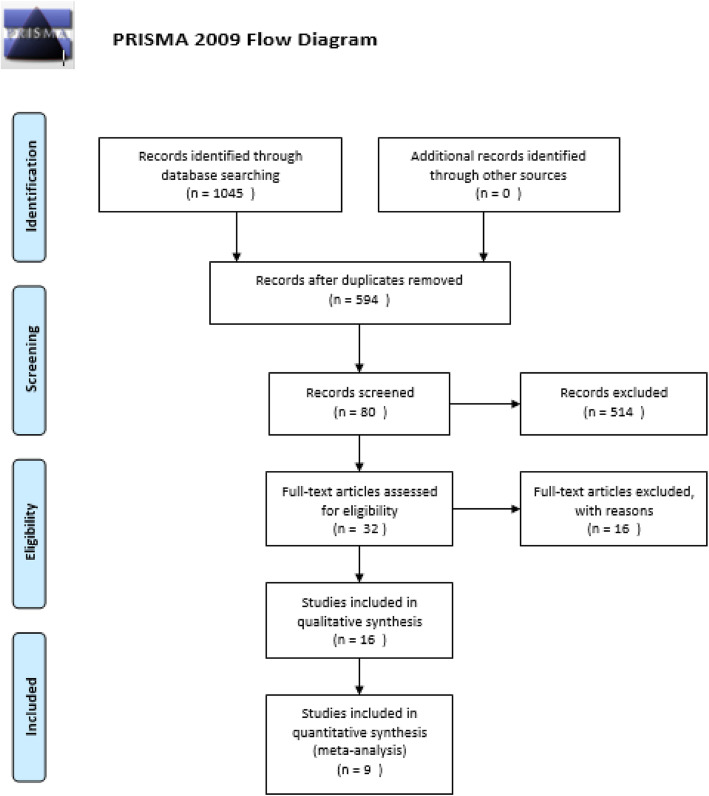
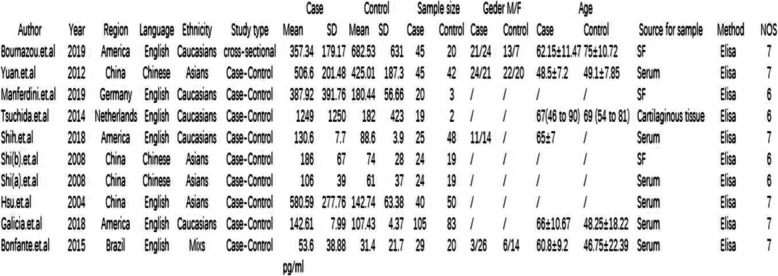
We searched PubMed, Cochrane Library, Embase, Web of Science, China National Knowledge Infrastructure (CNKI), VIP (Chinese database), and Wan Fang (Chinese database) (before May 10, 2020), with no language limitations. STATA version 12.0 and Revman version 5.3 were used for data analysis. The standard mean difference (SMD) and corresponding 95% confidence intervals (95% CIs) were calculated. Nine clinical studies, including 376 patients with osteoarthritis and 306 healthy controls, were evaluated.
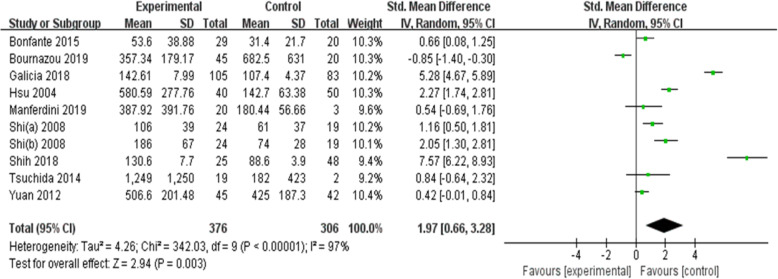
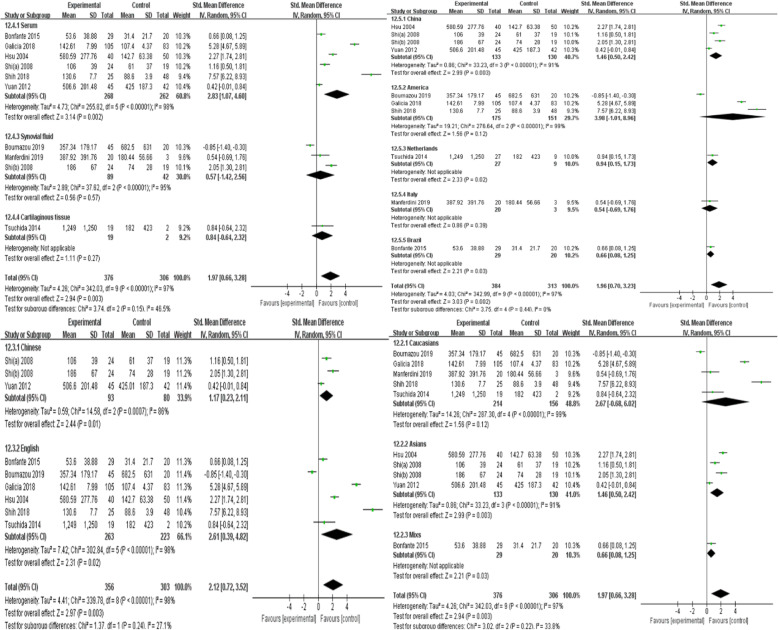
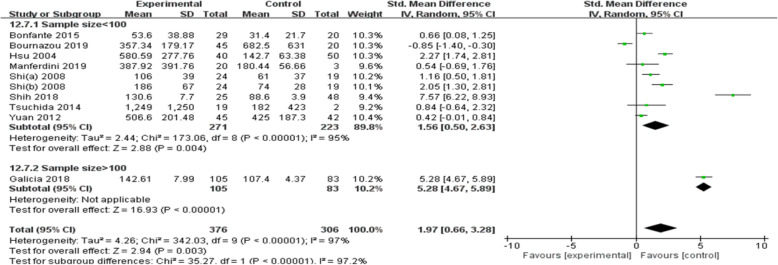
The combined SMDs of MCP-1 expression levels suggested that MCP-1 expression was significantly higher in patients with osteoarthritis than healthy controls (SMD = 1.97, 95% CI = 0.66-3.28, p = 0.003). Moreover, subgroup analysis implied that osteoarthritis patients from both Asians and mixed populations had higher MCP-1 expression levels than controls, whereas Caucasians did not (p > 0.05). Serum MCP-1 levels (SMD = 2.83, 95% CI = 1.07-4.6, p < 0.00001) were significantly higher in patients with osteoarthritis than in controls; however, this difference was not significant in synovial fluid and cartilage tissue. Subgroup analysis for ethnicity showed that MCP-1 levels were significantly higher in Chinese, Dutch, and Brazilian patients with osteoarthritis than in control groups, although significant differences were not observed for American and Italian subgroups.
Our meta-analysis demonstrated that MCP-1 expression levels were higher in patients with osteoarthritis than in healthy controls and that MCP-1 may play important roles in the progression of osteoarthritis. Serum MCP-1 levels may serve as a potential biomarker for the diagnosis of osteoarthritis.
评估单核细胞趋化蛋白-1(MCP-1)与骨关节炎之间的关系。
我们检索了 PubMed、Cochrane 图书馆、Embase、Web of Science、中国知网(CNKI)、维普(中文数据库)和万方(中文数据库)(截至 2020 年 5 月 10 日),不限制语言。使用 STATA 版本 12.0 和 Revman 版本 5.3 进行数据分析。计算标准均数差(SMD)和相应的 95%置信区间(95%CI)。评估了 9 项临床研究,包括 376 例骨关节炎患者和 306 例健康对照者。
MCP-1 表达水平的合并 SMD 表明,骨关节炎患者的 MCP-1 表达明显高于健康对照组(SMD=1.97,95%CI=0.66-3.28,p=0.003)。此外,亚组分析表明,来自亚洲人和混合人群的骨关节炎患者的 MCP-1 表达水平高于对照组,而白种人则没有(p>0.05)。血清 MCP-1 水平(SMD=2.83,95%CI=1.07-4.6,p<0.00001)在骨关节炎患者中明显高于对照组;然而,在滑液和软骨组织中,这种差异并不显著。种族的亚组分析表明,中国、荷兰和巴西骨关节炎患者的 MCP-1 水平明显高于对照组,尽管美国和意大利亚组没有显著差异。
我们的荟萃分析表明,骨关节炎患者的 MCP-1 表达水平高于健康对照组,MCP-1 可能在骨关节炎的进展中发挥重要作用。血清 MCP-1 水平可能是骨关节炎诊断的潜在生物标志物。