Department of Veterinary Clinical Sciences, Purdue University School of Veterinary Medicine, West Lafayette, Indiana, United States of America.
Department of Comparative Pathobiology, Purdue University School of Veterinary Medicine, West Lafayette, Indiana, United States of America.
PLoS One. 2020 Nov 19;15(11):e0242614. doi: 10.1371/journal.pone.0242614. eCollection 2020.
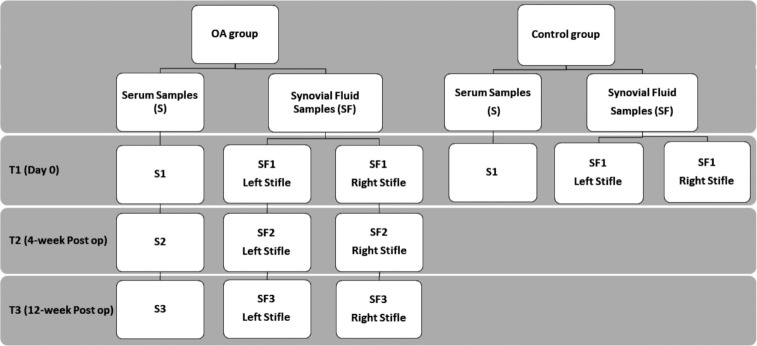
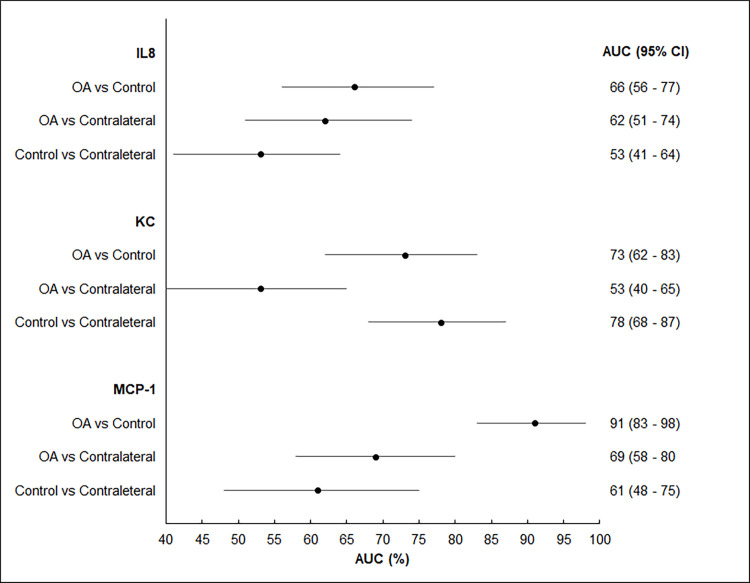
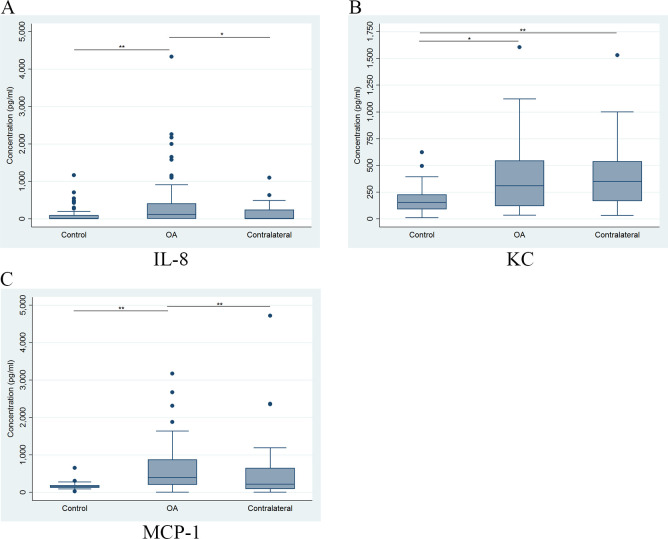
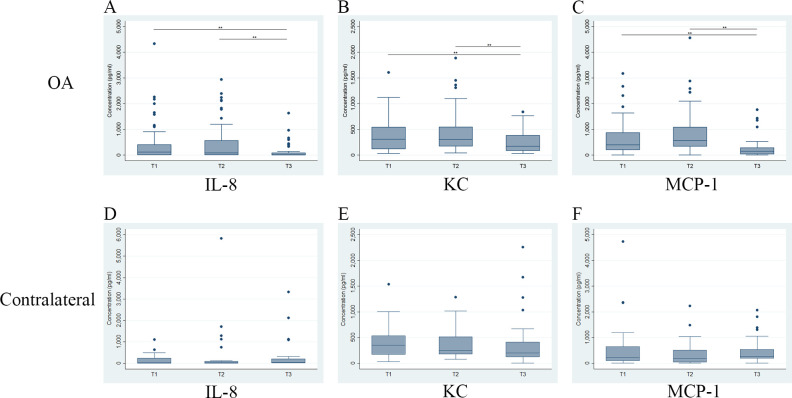
The purpose of this study was to evaluate matrix metalloproteinases (MMP) -2 and MMP-3 in serum, and keratinocyte-derived chemoattractant (KC), interleukin 8 (IL-8) and monocyte chemoattractant 1 (MCP-1) in synovial fluid (SF) as stifle osteoarthritis (OA) biomarkers in dogs. Dogs with naturally occurring cranial cruciate ligament (CrCL) rupture (OA group) and healthy controls were recruited. Stifles with CrCL deficiency were surgically stabilized. Serum, SF, and synovial biopsy samples were collected from the OA group preoperatively, whereas samples were collected once from control dogs. A blinded veterinary pathologist graded synovial biopsies. Serum and SF analyses were performed using xMAP technology. General linear regression was used for statistical comparisons of serum biomarkers, and mixed linear regression for SF biomarkers and temporal concentration changes. The overall discriminative ability was quantified using area under curve (AUC). Spearman's correlation coefficient was used to assess correlations between synovial histology grades and the biomarkers. Samples from 62 dogs in the OA group and 50 controls were included. The MMP-2 and MMP-3 concentrations between the OA and control groups were not significantly different, and both with an AUC indicating a poor discriminative ability. All three SF biomarker concentrations were significantly different between the OA group and controls (P <0.05). The MCP-1 was the only biomarker showing an acceptable discriminative performance with an AUC of 0.91 (95% confidence interval: 0.83-0.98). The sum of the inflammatory infiltrate score was significantly correlated with all three SF biomarkers (P <0.01). Summed synovial stroma, and all scores combined were significantly correlated with IL-8 and MCP-1 concentrations (P <0.003), and the summed synoviocyte scores were significantly correlated with MCP-1 concentrations (P <0.001). Correlations between MCP-1 concentrations and synovial histopathologic grading and its discriminative ability suggest its potential as a synovitis biomarker in canine stifle OA associated with CrCL rupture.
本研究旨在评估基质金属蛋白酶(MMP)-2 和 MMP-3 在血清中的表达,以及角质细胞衍生趋化因子(KC)、白细胞介素 8(IL-8)和单核细胞趋化蛋白 1(MCP-1)在滑液(SF)中的表达,作为犬膝关节骨关节炎(OA)的生物标志物。招募了自然发生前十字韧带(CrCL)断裂(OA 组)的犬和健康对照犬。患有 CrCL 缺陷的膝关节通过手术稳定。OA 组术前采集血清、SF 和滑膜活检样本,而对照组仅采集一次样本。一名盲法兽医病理学家对滑膜活检进行分级。使用 xMAP 技术进行血清和 SF 分析。使用一般线性回归比较血清生物标志物,使用混合线性回归比较 SF 生物标志物和时间浓度变化。使用曲线下面积(AUC)定量评估整体判别能力。使用 Spearman 相关系数评估滑膜组织学分级与生物标志物之间的相关性。共纳入 62 只 OA 组犬和 50 只对照组犬的样本。OA 组和对照组之间的 MMP-2 和 MMP-3 浓度无显著差异,AUC 均表明判别能力较差。OA 组和对照组之间所有三种 SF 生物标志物浓度均有显著差异(P<0.05)。MCP-1 是唯一具有可接受判别性能的生物标志物,AUC 为 0.91(95%置信区间:0.83-0.98)。炎症浸润评分总和与所有三种 SF 生物标志物均显著相关(P<0.01)。滑膜基质总和以及所有评分总和与 IL-8 和 MCP-1 浓度显著相关(P<0.003),滑膜细胞评分总和与 MCP-1 浓度显著相关(P<0.001)。MCP-1 浓度与滑膜组织病理学分级及其判别能力之间的相关性表明,MCP-1 可能是与 CrCL 断裂相关的犬膝关节 OA 滑膜炎症的生物标志物。