
阿巴西普治疗原发性干燥综合征活动期的疗效和安全性:一项 III 期、随机、安慰剂对照试验的结果。
Efficacy and safety of abatacept in active primary Sjögren's syndrome: results of a phase III, randomised, placebo-controlled trial.
机构信息
Division of Rheumatology, Department of Medicine, Johns Hopkins University School of Medicine, Baltimore, Maryland, USA
Department of Rheumatology, Strasbourg University Hospitals, National Reference Center for Rare Systemic Autoimmune Diseases, IBMC, CNRS, UPR3572, Strasbourg, France.
出版信息
Ann Rheum Dis. 2021 Mar;80(3):339-348. doi: 10.1136/annrheumdis-2020-218599. Epub 2020 Nov 9.
OBJECTIVES
To evaluate efficacy and safety of abatacept in adults with active primary Sjögren's syndrome (pSS) in a phase III, randomised, double-blind, placebo-controlled trial.
METHODS
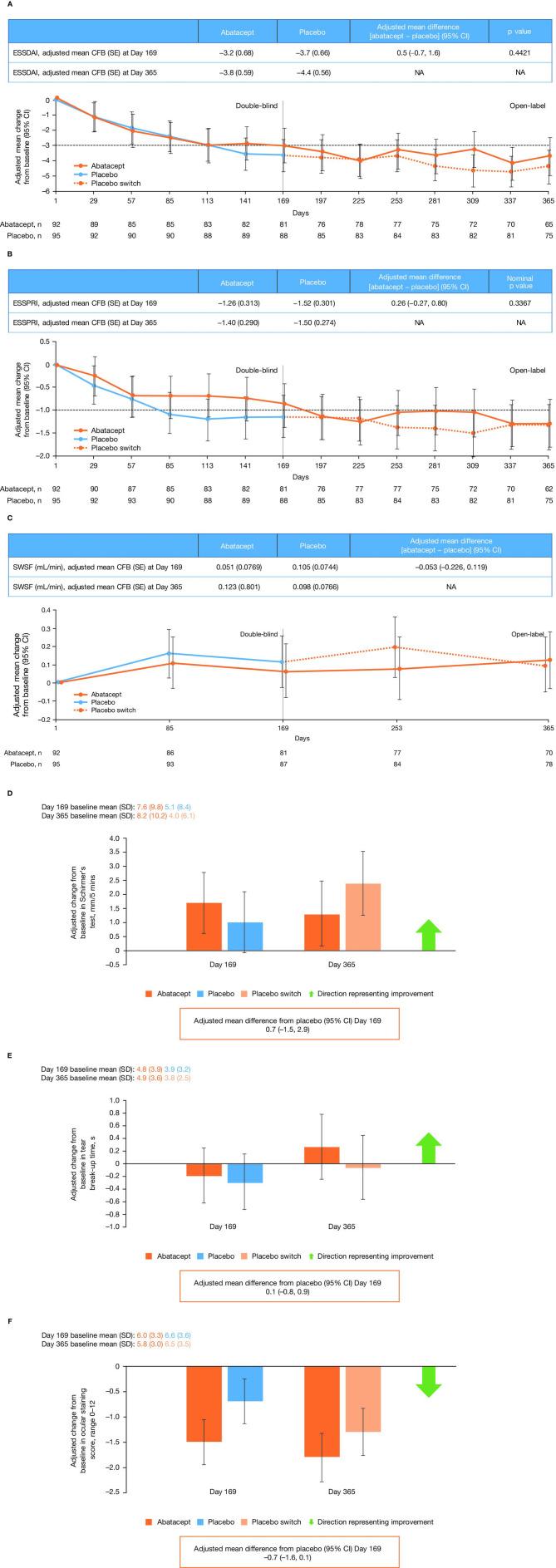
Eligible patients (moderate-to-severe pSS [2016 ACR/European League Against Rheumatism (EULAR) criteria], EULAR Sjögren's Syndrome Disease Activity Index [ESSDAI] ≥5, anti-SS-related antigen A/anti-Ro antibody positive) received weekly subcutaneous abatacept 125 mg or placebo for 169 days followed by an open-label extension to day 365. Primary endpoint was mean change from baseline in ESSDAI at day 169. Key secondary endpoints were mean change from baseline in EULAR Sjögren's Syndrome Patient Reported Index (ESSPRI) and stimulated whole salivary flow (SWSF) at day 169. Other secondary clinical endpoints included glandular functions and patient-reported outcomes. Selected biomarkers and immune cell phenotypes were examined. Safety was monitored.
RESULTS
Of 187 patients randomised, 168 completed double-blind period and 165 continued into open-label period. Mean (SD) baseline ESSDAI and ESSPRI total scores were 9.4 (4.3) and 6.5 (2.0), respectively. Statistical significance was not reached for primary (ESSDAI -3.2 abatacept vs -3.7 placebo, p=0.442) or key secondary endpoints (ESSPRI, p=0.337; SWSF, p=0.584). No clinical benefit of abatacept over placebo at day 169 was seen with other clinical and PRO endpoints. Relative to baseline, abatacept was associated with significant differences vs placebo in some disease-relevant biomarkers (including IgG, IgA, IgM-rheumatoid factor) and pathogenic cell subpopulations (post hoc analyses). No new safety signals were identified.
CONCLUSIONS
Abatacept treatment did not result in significant clinical efficacy compared with placebo in patients with moderate-to-severe pSS, despite evidence of biological activity.
目的
评估abatacept 在活动期原发性干燥综合征(pSS)成人患者中的疗效和安全性,这是一项 III 期、随机、双盲、安慰剂对照试验。
方法
符合条件的患者(中重度 pSS[2016 ACR/欧洲抗风湿病联盟(EULAR)标准],EULAR 干燥综合征疾病活动指数[ESSDAI]≥5,抗 SS 相关抗原 A/抗 Ro 抗体阳性)接受每周一次皮下注射 abatacept 125mg 或安慰剂治疗 169 天,随后进入开放标签扩展期至第 365 天。主要终点为第 169 天的 ESSDAI 自基线的平均变化。主要次要终点为 EULAR 干燥综合征患者报告指数(ESSPRI)和刺激全唾液流量(SWSF)自基线的平均变化。其他次要临床终点包括腺功能和患者报告的结局。检查了选定的生物标志物和免疫细胞表型。监测安全性。
结果
在 187 名随机患者中,168 名完成了双盲期,165 名继续进入开放标签期。平均(SD)基线 ESSDAI 和 ESSPRI 总评分分别为 9.4(4.3)和 6.5(2.0)。主要终点(ESSDAI -3.2 abatacept 与 -3.7 安慰剂,p=0.442)或主要次要终点(ESSPRI,p=0.337;SWSF,p=0.584)均未达到统计学意义。在第 169 天,与安慰剂相比,abatacept 并未显示出临床获益,其他临床和 PRO 终点也是如此。与基线相比,abatacept 与一些疾病相关的生物标志物(包括 IgG、IgA、IgM-类风湿因子)和致病性细胞亚群(事后分析)与安慰剂相比存在显著差异。未发现新的安全性信号。
结论
与安慰剂相比,在中重度 pSS 患者中,abatacept 治疗并未导致显著的临床疗效,尽管有生物学活性的证据。


 Zotero 插件