Department of Applied Chemistry, Graduate School of Engineering, The University of Tokyo, 113-8656 Tokyo, Japan;
Department of Applied Chemistry, Graduate School of Engineering, The University of Tokyo, 113-8656 Tokyo, Japan.
Proc Natl Acad Sci U S A. 2020 Nov 24;117(47):29647-29657. doi: 10.1073/pnas.2003163117. Epub 2020 Nov 9.
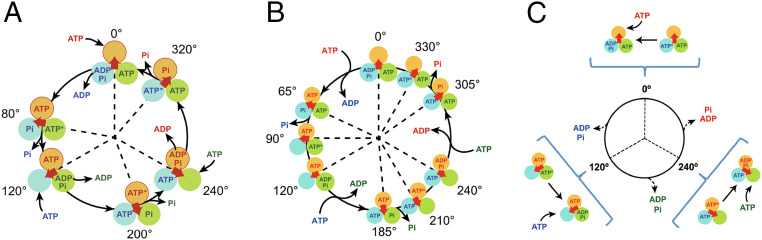
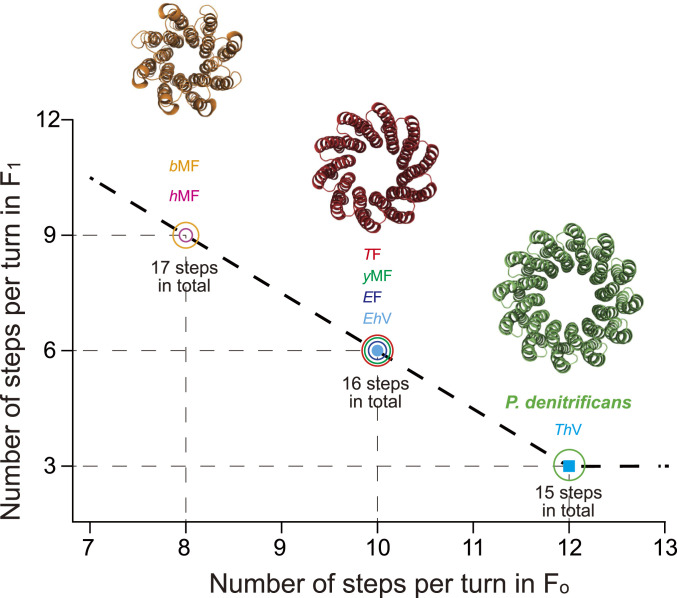
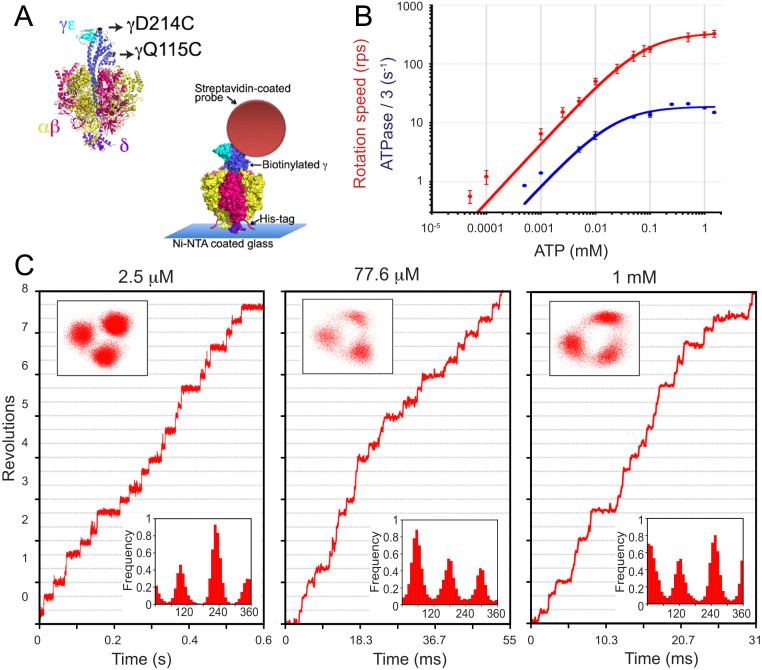
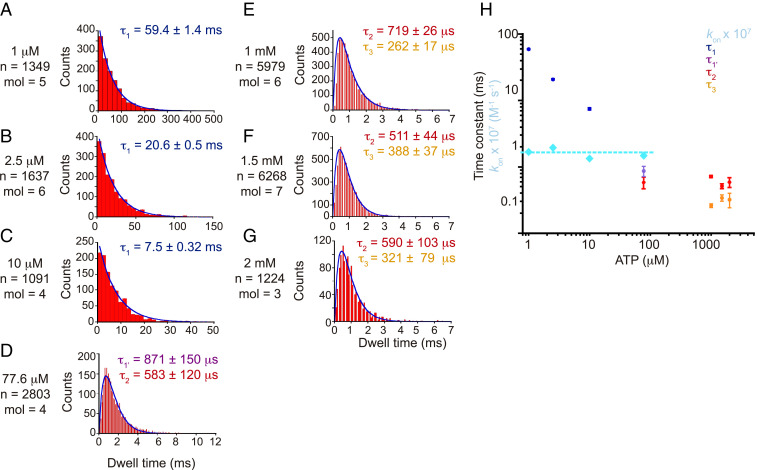
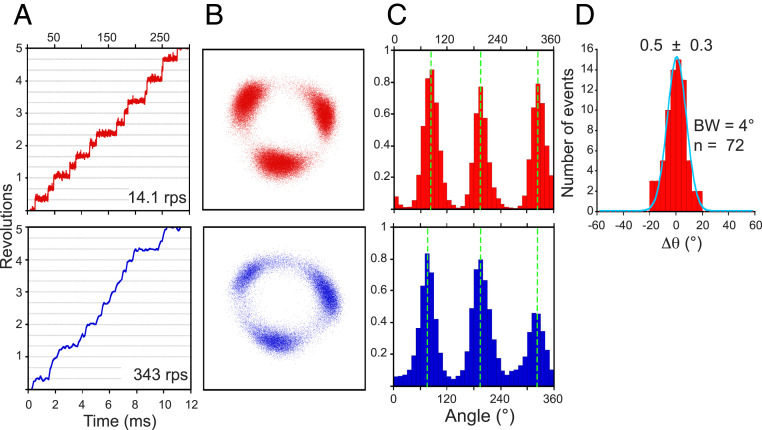
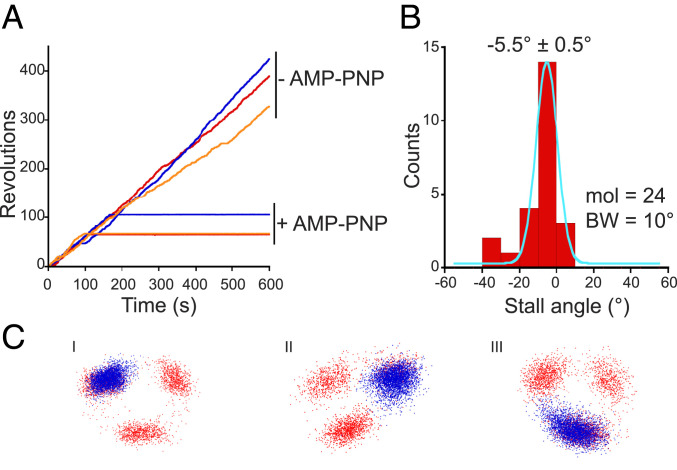
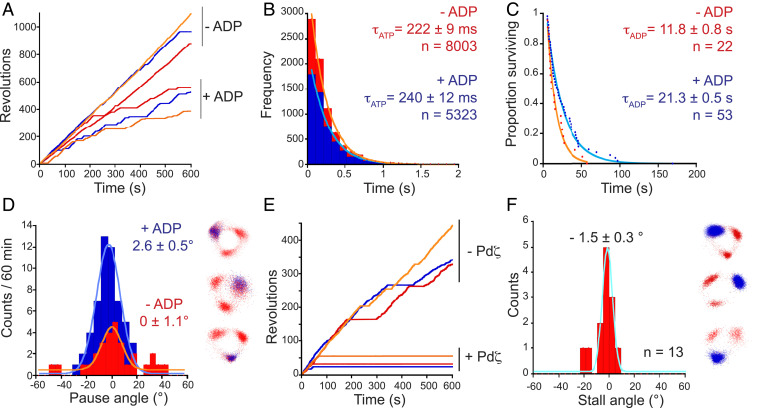
The rotation of F-ATPase (PdF) was studied using single-molecule microscopy. At all concentrations of adenosine triphosphate (ATP) or a slowly hydrolyzable ATP analog (ATPγS), above or below , PdF showed three dwells per turn, each separated by 120°. Analysis of dwell time between steps showed that PdF executes binding, hydrolysis, and probably product release at the same dwell. The comparison of ATP binding and catalytic pauses in single PdF molecules suggested that PdF executes both elementary events at the same rotary position. This point was confirmed in an inhibition experiment with a nonhydrolyzable ATP analog (AMP-PNP). Rotation assays in the presence of adenosine diphosphate (ADP) or inorganic phosphate at physiological concentrations did not reveal any obvious substeps. Although the possibility of the existence of substeps remains, all of the datasets show that PdF is principally a three-stepping motor similar to bacterial vacuolar (V)-ATPase from This contrasts with all other known F-ATPases that show six or nine dwells per turn, conducting ATP binding and hydrolysis at different dwells. Pauses by persistent Mg-ADP inhibition or the inhibitory ζ-subunit were also found at the same angular position of the rotation dwell, supporting the simplified chemomechanical scheme of PdF Comprehensive analysis of rotary catalysis of F from different species, including PdF, suggests a clear trend in the correlation between the numbers of rotary steps of F and F domains of F-ATP synthase. F motors with more distinctive steps are coupled with proton-conducting F rings with fewer proteolipid subunits, giving insight into the design principle the FF of ATP synthase.
使用单分子显微镜研究了 F-ATP 酶(PdF)的旋转。在高于或低于三磷酸腺苷(ATP)或缓慢水解的 ATP 类似物(ATPγS)的所有浓度下,PdF 显示每转三个停留,每个停留间隔 120°。分析步间停留时间表明,PdF 在同一停留时执行结合、水解和可能的产物释放。在单个 PdF 分子中比较 ATP 结合和催化暂停表明,PdF 在同一旋转位置执行这两个基本事件。在与非水解的 ATP 类似物(AMP-PNP)的抑制实验中证实了这一点。在生理浓度的腺苷二磷酸(ADP)或无机磷酸盐存在下进行的旋转测定未显示出任何明显的亚步骤。尽管亚步骤的存在仍然存在可能性,但所有数据集都表明,PdF 主要是一种三步旋转马达,类似于来自 的细菌液泡(V)-ATP 酶。这与所有其他已知的 F-ATP 酶形成对比,后者每转显示六个或九个停留,在不同的停留处进行 ATP 结合和水解。通过持续的 Mg-ADP 抑制或抑制 ζ-亚基的停顿也在旋转停留的相同角位置发现,支持 PdF 的简化化学机械方案。对来自不同物种的 F 的旋转催化的综合分析,包括 PdF,表明 F-ATP 合酶的 F 域的 F 旋转步骤数之间存在明显的相关性趋势。具有更独特步骤的 F 马达与具有较少的亲质蛋白亚基的质子传导 F 环耦合,深入了解 ATP 合酶 FF 的设计原理。