Departament de Psicobiologia i Metodologia de les Ciències de la Salut, Institut de Neurociències, Universitat Autònoma de Barcelona, Barcelona, Spain.
Sci Rep. 2020 Nov 9;10(1):19299. doi: 10.1038/s41598-020-76219-7.
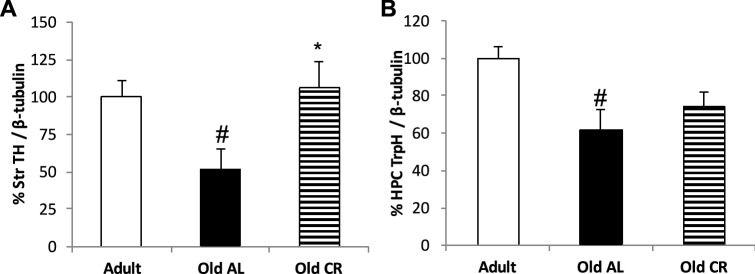
Caloric restriction (CR) can attenuate the general loss of health observed during aging, being one of the mechanisms involved the reduction of hormonal alteration, such as insulin and leptin. This change could also prevent age-specific fluctuations in brain monoamines, although few studies have addressed the effects of CR on peripheral hormones and central neurotransmitters exhaustively. Therefore, the variations in brain monoamine levels and some peripheral hormones were assessed here in adult 4-month old and 24-month old male Wistar rats fed ad libitum (AL) or maintained on a 30% CR diet from four months of age. Noradrenaline (NA), dopamine (DA), serotonin (5-HT) and its metabolites were measured by high-performance liquid chromatography with electrochemical detection (HPLC-ED) in nine brain regions: cerebellum, pons, midbrain, hypothalamus, thalamus, hippocampus, striatum, frontal cortex, and occipital cortex. In addition, the blood plasma levels of hormones like corticosterone, insulin and leptin were also evaluated, as were insulin-like growth factor 1 and other basal metabolic parameters using enzyme-linked immunosorbent assays (ELISAs): cholesterol, glucose, triglycerides, albumin, low-density lipoprotein, calcium and high-density lipoprotein (HDLc). CR was seen to increase the NA levels that are altered by aging in specific brain regions like the striatum, thalamus, cerebellum and hypothalamus, and the DA levels in the striatum, as well as modifying the 5-HT levels in the striatum, hypothalamus, pons and hippocampus. Moreover, the insulin, leptin, calcium and HDLc levels in the blood were restored in old animals maintained on a CR diet. These results suggest that a dietary intervention like CR may have beneficial health effects, recovering some negative effects on peripheral hormones, metabolic parameters and brain monoamine concentrations.
热量限制(CR)可以减轻衰老过程中普遍出现的健康损失,这是涉及减少激素改变的机制之一,如胰岛素和瘦素。这种变化也可以防止大脑单胺类物质随年龄特异性波动,尽管很少有研究全面探讨 CR 对外周激素和中枢神经递质的影响。因此,在这里评估了自由喂养(AL)或从四个月大开始维持在 30% CR 饮食的成年 4 个月大和 24 个月大的雄性 Wistar 大鼠的大脑单胺水平和一些外周激素的变化。通过高效液相色谱电化学检测(HPLC-ED)在九个脑区测量去甲肾上腺素(NA)、多巴胺(DA)、血清素(5-HT)及其代谢物:小脑、脑桥、中脑、下丘脑、丘脑、海马、纹状体、额叶皮质和枕叶皮质。此外,还评估了激素如皮质酮、胰岛素和瘦素的血浆水平,以及使用酶联免疫吸附测定(ELISA)评估胰岛素样生长因子 1 和其他基础代谢参数:胆固醇、葡萄糖、甘油三酯、白蛋白、低密度脂蛋白、钙和高密度脂蛋白(HDLc)。CR 增加了特定脑区如纹状体、丘脑、小脑和下丘脑的老化改变的 NA 水平,以及纹状体的 DA 水平,并改变了纹状体、下丘脑、脑桥和海马的 5-HT 水平。此外,维持 CR 饮食的老年动物的胰岛素、瘦素、钙和 HDLc 水平得到恢复。这些结果表明,像 CR 这样的饮食干预可能具有有益的健康影响,可以恢复一些对外周激素、代谢参数和大脑单胺浓度的负面影响。