Department of Biological Sciences, Universidad de Los Andes, Bogotá, Colombia.
Broad Institute of MIT and Harvard, Cambridge, MA, USA.
Mol Biol Evol. 2021 May 4;38(5):1715-1730. doi: 10.1093/molbev/msaa285.
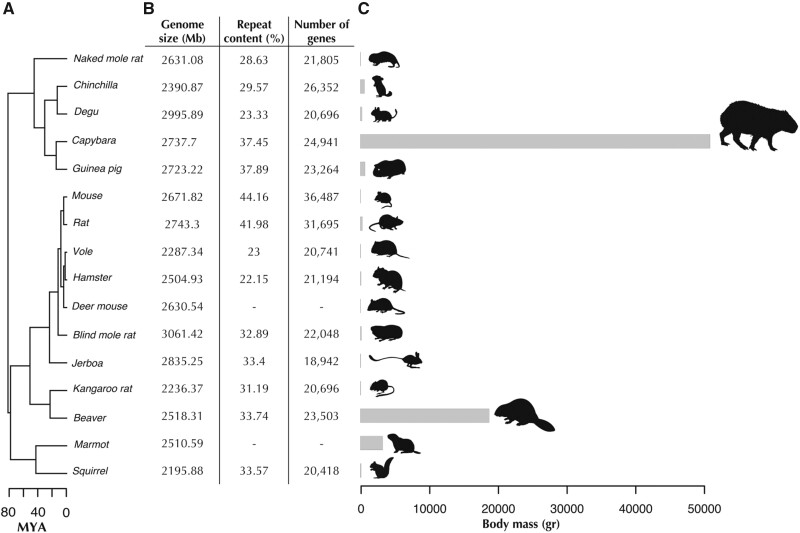
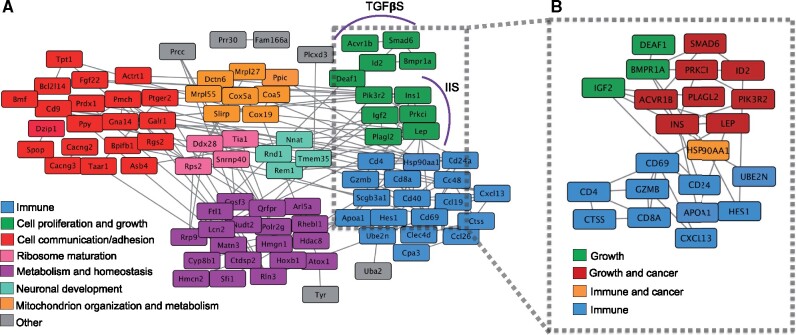
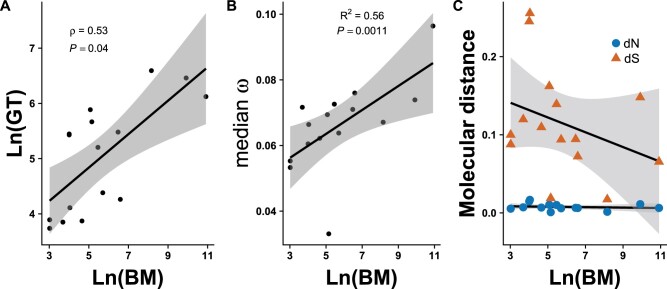
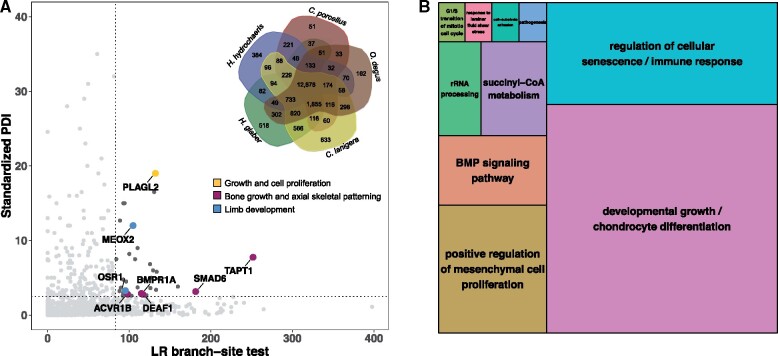
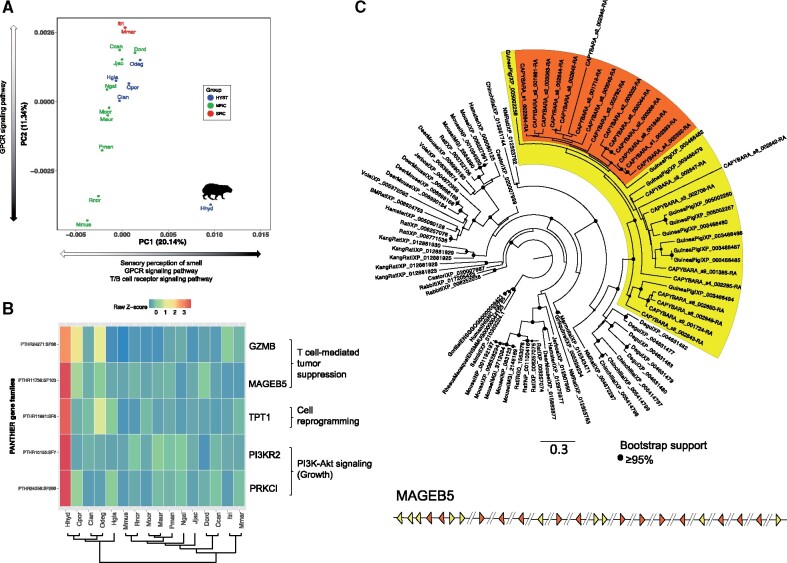
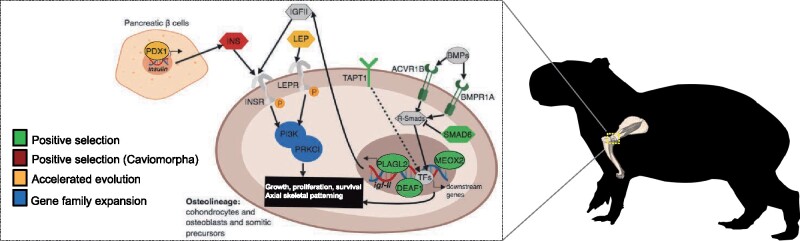
Gigantism results when one lineage within a clade evolves extremely large body size relative to its small-bodied ancestors, a common phenomenon in animals. Theory predicts that the evolution of giants should be constrained by two tradeoffs. First, because body size is negatively correlated with population size, purifying selection is expected to be less efficient in species of large body size, leading to increased mutational load. Second, gigantism is achieved through generating a higher number of cells along with higher rates of cell proliferation, thus increasing the likelihood of cancer. To explore the genetic basis of gigantism in rodents and uncover genomic signatures of gigantism-related tradeoffs, we assembled a draft genome of the capybara (Hydrochoerus hydrochaeris), the world's largest living rodent. We found that the genome-wide ratio of nonsynonymous to synonymous mutations (ω) is elevated in the capybara relative to other rodents, likely caused by a generation-time effect and consistent with a nearly neutral model of molecular evolution. A genome-wide scan for adaptive protein evolution in the capybara highlighted several genes controlling postnatal bone growth regulation and musculoskeletal development, which are relevant to anatomical and developmental modifications for an increase in overall body size. Capybara-specific gene-family expansions included a putative novel anticancer adaptation that involves T-cell-mediated tumor suppression, offering a potential resolution to the increased cancer risk in this lineage. Our comparative genomic results uncovered the signature of an intragenomic conflict where the evolution of gigantism in the capybara involved selection on genes and pathways that are directly linked to cancer.
巨人症是指一个分支在进化过程中相对于其小型祖先发展出非常大的体型,这在动物中是一种常见现象。理论预测,巨人的进化应该受到两个权衡的限制。首先,由于体型与种群大小呈负相关,因此体型较大的物种中净化选择的效率预计会降低,从而导致突变负荷增加。其次,巨人症是通过产生更多的细胞和更高的细胞增殖率来实现的,从而增加了癌症的可能性。为了探索啮齿动物中巨人症的遗传基础,并揭示与巨人症相关权衡的基因组特征,我们组装了水豚(Hydrochoerus hydrochaeris)的草图基因组,水豚是世界上最大的活体啮齿动物。我们发现,与其他啮齿动物相比,水豚的全基因组非同义突变与同义突变的比值(ω)升高,这可能是由于世代时间效应引起的,与分子进化的近中性模型一致。对水豚适应性蛋白质进化的全基因组扫描突出了几个控制出生后骨骼生长调节和肌肉骨骼发育的基因,这些基因与整体体型增加的解剖和发育修饰有关。水豚特有的基因家族扩张包括一种可能的新型抗癌适应性,涉及 T 细胞介导的肿瘤抑制,为该谱系中癌症风险增加提供了潜在的解决方案。我们的比较基因组结果揭示了基因组内冲突的特征,即水豚的巨人症进化涉及到与癌症直接相关的基因和途径的选择。