Lee B A, Maher D W, Hannink M, Donoghue D J
Department of Biology, University of California, San Diego, La Jolla 92093.
Mol Cell Biol. 1987 Oct;7(10):3527-37. doi: 10.1128/mcb.7.10.3527-3537.1987.
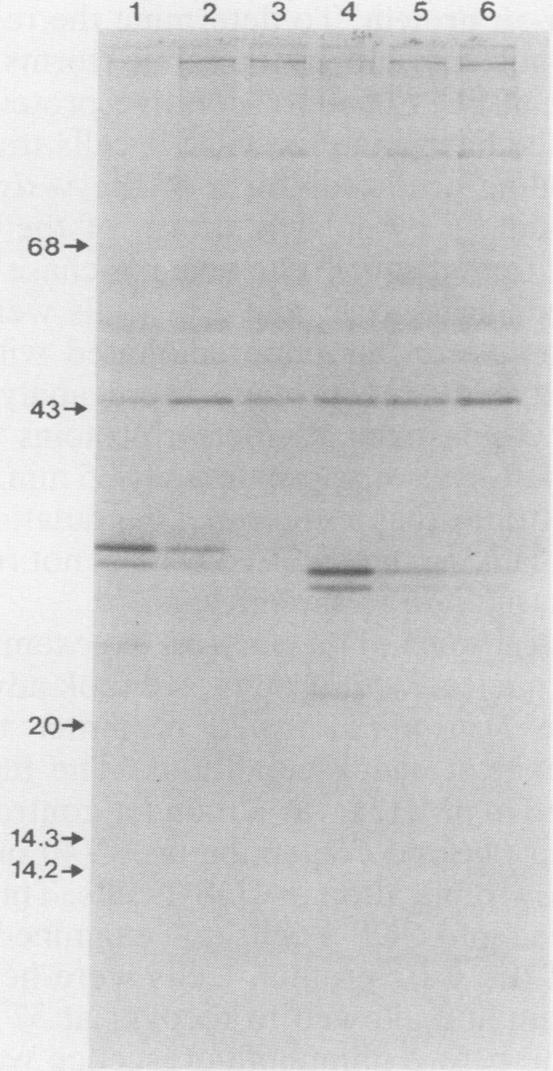
The v-vis gene encodes p28sis, the transforming protein of simian sarcoma virus. This gene resulted from a fusion of the env gene of simian sarcoma-associated virus and the woolly monkey gene for the B chain of platelet-derived growth factor (PDGF). Previous work has shown that the v-sis gene product undergoes signal sequence cleavage, glycosylation, dimerization, and proteolytic processing to yield a secreted form of the protein. It transport across the endoplasmic reticulum is blocked by the introduction of a charged amino acid residue within the signal sequence, the protein does not dimerize, is not secreted, and is no longer transforming as assayed by focus-forming ability in NIH 3T3 cells. Instead, this mutant protein localizes to the nucleus as demonstrated by both indirect immunofluorescence and cell fractionation. Using a series of deletion mutations, we delimited an amino acid sequence within this protein which is responsible for nuclear localization. This region is completely conserved in the predicted human c-sis protein, although it lies outside of regions required for transformation by the v-sis gene product. This nuclear transport signal is contained within amino acid residues 237 to 255, RVTIRTVRVRRPPKGKHRK. An amino acid sequence containing these residues is capable of directing cytoplasmic v-sis mutant proteins to the nucleus. This sequence is also capable of directing less efficient nuclear transport of a normally cytoplasmic protein, pyruvate kinase. Pulse-chase experiments indicate that the half-lives of nuclear and cytoplasmic v-sis mutant proteins are approximately 35 min. Using the heat-inducible hsp70 promoter from Drosophila melanogaster, we showed that the nuclear v-sis protein accumulates in the nucleus within 30 min of induction. The identification of a nuclear transport signal in the v-sis gene product raises interesting questions regarding the possibility of some function for PDGF or PDGF-related molecules in the nucleus.
v-sis基因编码p28sis,即猿猴肉瘤病毒的转化蛋白。该基因源于猿猴肉瘤相关病毒的env基因与毛猴血小板衍生生长因子(PDGF)B链基因的融合。先前的研究表明,v-sis基因产物会经历信号序列切割、糖基化、二聚化和蛋白水解加工,从而产生一种分泌形式的蛋白质。当在信号序列中引入一个带电荷的氨基酸残基时,其在内质网中的转运被阻断,该蛋白质不会二聚化,不会被分泌,并且通过NIH 3T3细胞中的集落形成能力检测不再具有转化活性。相反,通过间接免疫荧光和细胞分级分离证明,这种突变蛋白定位于细胞核。通过一系列缺失突变,我们确定了该蛋白质中负责核定位的氨基酸序列。尽管该区域位于v-sis基因产物转化所需区域之外,但在预测的人c-sis蛋白中完全保守。这个核转运信号包含在氨基酸残基237至255中,即RVTIRTVRVRRPPKGKHRK。包含这些残基的氨基酸序列能够将细胞质中的v-sis突变蛋白导向细胞核。该序列也能够指导正常位于细胞质中的蛋白丙酮酸激酶进行效率较低的核转运。脉冲追踪实验表明,细胞核和细胞质中的v-sis突变蛋白的半衰期约为35分钟。使用来自黑腹果蝇的热诱导型hsp70启动子,我们发现核v-sis蛋白在诱导后30分钟内积聚在细胞核中。v-sis基因产物中核转运信号的鉴定引发了关于PDGF或PDGF相关分子在细胞核中可能具有某些功能的有趣问题。