School of Minerals Processing and Bioengineering, Central South University, Changsha, Hunan 410083, P.R. China.
Department of Obstetrics and Gynecology, Xiangya Hospital, Central South University, Changsha, Hunan 410008, P.R. China.
Oncol Rep. 2021 Jan;45(1):119-128. doi: 10.3892/or.2020.7844. Epub 2020 Nov 10.
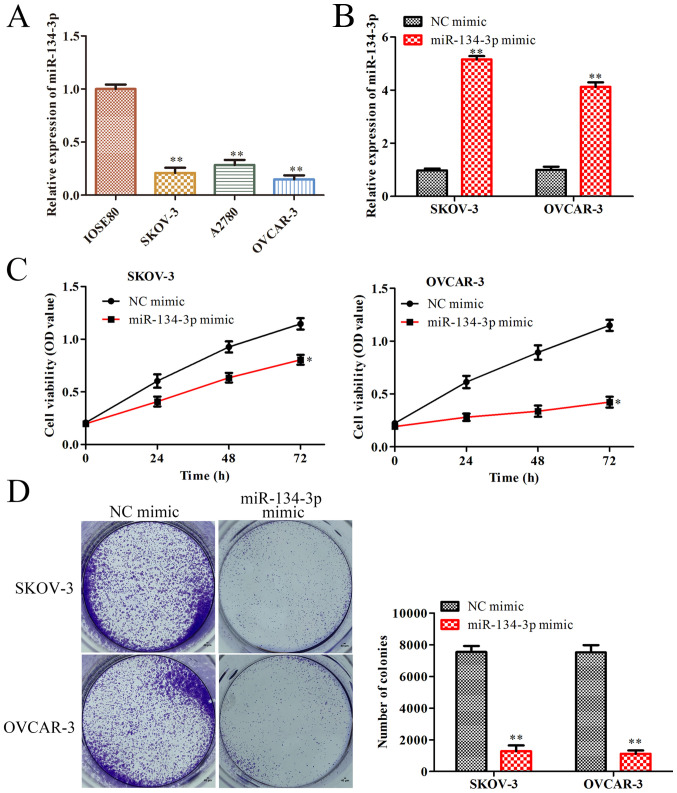
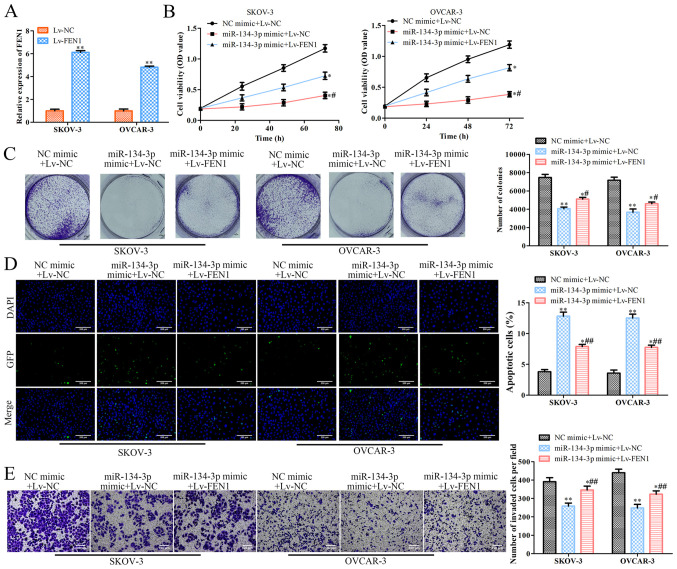
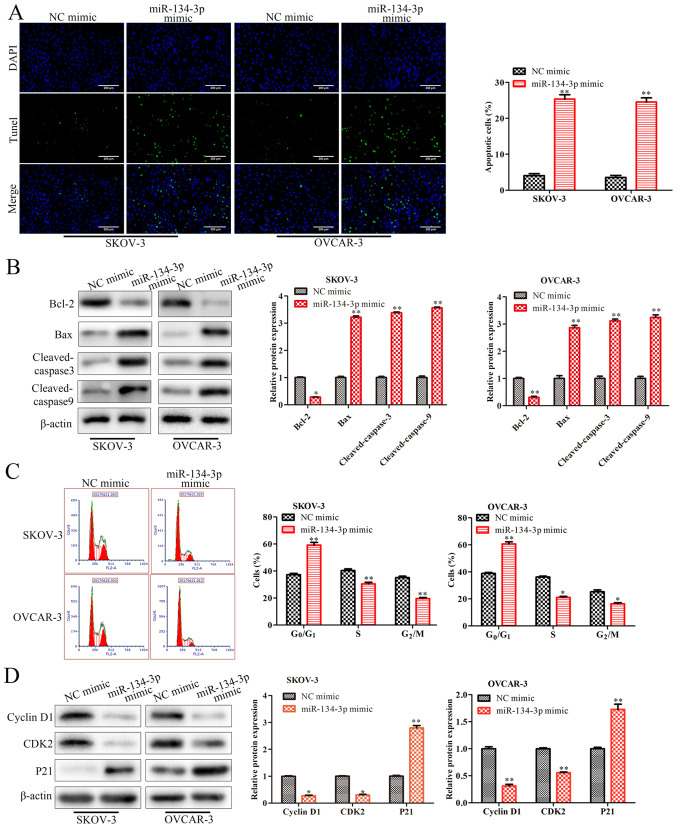
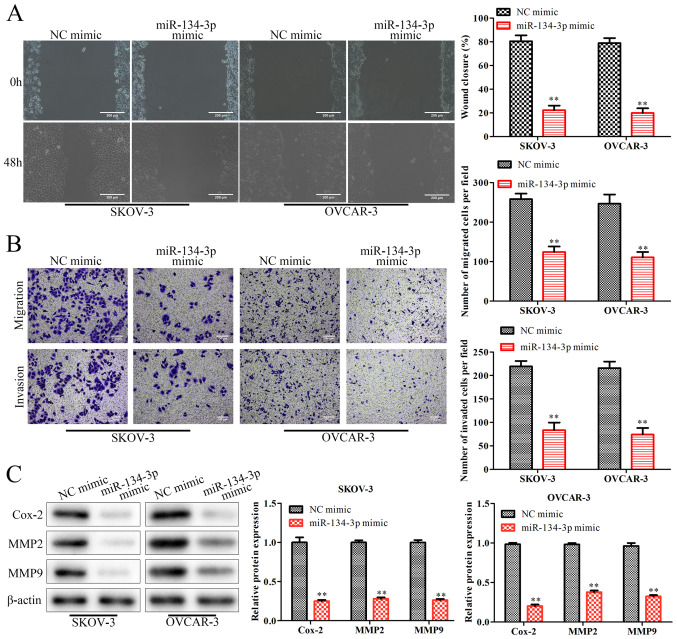
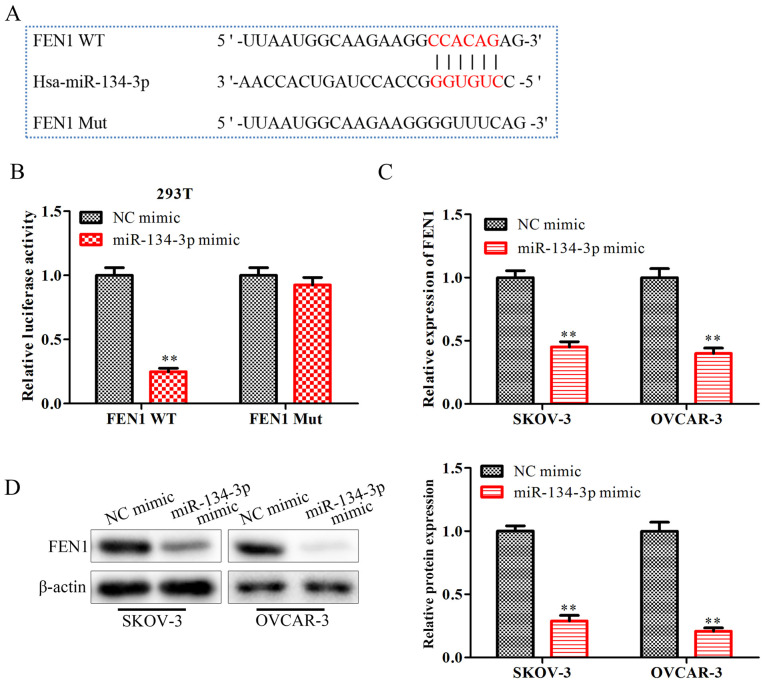
Ovarian cancer (OC) is one of the most lethal gynecological malignancies in the world. The aim of the present study was to examine the role of microRNA (miR)-134-3p in OC. Reverse transcription-quantitative PCR was used to measure the expression levels of miR-134-3p. Cell Counting Kit-8, TUNEL, flow cytometric and colony formation assays were performed to examine the effects of miR-134-3p on OC cell proliferation. Moreover, wound healing and Transwell assays were performed to examine the effects on migration and invasion. In addition, western blot analyses were used to assess protein expression. Finally, the target genes of miR-134-3p were analyzed by bioinformatics analysis and dual-luciferase reporter assay. The results revealed that miR-134-3p expression was low in OC cells compared with in normal ovarian cells. The overexpression of miR-134-3p decreased cell viability, facilitated cell apoptosis, inhibited cell proliferation and arrested the cell cycle in SKOV-3 and OVCAR-3 cells. Furthermore, transfection using a miR-134-3p mimic inhibited the migration and invasion of SKOV-3 and OVCAR-3 cells, and decreased the protein expression levels of cyclooxygenase-2, matrix metalloproteinase (MMP)2 and MMP9. Bioinformatics analysis indicated that one of the potential target genes of miR-134-3p was flap structure-specific endonuclease 1 (FEN1), which was confirmed by dual-luciferase reporter assay. Moreover, overexpression of miR-134-3p decreased the expression levels of FEN1 in SKOV-3 and OVCAR-3 cells. Additionally, overexpression of FEN1 reversed the effects of the miR-134-3p mimic on the proliferation, migration and invasion of SKOV-3 and OVCAR-3 cells. Overall, the findings of the present study demonstrated that miR-134-3p may inhibit OC cell proliferation, migration and invasion by directly targeting FEN1.
卵巢癌(OC)是世界上最致命的妇科恶性肿瘤之一。本研究旨在探讨 microRNA(miR)-134-3p 在 OC 中的作用。逆转录定量 PCR 用于测量 miR-134-3p 的表达水平。细胞计数试剂盒-8、TUNEL、流式细胞术和集落形成实验用于检测 miR-134-3p 对 OC 细胞增殖的影响。此外,进行划痕愈合和 Transwell 实验以检测迁移和侵袭的影响。还使用 Western blot 分析来评估蛋白表达。最后,通过生物信息学分析和双荧光素酶报告基因实验分析 miR-134-3p 的靶基因。结果显示,与正常卵巢细胞相比,OC 细胞中 miR-134-3p 的表达较低。miR-134-3p 的过表达降低了 SKOV-3 和 OVCAR-3 细胞的活力,促进了细胞凋亡,抑制了细胞增殖并使细胞周期停滞。此外,miR-134-3p 模拟物的转染抑制了 SKOV-3 和 OVCAR-3 细胞的迁移和侵袭,并降低了环氧合酶-2、基质金属蛋白酶(MMP)2 和 MMP9 的蛋白表达水平。生物信息学分析表明,miR-134-3p 的一个潜在靶基因是 flap structure-specific endonuclease 1(FEN1),这通过双荧光素酶报告基因实验得到了证实。此外,miR-134-3p 的过表达降低了 SKOV-3 和 OVCAR-3 细胞中 FEN1 的表达水平。此外,FEN1 的过表达逆转了 miR-134-3p 模拟物对 SKOV-3 和 OVCAR-3 细胞增殖、迁移和侵袭的影响。综上所述,本研究结果表明,miR-134-3p 可能通过直接靶向 FEN1 抑制 OC 细胞的增殖、迁移和侵袭。