Choi Yong K, Thompson Hilaire J, Demiris George
Department of Public Health Sciences, School of Medicine, University of California Davis, Sacramento, CA, United States.
School of Nursing, University of Washington, Seattle, WA, United States.
JMIR Aging. 2020 Nov 10;3(2):e21964. doi: 10.2196/21964.
The Internet-of-Things (IoT) technologies can create smart residences that integrate technology within the home to enhance residents' safety as well as monitor their health and wellness. However, there has been little research on real-world testing of IoT smart home devices with older adults, and the feasibility and acceptance of such tools have not been systematically examined.
This study aims to conduct a pilot study to investigate the feasibility of using IoT smart home devices in the actual residences of older adults to facilitate healthy aging.
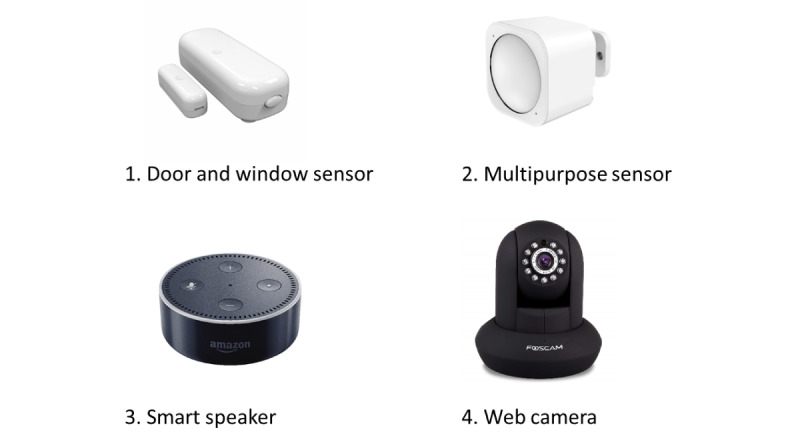
We conducted a 2-month feasibility study on community-dwelling older adults. Participants chose among different IoT devices to be installed and deployed within their homes. The IoT devices tested varied depending on the participant's preference: a door and window sensor, a multipurpose sensor (motion, temperature, luminosity, and humidity), a voice-operated smart speaker, and an internet protocol (IP) video camera.
We recruited a total of 37 older adults for this study, with 35 (95%) successfully completing all procedures in the 2-month study. The average age of the sample was 78 (SD 9) years and primarily comprised women (29/37, 78%), those who were educated (31/37, 86%; bachelor's degree or higher), and those affected by chronic conditions (33/37, 89%). The most widely chosen devices among the participants were multipurpose sensors and smart speakers. An IP camera was a significantly unpopular choice among participants in both phases. The participant feedback suggests that perceived privacy concerns, perceived usefulness, and curiosity to technology were strong factors when considering which device to have installed in their home.
Overall, our deployment results revealed that the use of IoT smart home devices is feasible in actual residences of older adults. These findings may inform the follow-up assessment of IoT technologies and their impact on health-related outcomes and advance our understanding of the role of IoT home-based monitoring technologies to promote successful aging-in-place for older adults. Future trials should consider older adults' preferences for the different types of smart home devices to be installed in real-world residential settings.
物联网(IoT)技术可以打造智能住宅,将技术融入家庭,以提高居民的安全性,并监测他们的健康状况。然而,针对老年人对物联网智能家居设备进行实际测试的研究较少,此类工具的可行性和可接受性尚未得到系统检验。
本研究旨在开展一项试点研究,调查在老年人的实际住所中使用物联网智能家居设备以促进健康老龄化的可行性。
我们对社区居住的老年人进行了为期2个月的可行性研究。参与者从不同的物联网设备中选择,以便安装和部署在他们家中。测试的物联网设备因参与者的偏好而异:门窗传感器、多功能传感器(运动、温度、亮度和湿度)、语音操作智能音箱和网络协议(IP)摄像机。
我们共招募了37名老年人参与本研究,其中35人(95%)在为期2个月的研究中成功完成了所有程序。样本的平均年龄为78岁(标准差9),主要为女性(29/37,78%)、受过教育的人(31/37,86%;学士学位或更高)以及患有慢性病的人(33/37,89%)。参与者中选择最广泛的设备是多功能传感器和智能音箱。在两个阶段中,IP摄像机在参与者中都是明显不受欢迎的选择。参与者的反馈表明,在考虑在家中安装哪种设备时,感知到的隐私问题、感知到的有用性以及对技术的好奇心是重要因素。
总体而言,我们的部署结果表明,在老年人的实际住所中使用物联网智能家居设备是可行的。这些发现可能为物联网技术的后续评估及其对健康相关结果的影响提供信息,并增进我们对基于物联网的家庭监测技术在促进老年人成功就地养老方面作用的理解。未来的试验应考虑老年人对在实际居住环境中安装的不同类型智能家居设备的偏好。