Lee Heayon, Park Yu Rang, Kim Hae-Reong, Kang Na Young, Oh Gahee, Jang Il-Young, Lee Eunju
Division of Geriatrics, Department of Internal Medicine, Asan Medical Center, University of Ulsan College of Medicine, Seoul, Republic of Korea.
Department of Biomedical System Informatics, Yonsei University College of Medicine, Seoul, Republic of Korea.
J Med Internet Res. 2020 Apr 15;22(4):e16614. doi: 10.2196/16614.
Home Internet of Things (IoT) services and devices have the potential to aid older adults and people with disabilities in their living environments. IoT services and devices can also aid caregivers and health care providers in conveniently providing care to those in need. However, real-world data on the IoT needs of vulnerable people are lacking.
The objective of this study is to conduct a face-to-face survey on the demand for IoT services among older people and people with disabilities, their caregivers, and health care providers in a real-world setting and to see if there are any differences in the aspects of need.
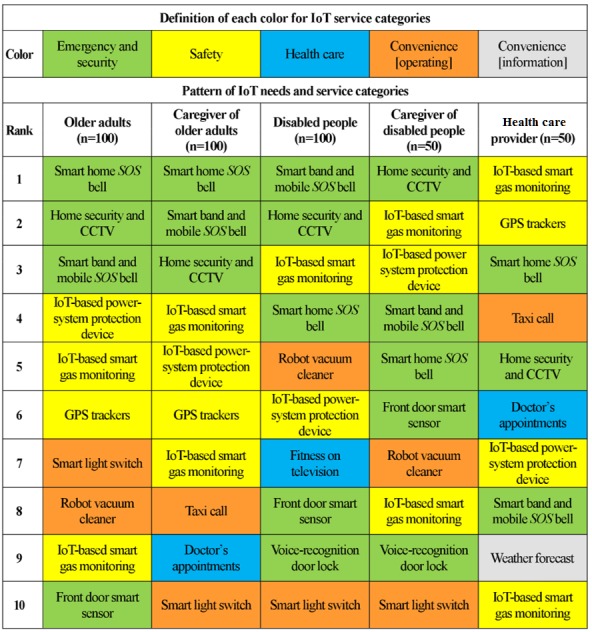
We conducted a face-to-face survey with 500 participants between January 2019 and March 2019. A total of 300 vulnerable people (200 older adults aged ≥65 years and 100 physically disabled people aged 30-64 years) were randomly sampled from either a population-based, prospective cohort study of aging-the Aging Study of Pyeongchang Rural Area (ASPRA)-or from the outpatient clinics at the Asan Medical Center, Seoul, South Korea. Simultaneously, their caregivers (n=150) and health care providers (n=50) participated in the survey. Detailed socioeconomic status, digital literacy, health and physical function, and home IoT service needs were determined. Among all commercially available IoT services, 27 services were classified into five categories: emergency and security, safety, health care, convenience (information), and convenience (operation). The weighted-ranking method was used to rank the IoT needs in different groups.
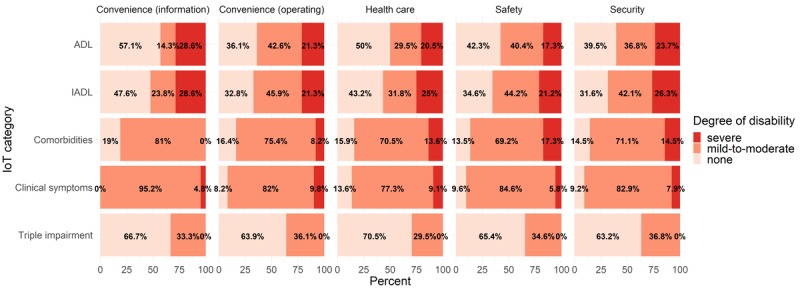
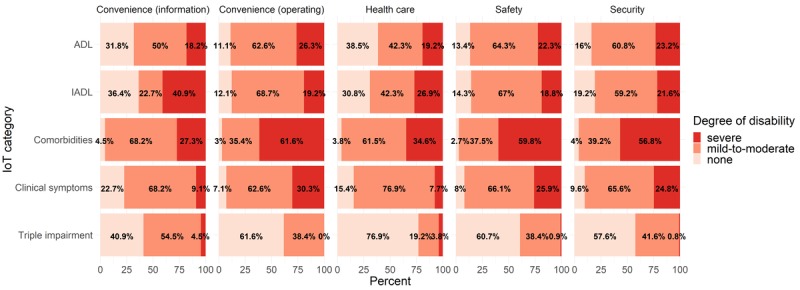
There were discrepancies in the demand of IoT services among the vulnerable groups, their caregivers, and health care providers. The home IoT service category that was required the most by the vulnerable groups and their caregivers was emergency and security. However, health care providers indicated that the safety category was most needed by the older adults and disabled people. Home IoT service requirements differed according to the different types of disabilities among the vulnerable groups. Participants with fewer disabilities were more willing to use IoT services than those with more disabilities.
Our survey study shows that there were discrepancies in the demand of IoT services among the vulnerable groups, their caregivers, and health care providers. IoT service requirements differed according to the various types of disabilities. Home IoT technology should be established by combining patients' priorities and individualized functional assessments among vulnerable people.
Clinical Research Information Service (CRIS; KCT0004157); https://tinyurl.com/r83eyva.
家庭物联网(IoT)服务和设备有潜力帮助老年人和残疾人改善生活环境。物联网服务和设备还能协助护理人员和医疗服务提供者更便捷地为有需要的人提供护理。然而,关于弱势群体对物联网需求的真实数据却很匮乏。
本研究旨在对老年人、残疾人及其护理人员和医疗服务提供者在现实环境中对物联网服务的需求进行面对面调查,并探究需求方面是否存在差异。
2019年1月至2019年3月期间,我们对500名参与者进行了面对面调查。从一项基于人群的老龄化前瞻性队列研究——平昌农村地区老龄化研究(ASPRA)或韩国首尔峨山医疗中心的门诊中,随机抽取了300名弱势群体(200名年龄≥65岁的老年人和100名年龄在30 - 64岁的肢体残疾人)。同时,他们的护理人员(n = 150)和医疗服务提供者(n = 50)参与了调查。确定了详细的社会经济状况、数字素养、健康和身体功能以及家庭物联网服务需求。在所有商用物联网服务中,27项服务被分为五类:应急与安全、安全、医疗保健、便利(信息)和便利(操作)。采用加权排序法对不同群体的物联网需求进行排序。
弱势群体、其护理人员和医疗服务提供者在物联网服务需求方面存在差异。弱势群体及其护理人员最需要的家庭物联网服务类别是应急与安全。然而,医疗服务提供者表示,老年人和残疾人最需要的是安全类别。弱势群体中不同类型的残疾人群对家庭物联网服务的需求也有所不同。残疾较少的参与者比残疾较多的参与者更愿意使用物联网服务。
我们的调查研究表明,弱势群体、其护理人员和医疗服务提供者在物联网服务需求方面存在差异。物联网服务需求因残疾类型而异。应结合弱势群体患者的优先事项和个性化功能评估来建立家庭物联网技术。
临床研究信息服务(CRIS;KCT0004157);https://tinyurl.com/r83eyva 。