Department of Thoracic Surgery, Jiangsu Cancer Hospital and Jiangsu Institute of Cancer Research and The Affiliated Cancer Hospital of Nanjing Medical University, Jiangsu Key Laboratory of Molecular and Translational Cancer Research, Collaborative Innovation Center for Cancer Personalized Medicine, Nanjing, China.
Department of Scientific Research, Jiangsu Cancer Hospital and Jiangsu Institute of Cancer Research and The Affiliated Cancer Hospital of Nanjing Medical University, Jiangsu Key Laboratory of Molecular and Translational Cancer Research, Nanjing, China.
Cell Mol Life Sci. 2021 Mar;78(5):1983-2000. doi: 10.1007/s00018-020-03691-9. Epub 2020 Nov 10.
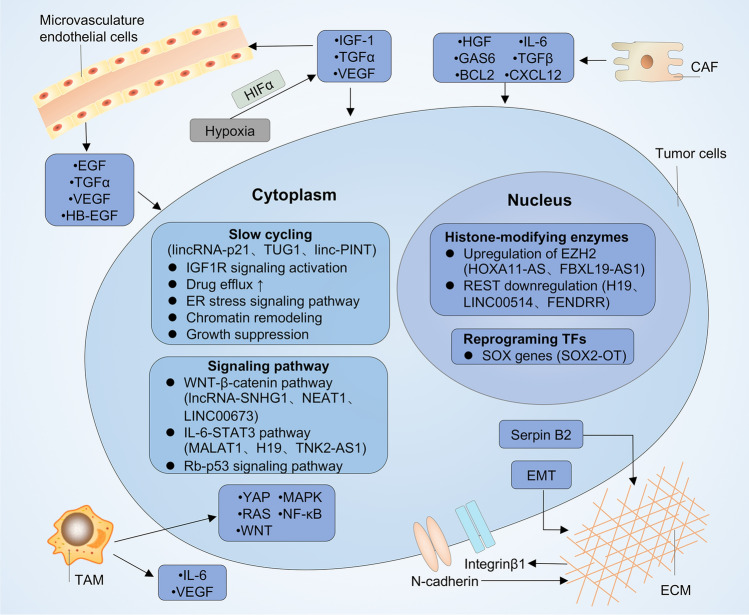
The efficacy of targeted therapy in non-small-cell lung cancer (NSCLC) has been impeded by various mechanisms of resistance. Besides the mutations in targeted oncogenes, reversible lineage plasticity has recently considered to play a role in the development of tyrosine kinase inhibitors (TKI) resistance in NSCLC. Lineage plasticity enables cells to transfer from one committed developmental pathway to another, and has been a trigger of tumor adaptation to adverse microenvironment conditions including exposure to various therapies. More importantly, besides somatic mutation, lineage plasticity has also been proposed as another source of intratumoural heterogeneity. Lineage plasticity can drive NSCLC cells to a new cell identity which no longer depends on the drug-targeted pathway. Histological transformation and epithelial-mesenchymal transition are two well-known pathways of lineage plasticity-mediated TKI resistance in NSCLC. In the last decade, increased re-biopsy practice upon disease recurrence has increased the recognition of lineage plasticity induced resistance in NSCLC and has improved our understanding of the underlying biology. Long non-coding RNAs (lncRNAs), the dark matter of the genome, are capable of regulating variant malignant processes of NSCLC like the invisible hands. Recent evidence suggests that lncRNAs are involved in TKI resistance in NSCLC, particularly in lineage plasticity-mediated resistance. In this review, we summarize the mechanisms of lncRNAs in regulating lineage plasticity and TKI resistance in NSCLC. We also discuss how understanding these themes can alter therapeutic strategies, including combination therapy approaches to overcome TKI resistance.
靶向治疗在非小细胞肺癌(NSCLC)中的疗效受到多种耐药机制的阻碍。除了靶向致癌基因的突变外,最近有研究认为,可逆的谱系可塑性在 NSCLC 酪氨酸激酶抑制剂(TKI)耐药的发展中起作用。谱系可塑性使细胞能够从一种特定的发育途径转移到另一种途径,并且是肿瘤适应包括暴露于各种治疗在内的不利微环境条件的触发因素。更重要的是,除了体细胞突变外,谱系可塑性也被认为是肿瘤内异质性的另一个来源。谱系可塑性可以驱动 NSCLC 细胞获得新的细胞身份,不再依赖于药物靶向途径。组织学转化和上皮-间充质转化是 NSCLC 中谱系可塑性介导的 TKI 耐药的两个众所周知的途径。在过去的十年中,随着疾病复发时进行更多的再活检,人们对 NSCLC 中由谱系可塑性引起的耐药性有了更多的认识,并加深了对其潜在生物学的理解。长链非编码 RNA(lncRNA)是基因组的暗物质,能够调节 NSCLC 如无形之手般的各种恶性变化过程。最近的证据表明,lncRNA 参与 NSCLC 的 TKI 耐药,特别是在谱系可塑性介导的耐药中。在这篇综述中,我们总结了 lncRNA 在调节 NSCLC 中的谱系可塑性和 TKI 耐药的机制。我们还讨论了如何理解这些主题可以改变治疗策略,包括联合治疗方法以克服 TKI 耐药。