Department of Gastroenterological Surgery, Okayama University Graduate School of Medicine, Dentistry and Pharmaceutical Sciences, Okayama, Japan.
Department of Surgery, Hiroshima City Hiroshima Citizens Hospital, 7-33 Motomachi, Naka-ku, Hiroshima, 730-8518, Japan.
Surg Endosc. 2021 Dec;35(12):6568-6576. doi: 10.1007/s00464-020-08154-7. Epub 2020 Nov 10.
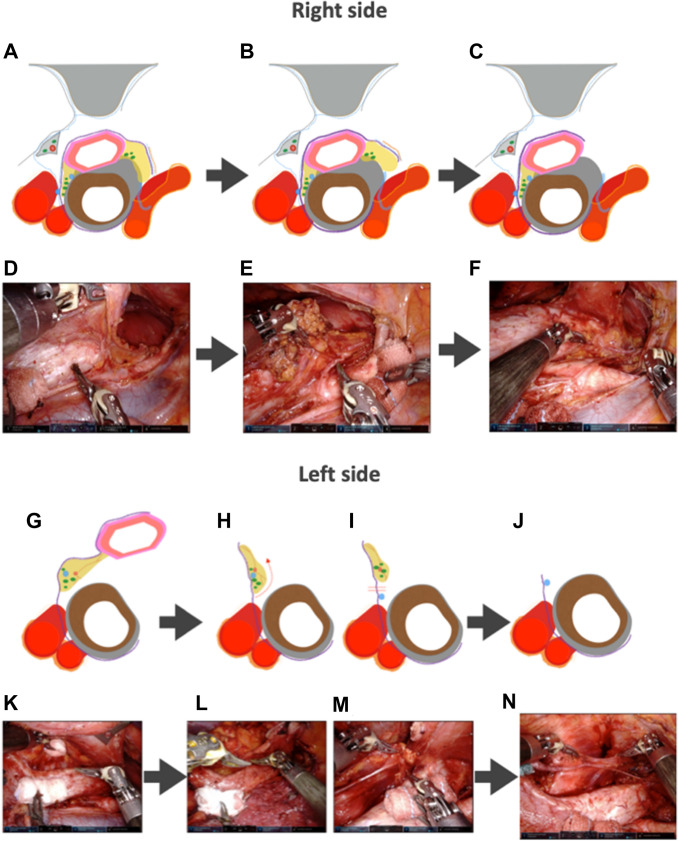
We have recently standardized upper mediastinal lymph node dissection (UMLND) using a microanatomy-based concept in thoracoscopic esophagectomy in the prone position (TEPP), and introduced robot-assisted minimally invasive esophagectomy (RAMIE) using the same concept as in TEPP while aiming at solo surgery. The purpose of this study was to investigate the outcomes of RAMIE using the microanatomy-based concept in the initial introduction phase.
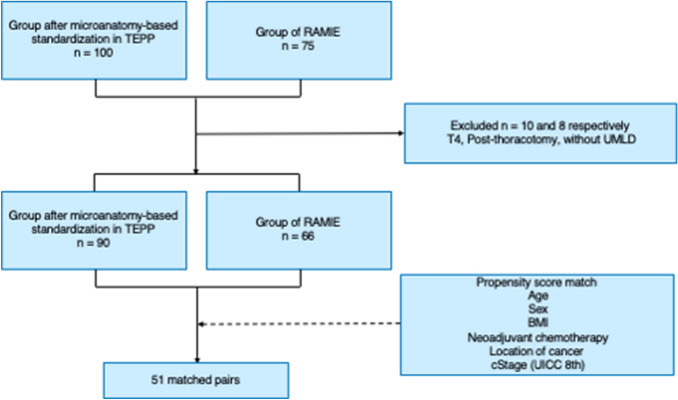
We have performed more than 500 TEPP procedures as minimally invasive esophagectomy (MIE). After performing about 400 cases of MIE, we established a microanatomy-based standardization of UMLND. In October 2018, we introduced RAMIE, and have performed 75 procedures in 20 months. Two groups were analyzed: a group after microanatomy-based standardization in TEPP (100 cases after completing 400 cases of TEPP) and a RAMIE group (75 cases). Finally, 51 paired cases were matched using a propensity score. Furthermore, the change in postoperative short-term outcome for RAMIE in the initial introduction phase was analyzed.
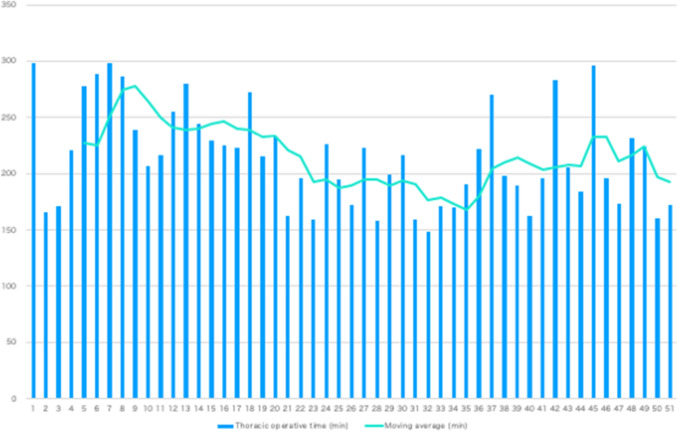
Although there were no significant differences between the two groups in the number of upper mediastinal lymph nodes dissected, there was a significant decrease (P = 0.036) in intraoperative blood loss volume with RAMIE, representing a definite benefit for patients. The thoracoscopic operative time for RAMIE decreased by almost 100 min following less than 50 cases of experience, reaching the same level as that for recent TEPP, but with only one-tenth the operator experience. There were no significant differences in the total postoperative morbidity rate including the recurrent laryngeal nerve palsy rate.
RAMIE has been introduced safely and smoothly using the microanatomy-based concept established in TEPP.
我们最近在经胸腹腔镜食管切除术(TEPP)中采用基于微解剖的概念对纵隔淋巴结清扫术(UMLND)进行了标准化,并引入了机器人辅助微创食管切除术(RAMIE),同时旨在实现单人手术,其采用了与 TEPP 相同的概念。本研究的目的是在 RAMIE 的初始引入阶段,调查基于微解剖的概念的结果。
我们已经完成了超过 500 例微创食管切除术(MIE)的 TEPP 手术。在完成了约 400 例 MIE 手术后,我们建立了基于微解剖的 UMLND 标准化。2018 年 10 月,我们引入了 RAMIE,并在 20 个月内完成了 75 例手术。分析了两组:TEPP 基于微解剖的标准化后组(完成 400 例 TEPP 后的 100 例)和 RAMIE 组(75 例)。最后,使用倾向评分匹配了 51 对病例。此外,还分析了 RAMIE 在初始引入阶段术后短期结果的变化。
虽然两组切除的纵隔淋巴结数量无显著差异,但 RAMIE 的术中出血量显著减少(P=0.036),这对患者有明显的益处。随着经验不足 50 例,RAMIE 的胸腔镜手术时间减少了近 100 分钟,达到了最近 TEPP 的相同水平,但手术经验仅为十分之一。包括喉返神经麻痹发生率在内的总术后发病率没有显著差异。
使用在 TEPP 中建立的基于微解剖的概念,安全平稳地引入了 RAMIE。