Alam Shama, Elwyn Glyn, Percac-Lima Sanja, Grande Stuart, Durand Marie-Anne
The Dartmouth Institute for Health Policy and Clinical Practice, Level 5, Williamson Translational Research Building, One Medical Center Drive, Lebanon, NH 03756, USA.
Massachusetts General Hospital, Boston, MA, USA.
BMC Med Inform Decis Mak. 2016 Nov 21;16(1):147. doi: 10.1186/s12911-016-0384-2.
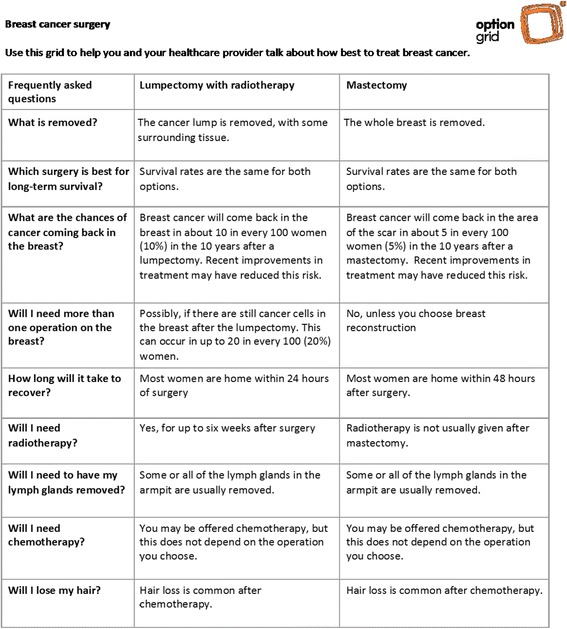
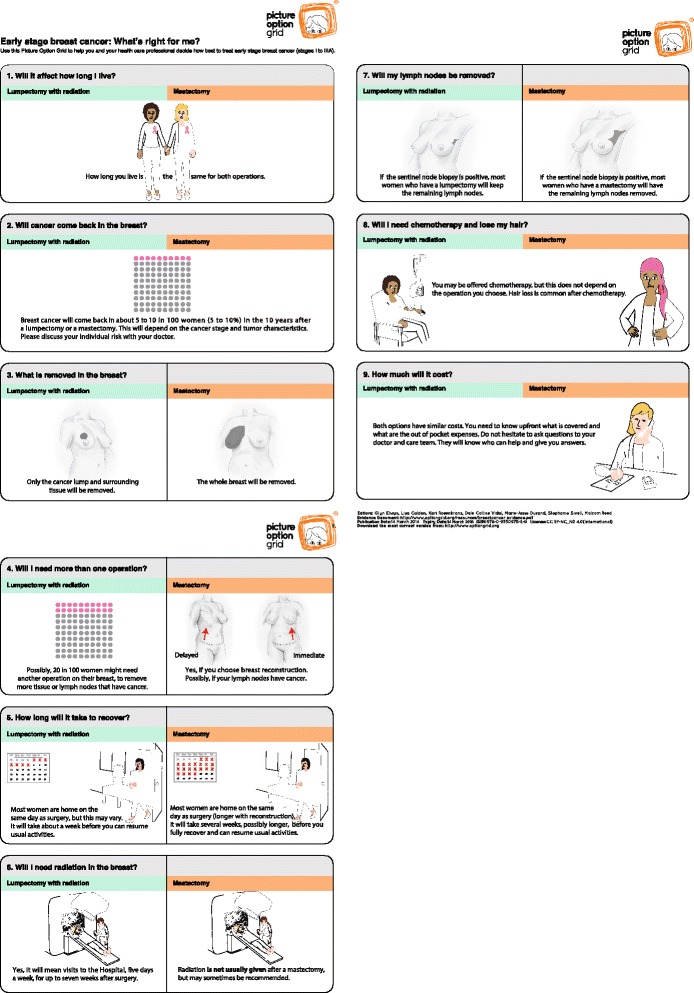
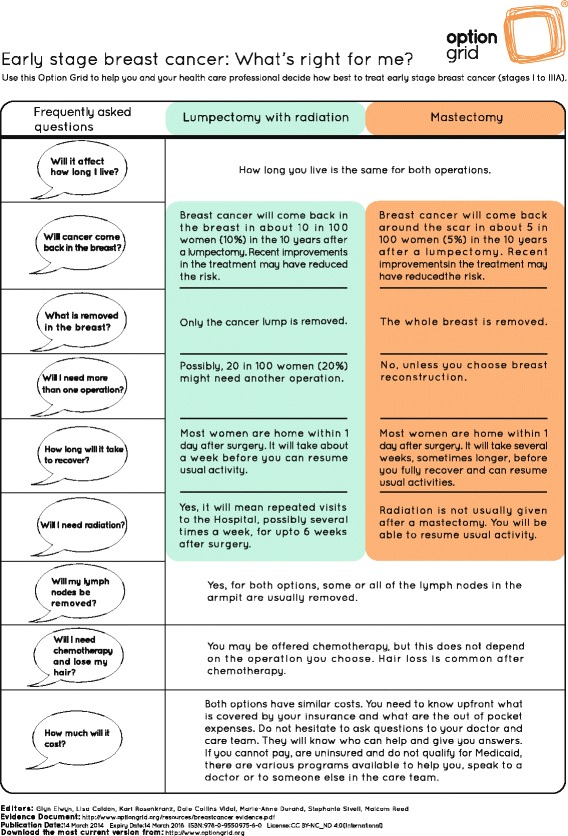
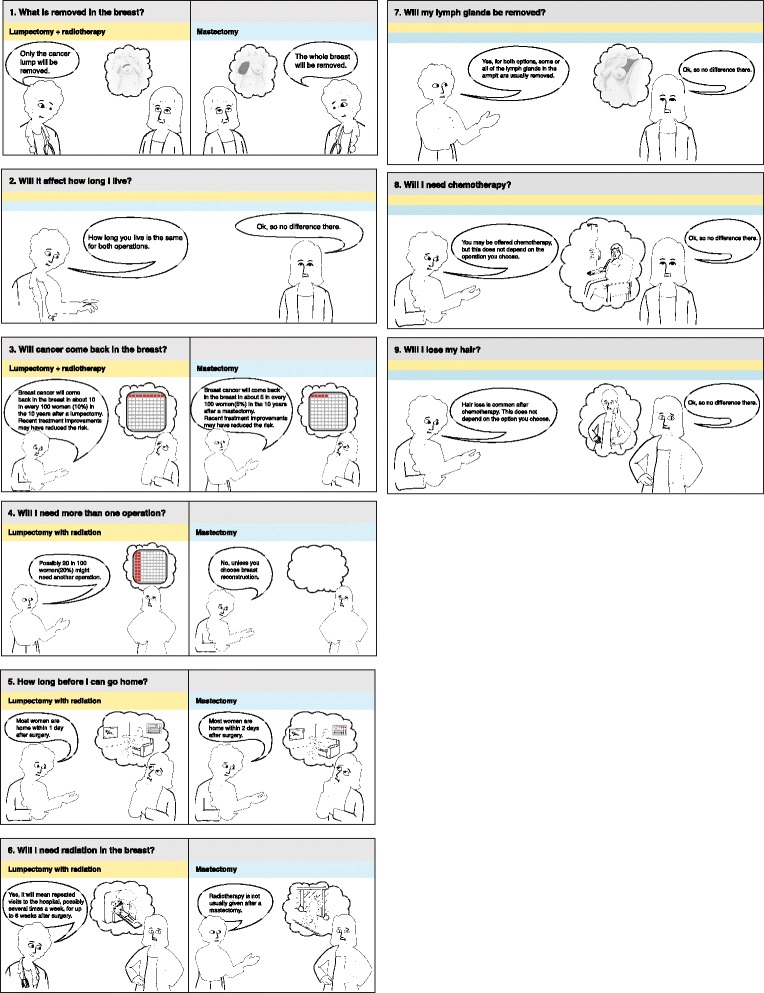
Women of low socioeconomic status (SES) diagnosed with early stage breast cancer are less likely to be involved in treatment decisions. They tend to report higher decisional regret and poorer communication. Evidence suggests that well-designed encounter decision aids (DAs) could improve outcomes and potentially reduce healthcare disparities. Our goal was to evaluate the acceptability and feasibility of encounter decision aids (Option Grid, Comic Option Grid, and Picture Option Grid) adapted for a low-SES and low-literacy population.
We used a multi-phase, mixed-methods approach. In phase 1, we conducted a focus group with rural community stakeholders. In phase 2, we developed and administered a web-based questionnaire with patients of low and high SES. In phase 3, we interviewed patients of low SES and relevant healthcare professionals.
Data from phase 1 (n = 5) highlighted the importance of addressing treatment costs for patients. Data from phase 2 (n = 268) and phase 3 (n = 15) indicated that using both visual displays and numbers are helpful for understanding statistical information. Data from all three phases suggested that using plain language and simple images (Picture Option Grid) was most acceptable and feasible. The Comic Option Grid was deemed least acceptable.
Option Grid and Picture Option Grid appeared acceptable and feasible in facilitating patient involvement and improving perceived understanding among patients of high and low SES. Picture Option Grid was considered most acceptable, accessible and feasible in the clinic visit. However, given the small sample sizes used, those findings need to be interpreted with caution. Further research is needed to determine the impact of pictorial and text-based encounter decision aids in underserved patients and across socioeconomic strata.
被诊断为早期乳腺癌的社会经济地位(SES)较低的女性参与治疗决策的可能性较小。她们往往报告有更高的决策遗憾感和更差的沟通情况。有证据表明,精心设计的就诊决策辅助工具(DAs)可以改善治疗结果,并有可能减少医疗保健方面的差距。我们的目标是评估为低SES和低识字率人群改编的就诊决策辅助工具(选项网格、漫画选项网格和图片选项网格)的可接受性和可行性。
我们采用了多阶段、混合方法。在第1阶段,我们与农村社区利益相关者进行了焦点小组讨论。在第2阶段,我们开发并向SES高和低的患者发放了一份基于网络的问卷。在第3阶段,我们采访了SES低的患者和相关医疗保健专业人员。
第1阶段(n = 5)的数据突出了为患者解决治疗费用问题的重要性。第2阶段(n = 268)和第3阶段(n = 15)的数据表明,同时使用视觉展示和数字有助于理解统计信息。来自所有三个阶段的数据表明,使用通俗易懂的语言和简单图像(图片选项网格)是最可接受和可行的。漫画选项网格被认为最不可接受。
选项网格和图片选项网格在促进患者参与以及提高SES高和低的患者的理解度方面似乎是可接受和可行的。图片选项网格在门诊就诊中被认为是最可接受、最易理解和最可行的。然而,鉴于所使用的样本量较小,这些发现需要谨慎解释。需要进一步研究以确定基于图片和文本的就诊决策辅助工具对服务不足的患者以及不同社会经济阶层的影响。