Division of Sciences and Division of Social Sciences, Krea University, Sri City, Andhra Pradesh, India.
Centre for Complexity Science and Dept. of Mathematics, Imperial College London, London, United Kingdom.
PLoS One. 2020 Nov 10;15(11):e0242042. doi: 10.1371/journal.pone.0242042. eCollection 2020.
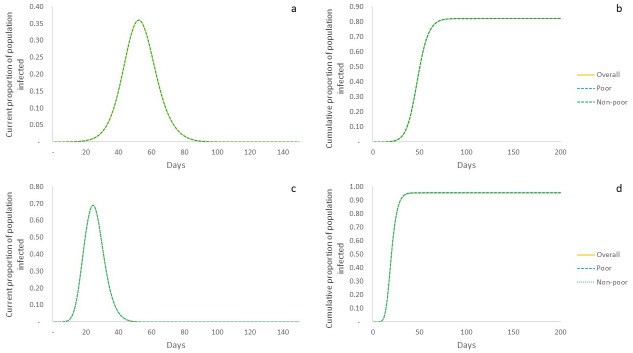
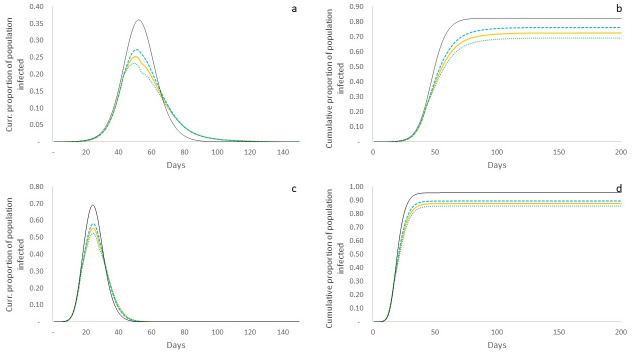
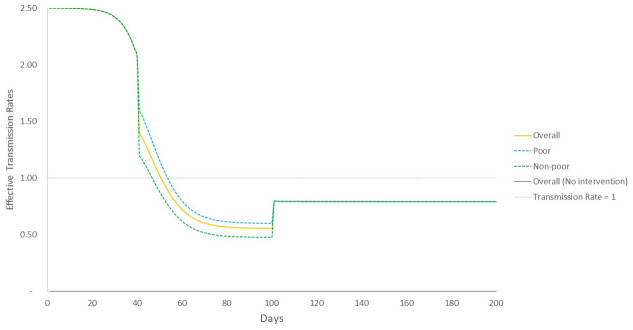
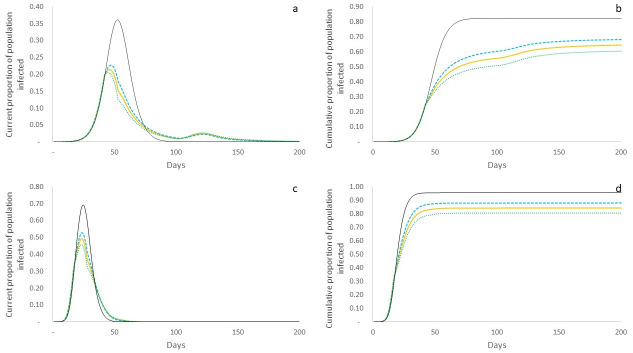
We create a network model to study the spread of an epidemic through physically proximate and accidental daily human contacts in a city, and simulate outcomes for two kinds of agents-poor and non-poor. Under non-intervention, peak caseload is maximised, but no differences are observed in infection rates across poor and non-poor. Introducing interventions to control spread, peak caseloads are reduced, but both cumulative infection rates and current infection rates are systematically higher for the poor than for non-poor, across all scenarios. Larger populations, higher fractions of poor, and longer durations of intervention are found to progressively worsen outcomes for the poor; and these are of particular concern for economically vulnerable populations in cities of the developing world. Addressing these challenges requires a deeper, more rigorous understanding of the relationships between structural poverty and epidemy, as well as effective utilization of extant community level infrastructure for primary care in developing cities. Finally, improving iniquitous outcomes for the poor creates better outcomes for the whole population, including the non-poor.
我们创建了一个网络模型,以研究城市中通过身体接近和偶然的日常人际接触传播的传染病,并对两种人群——贫困人口和非贫困人口——的结果进行模拟。在没有干预的情况下,发病高峰期的病例数达到最大值,但贫困人口和非贫困人口的感染率没有差异。引入控制传播的干预措施后,发病高峰期的病例数减少,但在所有情况下,贫困人口的累计感染率和当前感染率都比非贫困人口高。研究发现,人口规模更大、贫困人口比例更高、干预持续时间更长,都会使贫困人口的情况进一步恶化;而这对于发展中国家城市中经济脆弱的人群来说尤为令人担忧。要应对这些挑战,需要更深入、更严格地了解结构性贫困与传染病之间的关系,以及更有效地利用现有的社区一级初级保健基础设施。最后,改善贫困人口的不平等结果将为整个人口,包括非贫困人口,带来更好的结果。