Radiology Department, Hopital Cochin - AP-HP. Centre Université de Paris, 27 Rue du Faubourg Saint-Jacques, Paris 75014, France; Université de Paris, 85 boulevard Saint-Germain, Paris 75006, France; Inserm U1016, Institut Cochin, 22 rue Méchain, Paris 75014, France.
Université Paris-Saclay, CentraleSupélec, Mathématiques et Informatique pour la Complexité et les Systémes, Gif-sur-Yvette, France, 3 Rue Joliot Curie, Gif-sur-Yvette 91190, France; Inria Saclay, Gif-sur-Yvette 91190, France; Gustave Roussy-CentraleSupélec-TheraPanacea, Noesia Center of Artificial Intelligence in Radiation Therapy and Oncology, Gustave Roussy Cancer Campus, Villejuif, France.
Med Image Anal. 2021 Jan;67:101860. doi: 10.1016/j.media.2020.101860. Epub 2020 Oct 15.
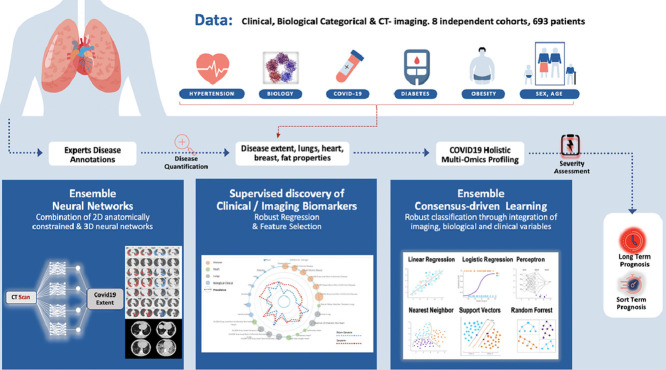
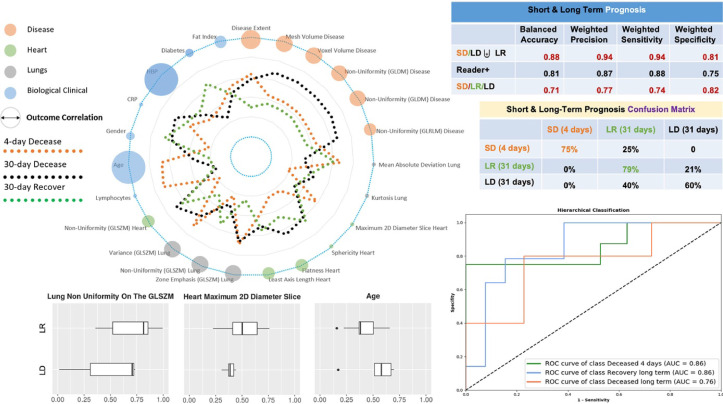
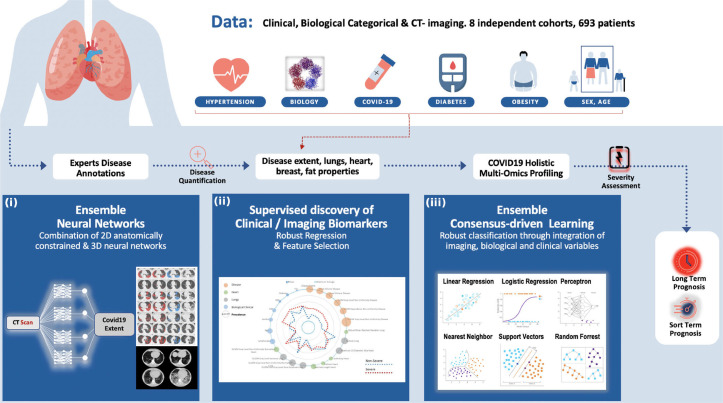
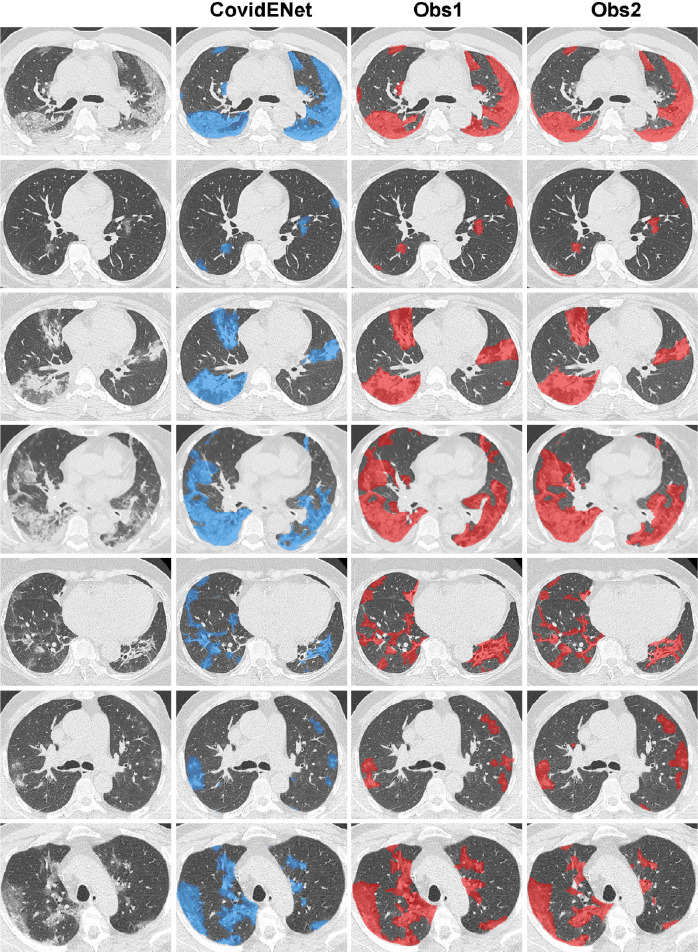
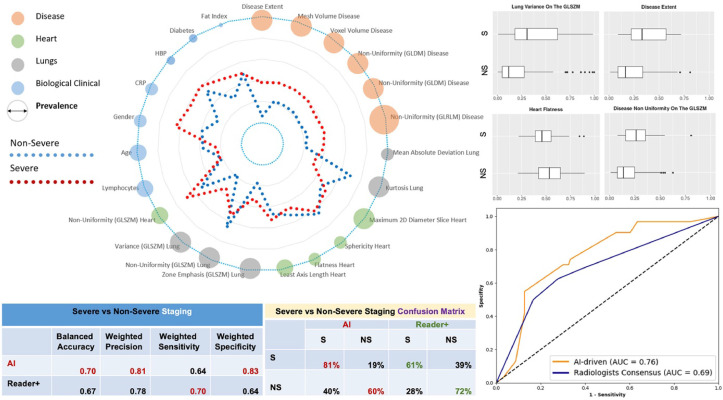
Coronavirus disease 2019 (COVID-19) emerged in 2019 and disseminated around the world rapidly. Computed tomography (CT) imaging has been proven to be an important tool for screening, disease quantification and staging. The latter is of extreme importance for organizational anticipation (availability of intensive care unit beds, patient management planning) as well as to accelerate drug development through rapid, reproducible and quantified assessment of treatment response. Even if currently there are no specific guidelines for the staging of the patients, CT together with some clinical and biological biomarkers are used. In this study, we collected a multi-center cohort and we investigated the use of medical imaging and artificial intelligence for disease quantification, staging and outcome prediction. Our approach relies on automatic deep learning-based disease quantification using an ensemble of architectures, and a data-driven consensus for the staging and outcome prediction of the patients fusing imaging biomarkers with clinical and biological attributes. Highly promising results on multiple external/independent evaluation cohorts as well as comparisons with expert human readers demonstrate the potentials of our approach.
2019 年出现的 2019 年冠状病毒病(COVID-19)在全球迅速传播。计算机断层扫描(CT)成像已被证明是筛查、疾病定量和分期的重要工具。后者对于组织预测(重症监护病房床位的可用性、患者管理计划)极其重要,并且通过快速、可重复和量化评估治疗反应来加速药物开发。即使目前尚无针对患者分期的特定指南,但仍会将 CT 与一些临床和生物学生物标志物一起使用。在这项研究中,我们收集了一个多中心队列,并研究了使用医学影像学和人工智能进行疾病定量、分期和预后预测。我们的方法依赖于使用基于深度学习的自动疾病定量,使用一组体系结构,并通过将成像生物标志物与临床和生物学属性融合来进行数据驱动的患者分期和预后预测的共识。在多个外部/独立评估队列上以及与专家人类读者的比较中,均获得了非常有前途的结果,证明了我们方法的潜力。