Department of Radiology and Radiologic Sciences, Division of Cardiothoracic Radiology, Medical University of South Carolina, Charleston, SC, USA.
Siemens Healthineers, Malvern, PA, USA.
BMC Infect Dis. 2022 Jul 21;22(1):637. doi: 10.1186/s12879-022-07617-7.
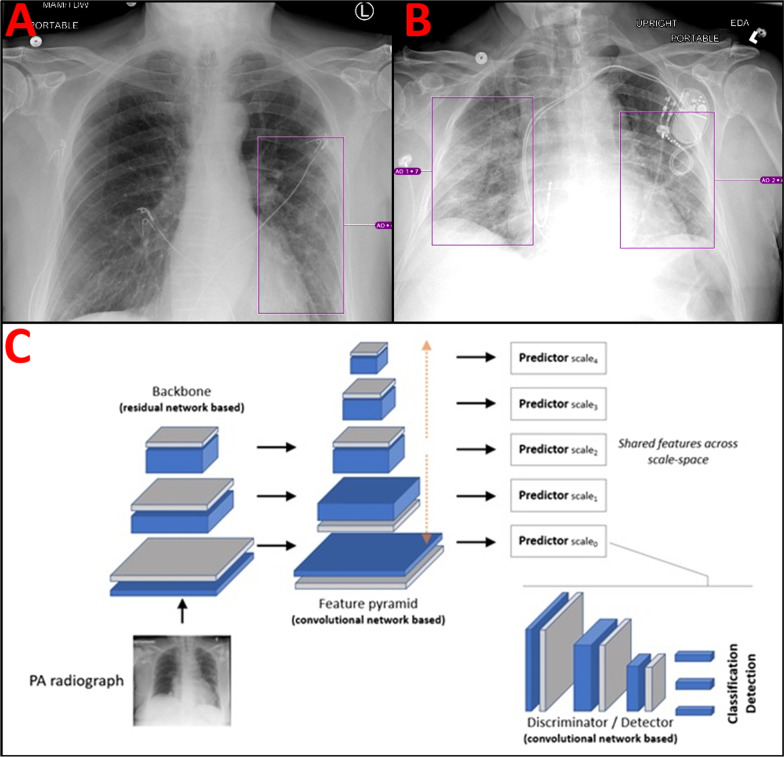
Airspace disease as seen on chest X-rays is an important point in triage for patients initially presenting to the emergency department with suspected COVID-19 infection. The purpose of this study is to evaluate a previously trained interpretable deep learning algorithm for the diagnosis and prognosis of COVID-19 pneumonia from chest X-rays obtained in the ED.
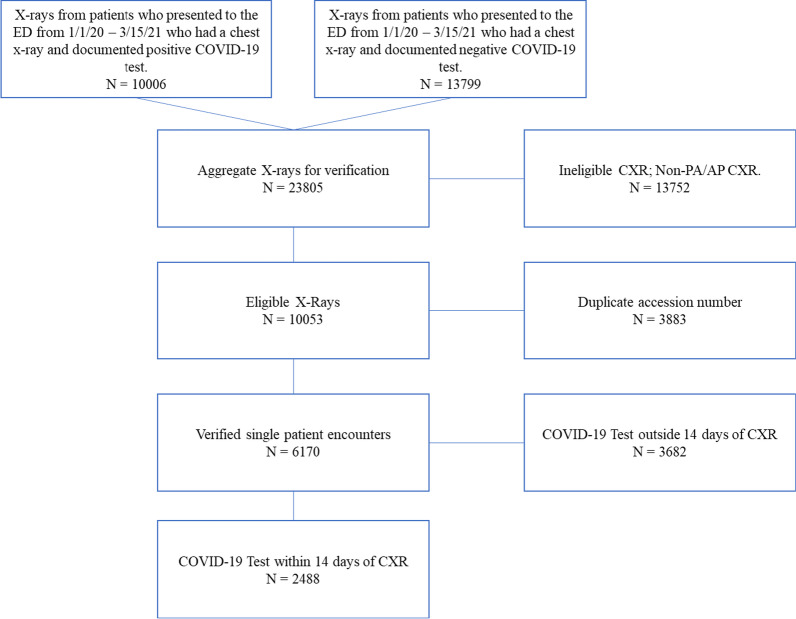
This retrospective study included 2456 (50% RT-PCR positive for COVID-19) adult patients who received both a chest X-ray and SARS-CoV-2 RT-PCR test from January 2020 to March of 2021 in the emergency department at a single U.S.
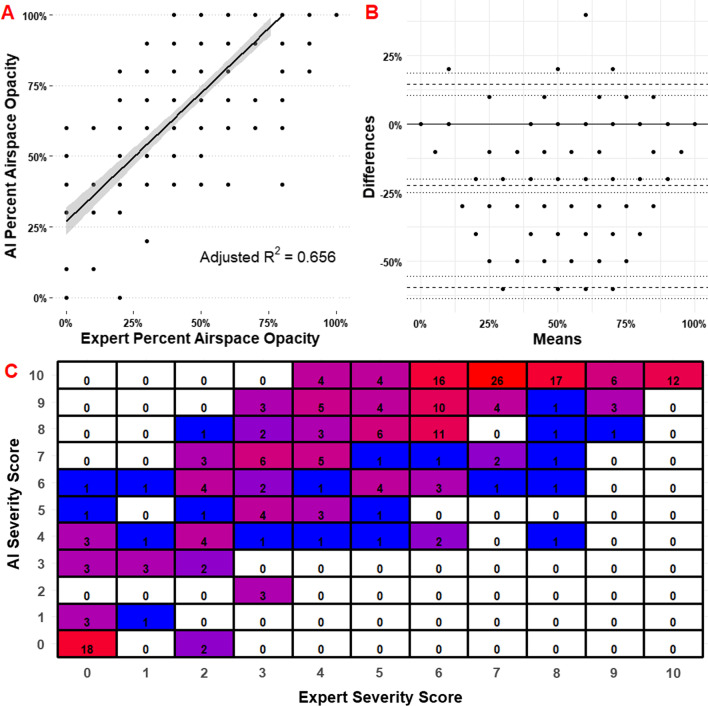
A total of 2000 patients were included as an additional training cohort and 456 patients in the randomized internal holdout testing cohort for a previously trained Siemens AI-Radiology Companion deep learning convolutional neural network algorithm. Three cardiothoracic fellowship-trained radiologists systematically evaluated each chest X-ray and generated an airspace disease area-based severity score which was compared against the same score produced by artificial intelligence. The interobserver agreement, diagnostic accuracy, and predictive capability for inpatient outcomes were assessed. Principal statistical tests used in this study include both univariate and multivariate logistic regression.
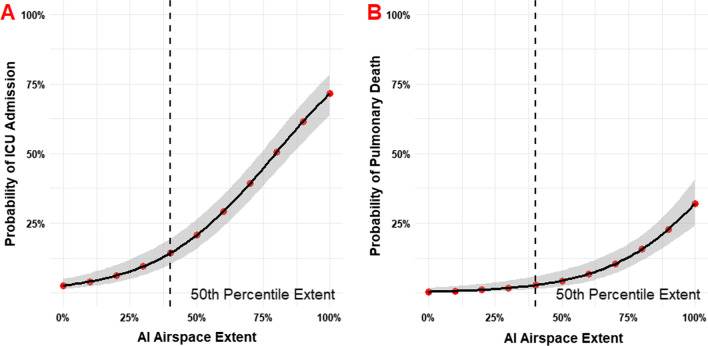
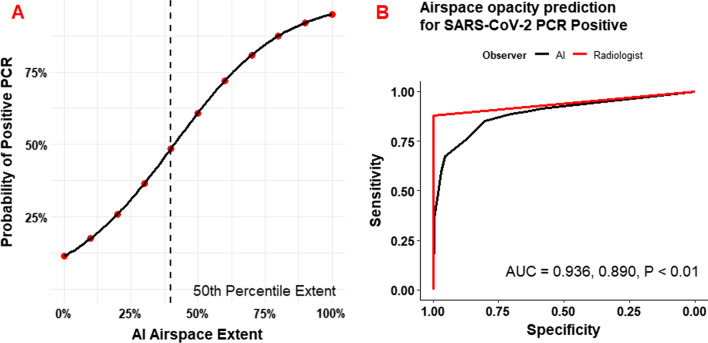
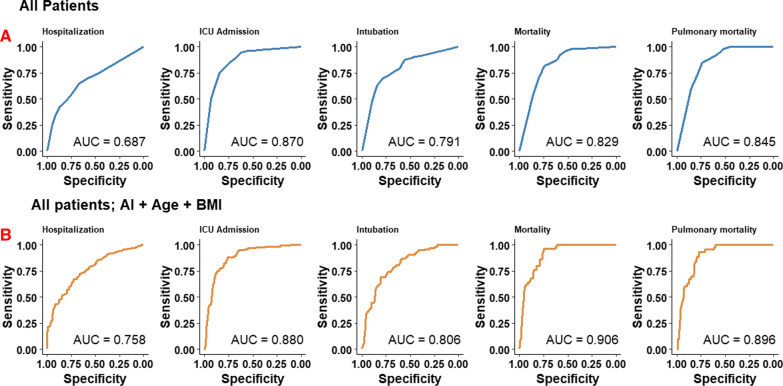
Overall ICC was 0.820 (95% CI 0.790-0.840). The diagnostic AUC for SARS-CoV-2 RT-PCR positivity was 0.890 (95% CI 0.861-0.920) for the neural network and 0.936 (95% CI 0.918-0.960) for radiologists. Airspace opacities score by AI alone predicted ICU admission (AUC = 0.870) and mortality (0.829) in all patients. Addition of age and BMI into a multivariate log model improved mortality prediction (AUC = 0.906).
The deep learning algorithm provides an accurate and interpretable assessment of the disease burden in COVID-19 pneumonia on chest radiographs. The reported severity scores correlate with expert assessment and accurately predicts important clinical outcomes. The algorithm contributes additional prognostic information not currently incorporated into patient management.
在胸部 X 光片上观察到的气腔疾病是对最初因疑似 COVID-19 感染而到急诊科就诊的患者进行分诊的一个重要要点。本研究的目的是评估之前经过训练的可解释深度学习算法,用于诊断和预测急诊科获得的 COVID-19 肺炎的胸部 X 光片。
本回顾性研究纳入了 2020 年 1 月至 2021 年 3 月期间在美国一家医院急诊科接受胸部 X 光检查和 SARS-CoV-2 RT-PCR 检测的 2456 名(50% RT-PCR 检测 COVID-19 阳性)成年患者。共纳入 2000 名患者作为额外的训练队列,456 名患者在随机内部保留测试队列中接受了之前经过训练的西门子 AI-Radiology Companion 深度学习卷积神经网络算法的测试。三名心胸科研究员对每一张胸部 X 光片进行了系统评估,并生成了基于气腔疾病面积的严重程度评分,该评分与人工智能生成的评分进行了比较。评估了观察者间的一致性、诊断准确性和住院患者结局的预测能力。本研究中使用的主要统计检验包括单变量和多变量逻辑回归。
总体 ICC 为 0.820(95% CI 0.790-0.840)。对于 SARS-CoV-2 RT-PCR 阳性,神经网络的诊断 AUC 为 0.890(95% CI 0.861-0.920),放射科医生的 AUC 为 0.936(95% CI 0.918-0.960)。仅使用 AI 进行的气腔混浊评分可预测所有患者的 ICU 入院(AUC=0.870)和死亡率(0.829)。将年龄和 BMI 纳入多变量 log 模型可改善死亡率预测(AUC=0.906)。
深度学习算法可对胸部 X 光片上 COVID-19 肺炎的疾病负担进行准确且可解释的评估。报告的严重程度评分与专家评估相关,可准确预测重要的临床结局。该算法提供了当前患者管理中未包含的额外预后信息。