Mental Health Research Center, 117152 Moscow, Russia.
Veltischev Research and Clinical Institute for Pediatrics of the Pirogov Russian National Research Medical University, Ministry of Health of Russian Federation, 125412 Moscow, Russia.
Int J Mol Sci. 2020 Nov 6;21(21):8328. doi: 10.3390/ijms21218328.
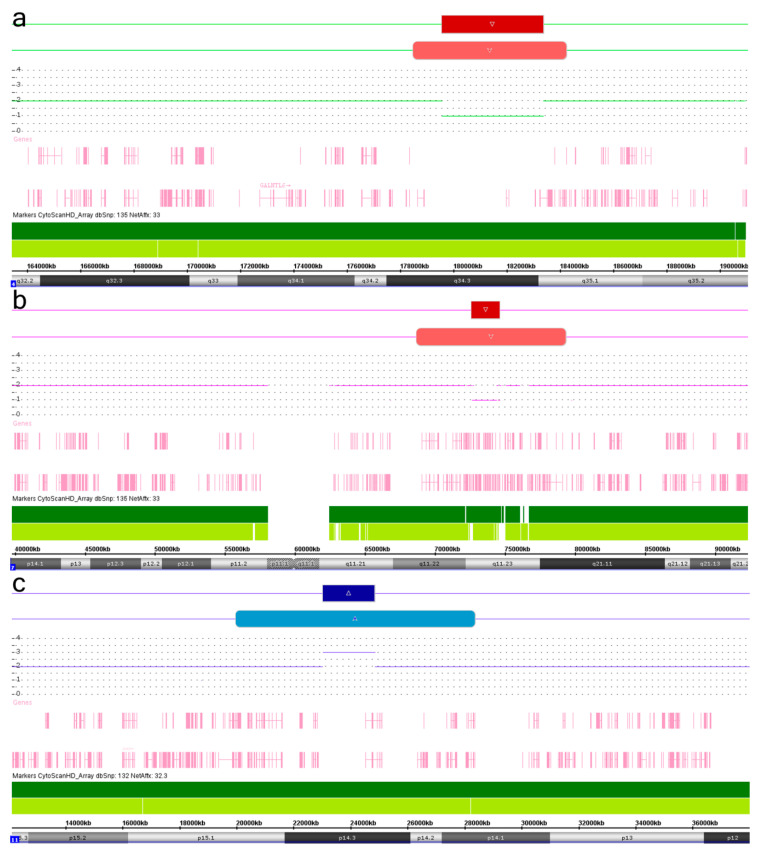
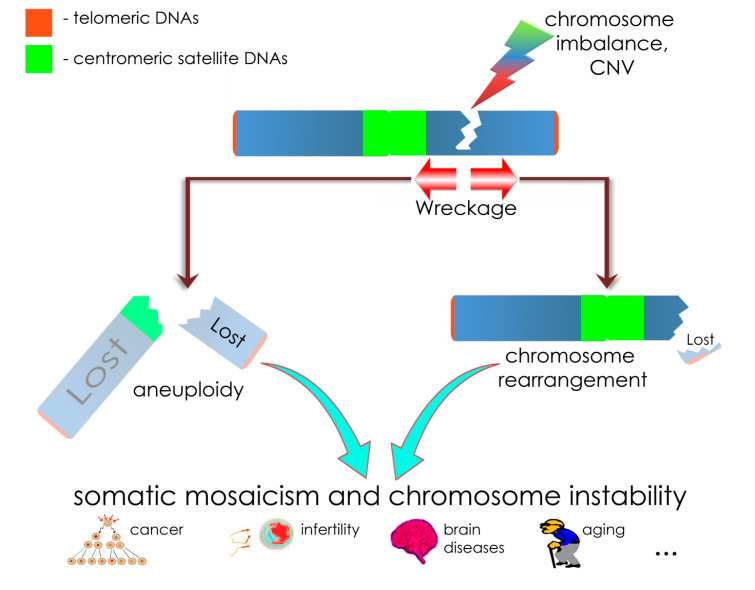
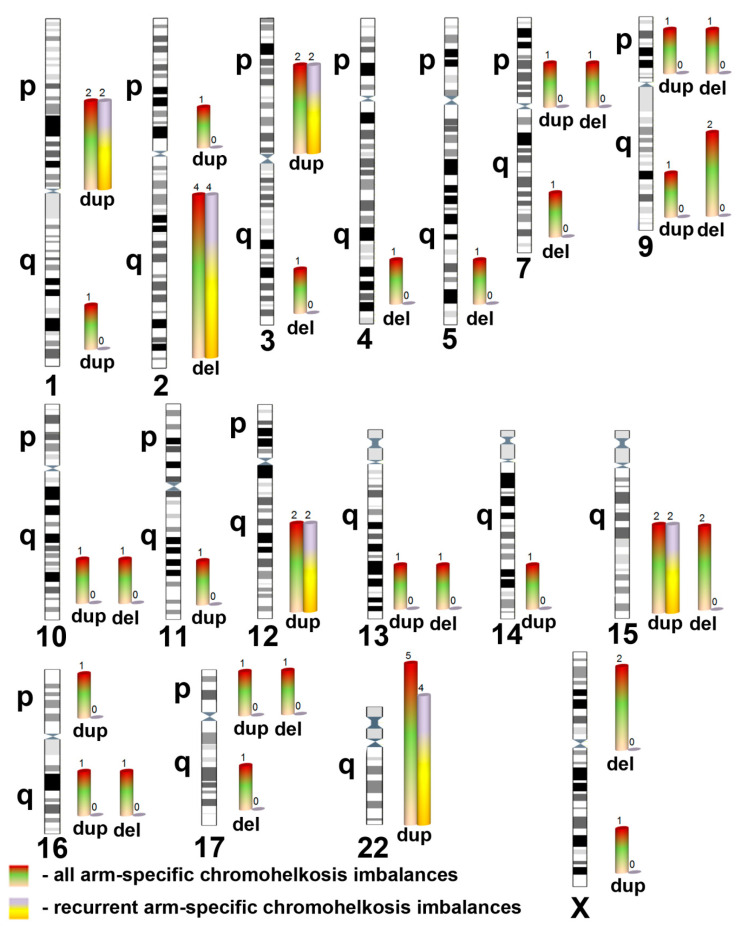
Mechanisms for somatic chromosomal mosaicism (SCM) and chromosomal instability (CIN) are not completely understood. During molecular karyotyping and bioinformatic analyses of children with neurodevelopmental disorders and congenital malformations ( = 612), we observed colocalization of regular chromosomal imbalances or copy number variations (CNV) with mosaic ones ( = 47 or 7.7%). Analyzing molecular karyotyping data and pathways affected by CNV burdens, we proposed a mechanism for SCM/CIN, which had been designated as "chromohelkosis" (from the Greek words chromosome ulceration/open wound). Briefly, structural chromosomal imbalances are likely to cause local instability ("wreckage") at the breakpoints, which results either in partial/whole chromosome loss (e.g., aneuploidy) or elongation of duplicated regions. Accordingly, a function for classical/alpha satellite DNA (protection from the wreckage towards the centromere) has been hypothesized. Since SCM and CIN are ubiquitously involved in development, homeostasis and disease (e.g., prenatal development, cancer, brain diseases, aging), we have metaphorically (ironically) designate the system explaining chromohelkosis contribution to SCM/CIN as the cytogenomic "theory of everything", similar to the homonymous theory in physics inasmuch as it might explain numerous phenomena in chromosome biology. Recognizing possible empirical and theoretical weaknesses of this "theory", we nevertheless believe that studies of chromohelkosis-like processes are required to understand structural variability and flexibility of the genome.
体细胞染色体嵌合(SCM)和染色体不稳定性(CIN)的机制尚不完全清楚。在对患有神经发育障碍和先天性畸形的儿童(= 612 例)进行分子核型分析和生物信息学分析时,我们观察到常规染色体不平衡或拷贝数变异(CNV)与嵌合(= 47 例或 7.7%)的共定位。通过分析分子核型分析数据和受 CNV 负担影响的途径,我们提出了一种 SCM/CIN 的机制,该机制被称为“chromohelkosis”(来自希腊语 chromosome ulceration/open wound)。简而言之,结构性染色体不平衡可能导致断点处的局部不稳定(“残骸”),从而导致部分/全部染色体丢失(例如非整倍体)或重复区域的延长。因此,人们假设了经典/alpha 卫星 DNA 的功能(防止残骸向着丝粒方向的损伤)。由于 SCM 和 CIN 广泛参与发育、内稳定和疾病(例如产前发育、癌症、脑部疾病、衰老),我们已经将解释 chromohelkosis 对 SCM/CIN 贡献的系统比喻性地(讽刺地)命名为细胞基因组的“万有理论”,类似于物理学中的同名理论,因为它可能解释了染色体生物学中的许多现象。尽管认识到这个“理论”可能存在经验和理论上的弱点,但我们仍然认为,需要研究类似于 chromohelkosis 的过程,以了解基因组的结构性变异性和灵活性。