Department of Zoology, Faculty of Biology and Biotechnology, University of Warmia and Mazury, M. Oczapowskiego St. 5, 10-718 Olsztyn, Poland.
Genes (Basel). 2020 Nov 6;11(11):1317. doi: 10.3390/genes11111317.
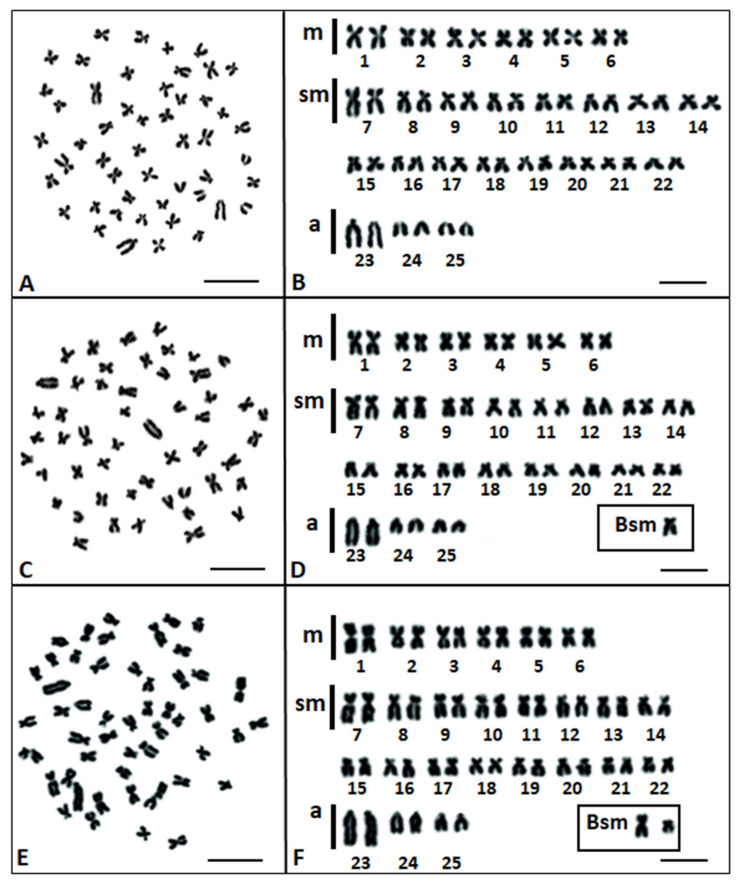
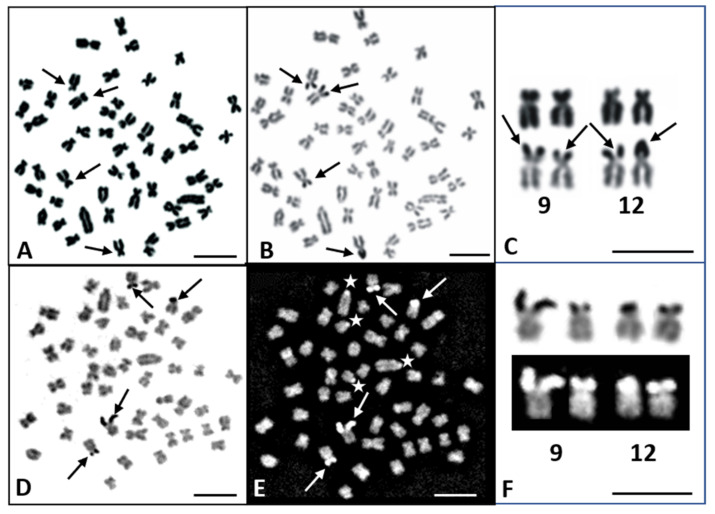
Supernumerary B chromosomes (Bs) are very promising structures, among others, in that they are an additional genomic compartment for evolution. In this study, we tested the presence and frequency of B chromosomes and performed the first cytogenetic examination of the common nase (). We investigated the individuals from two populations in the Vistula River basin, in Poland, according to the chromosomal distribution of the C-bands and silver nucleolar organizer regions (Ag-NORs), using sequential staining with AgNO and chromomycin A (CMA). Furthermore, we analyzed the chromosomal localization of two rDNA families (45S and 5S rDNA) using fluorescence in situ hybridization (FISH) with rDNA probes. individuals showed a standard (A) chromosome set consisting of 2 = 50: 12 metacentric, 32 submetacentric, and 6 acrocentric chromosomes ( = 94). Fourteen out of the 20 analyzed individuals showed 1-2 mitotically unstable submetacentric B chromosomes of different sizes. Six of them, in 14.1% of the analyzed metaphase plates, had a single, medium-sized submetacentric B (Bsm) chromosome (2 = 51) with a heterochromatic block located in its pericentromeric region. The other seven individuals possessed a Bsm (2 = 51) in 19.4% of the analyzed metaphase plates, and a second Bsm chromosome (2 = 52), the smallest in the set, in 15.5% of metaphase plates, whereas one female was characterized by both Bsm chromosomes (2 = 52) in 14.3% of the analyzed metaphase plates. AgNORs, GC-rich DNA sites, and 28S rDNA hybridization sites were observed in the short arms of two submetacentric chromosome pairs of A set. The constitutive heterochromatin was visible as C bands in the centromeric regions of almost all chromosomes and in the pericentromeric region of several chromosome pairs. Two 5S rDNA hybridization sites in the pericentromeric position of the largest acrocentric chromosome pair were observed, whereas two other such sites in co-localization on a smaller pair of NOR chromosomes indicate a species-specific character. The results herein broaden our knowledge in the field of B chromosome distribution and molecular cytogenetics of : a freshwater species from the Leuciscidae family.
额外的 B 染色体 (Bs) 是非常有前途的结构,尤其是因为它们是进化的另一个基因组区室。在这项研究中,我们测试了 B 染色体的存在和频率,并对普通 nase () 进行了首次细胞遗传学检查。我们根据 C 带和银核仁组织区 (Ag-NORs) 的染色体分布,对波兰维斯瓦河流域的两个种群的个体进行了研究,使用 AgNO 和 chromomycin A (CMA) 进行顺序染色。此外,我们使用 rDNA 探针的荧光原位杂交 (FISH) 分析了两个 rDNA 家族 (45S 和 5S rDNA) 的染色体定位。 个个体显示出标准的 (A) 染色体组,由 2 = 50 个组成:12 个着丝粒、32 个亚着丝粒和 6 个近端着丝粒染色体 (= 94)。在分析的 20 个个体中,有 14 个显示出 1-2 个有丝分裂不稳定的不同大小的亚着丝粒 B 染色体。其中 6 个个体在 14.1%的分析中期板中具有单个中等大小的亚着丝粒 B (Bsm) 染色体 (2 = 51),其着丝粒区域有一个异染色质块。其他 7 个个体在 19.4%的分析中期板中具有 Bsm (2 = 51),在 15.5%的中期板中具有最小的第二个 Bsm 染色体 (2 = 52),而一个雌性在 14.3%的分析中期板中具有两个 Bsm 染色体 (2 = 52)。AgNORs、富含 GC 的 DNA 位点和 28S rDNA 杂交位点在 A 组的两个亚着丝粒染色体对的短臂中观察到。组成型异染色质在几乎所有 染色体的着丝粒区域和几个染色体对的着丝粒区域作为 C 带可见。在最大的近端着丝粒染色体对的着丝粒位置观察到两个 5S rDNA 杂交位点,而在 NOR 染色体的较小对上的另两个共定位的杂交位点表明其具有种特异性。本研究结果拓宽了我们在 B 染色体分布和 Leuciscidae 科淡水物种的分子细胞遗传学领域的知识:一种普通 nase()。