Department of Aging and Longevity Research, Kumamoto University, Kumamoto, 860-0811, Japan.
Division of Immunobiology, Institute for Genetic Medicine, Hokkaido University, Hokkaido, 060-0815, Japan.
Sci Rep. 2020 Nov 10;10(1):19488. doi: 10.1038/s41598-020-74929-6.
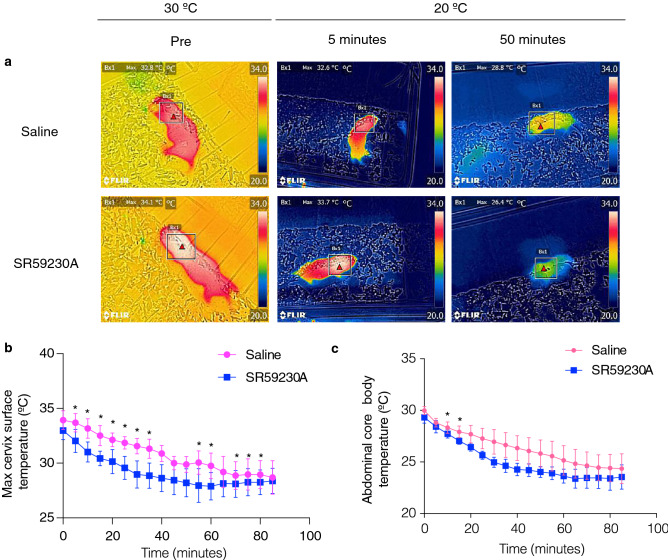
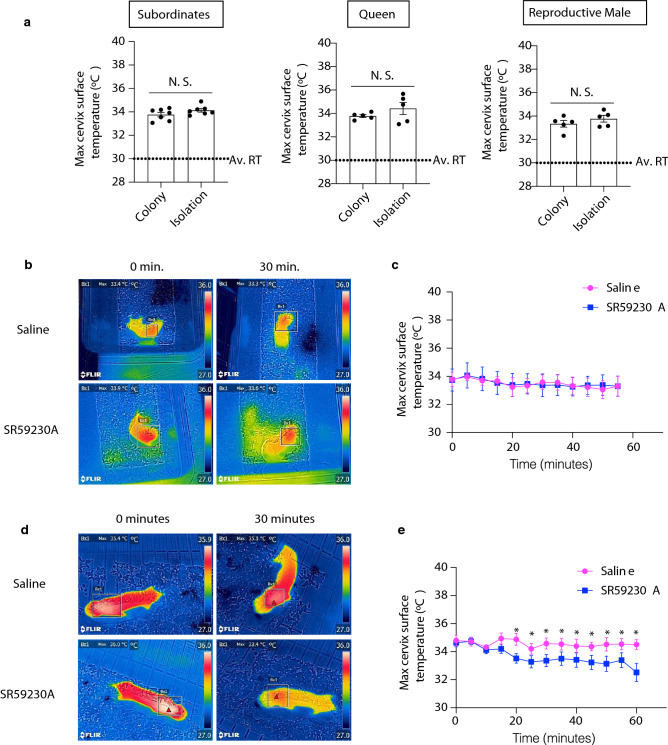
The naked mole-rat (NMR) is a heterothermic mammal that forms eusocial colonies consisting of one reproductive female (queen), several reproductive males, and subordinates. Despite their heterothermy, NMRs possess brown adipose tissue (BAT), which generally induces thermogenesis in cold and some non-cold environments. Previous studies suggest that NMR-BAT induces thermogenesis by cold exposure. However, detailed NMR-BAT characteristics and whether NMR-BAT thermogenesis occurs in non-cold environments are unknown. Here, we show beta-3 adrenergic receptor (ADRB3)-dependent thermogenic potential of NMR-BAT, which contributes to thermogenesis in the isolated queen in non-cold environments (30 °C). NMR-BAT expressed several brown adipocyte marker genes and showed noradrenaline-dependent thermogenic activity in vitro and in vivo. Although our ADRB3 inhibition experiments revealed that NMR-BAT thermogenesis slightly delays the decrease in body temperature in a cold environment (20 °C), it was insufficient to prevent the decrease in the body temperatures. Even at 30 °C, NMRs are known to prevent the decrease of and maintain their body temperature by heat-sharing behaviors within the colony. However, isolated NMRs maintained their body temperature at the same level as when they are in the colony. Interestingly, we found that queens, but not subordinates, induce BAT thermogenesis in this condition. Our research provides novel insights into NMR thermoregulation.
裸鼹鼠(NMR)是一种异温哺乳动物,形成由一个繁殖雌性(女王)、几个繁殖雄性和下属组成的真社会性群体。尽管它们是异温动物,但 NMR 拥有棕色脂肪组织(BAT),通常在寒冷和一些非寒冷环境中诱导产热。以前的研究表明,NMR-BAT 通过暴露于寒冷中来诱导产热。然而,NMR-BAT 的详细特征以及是否在非寒冷环境中发生 NMR-BAT 产热尚不清楚。在这里,我们展示了 NMR-BAT 的β-3 肾上腺素能受体(ADRB3)依赖性产热潜力,这有助于非寒冷环境(30°C)中孤立女王的产热。NMR-BAT 表达了几种棕色脂肪细胞标记基因,并表现出体外和体内去甲肾上腺素依赖性产热活性。尽管我们的 ADRB3 抑制实验表明,NMR-BAT 产热在寒冷环境(20°C)中略微延迟体温下降,但不足以防止体温下降。即使在 30°C,众所周知,NMR 通过群体内的热共享行为来防止体温下降并维持体温。然而,孤立的 NMR 能够保持与在群体中相同的体温水平。有趣的是,我们发现只有女王,而不是下属,在这种情况下会诱导 BAT 产热。我们的研究为 NMR 体温调节提供了新的见解。