1st Department of Cardiology, University of Medical Sciences in Poznan, Poznan, Poland.
Department of Clinical Nursing, Wroclaw Medical University, Wroclaw, Poland.
Clin Interv Aging. 2020 Nov 2;15:2041-2051. doi: 10.2147/CIA.S273967. eCollection 2020.
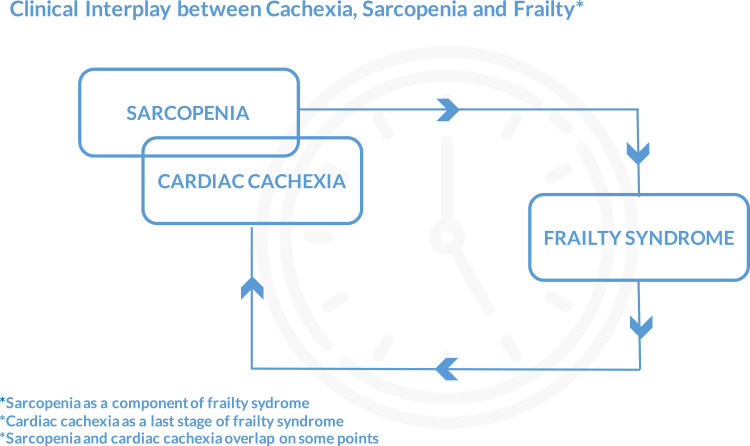
Heart failure (HF) is a common complication of various cardiac diseases, and its incidence constantly increases. This is caused mainly by aging of populations and improvement in the treatment of coronary artery disease. As HF patients age, they tend to develop comorbidities, creating new problems for health-care professionals. Sarcopenia, defined as the loss of muscle mass and function, and cachexia, defined as weight loss due to an underlying illness, are muscle wasting disorders of particular relevance in the heart failure population, but they go mostly unrecognized. The coexistence of chronic HF and metabolic disorders facilitates the development of cachexia. Cachexia, in turn, significantly worsens a patient's prognosis and quality of life. The mechanisms underlying cachexia have not been explained yet and require further research. Understanding its background is crucial in the development of treatment strategies to prevent and treat tissue wasting. There are currently no specific European guidelines or recommended therapy for cachexia treatment in HF ("cardiac cachexia").
心力衰竭(HF)是各种心脏疾病的常见并发症,其发病率不断增加。这主要是由于人口老龄化和冠状动脉疾病治疗的改善所致。随着 HF 患者年龄的增长,他们往往会出现合并症,这给医疗保健专业人员带来了新的问题。肌肉减少症定义为肌肉质量和功能的丧失,恶病质定义为由于潜在疾病导致的体重减轻,是心力衰竭人群中特别相关的肌肉消耗疾病,但它们大多未被识别。慢性 HF 和代谢紊乱的并存促进了恶病质的发展。恶病质反过来又显著恶化了患者的预后和生活质量。恶病质的发病机制尚未得到解释,需要进一步研究。了解其背景对于制定预防和治疗组织消耗的治疗策略至关重要。目前,HF(“心脏恶病质”)中没有针对恶病质治疗的具体欧洲指南或推荐疗法。