Stuijfzand Suzannah, Garthus-Niegel Susan, Horsch Antje
Faculty of Biology and Medicine, Institute of Higher Education and Research in Healthcare-IUFRS, University of Lausanne, Lausanne, Switzerland.
Department of Medicine, Faculty of Human Sciences, Medical School Hamburg, Hamburg, Germany.
Front Psychiatry. 2020 Sep 23;11:570727. doi: 10.3389/fpsyt.2020.570727. eCollection 2020.
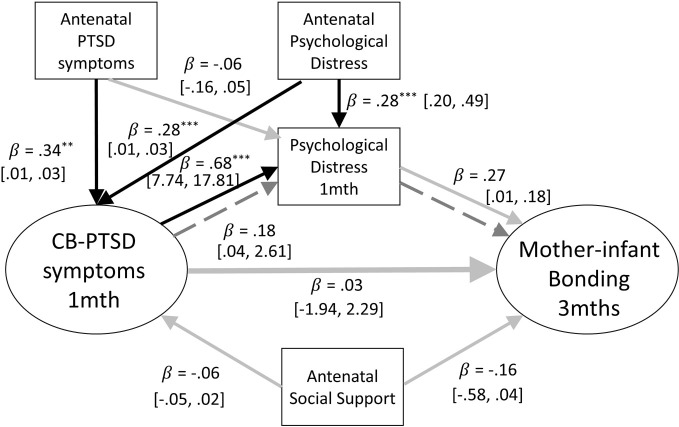
The parent-infant bond following childbirth is an important facilitator of optimal infant development. So far, research has mainly focused on mother-infant bonding. Data on fathers are still sparse. Parental mental health, such as posttraumatic stress symptoms (PTSD), may influence mother-infant relations and/or interactions. There is evidence that both parents can experience PTSD symptoms following childbirth (PTSD-CB). The aim of this study is to investigate the prospective relationship between parental PTSD-CB symptoms at 1 month postpartum and perceived parent-infant bonding at 3 months postpartum, while adjusting for antenatal confounders. A subsample was used for this study ( 488, = 356, = 132) of an ongoing prospective cohort study. Future parents awaiting their third trimester antenatal appointments at a Swiss university hospital were recruited. Self-report questionnaires assessed PTSD-CB symptoms and psychological distress at 1 month postpartum, and parent-infant bonding at 3 months postpartum. Confounders included antenatal PTSD symptoms and social support measured self-report questionnaires, and gestity and gestational age, extracted from medical records. Using structural equation modeling, the predictive ability of PTSD-CB symptoms at 1 month postpartum on parent-infant bonding at 3 months postpartum was assessed for both parents respectively. Maternal PTSD-CB symptoms at 1 month postpartum were found to be negatively prospectively associated with mother-infant bonding at 3 months postpartum; however, this effect disappeared after adjusting for psychological distress at 1 month postpartum. No such effects were found for fathers. There was no evidence of mediation of the relationship between parental PTSD-CB symptoms at 1 month postpartum and parental-infant bonding at 3 months postpartum psychological distress at 1 month postpartum. However, such a mediation was found for maternal intrusion and hyperarousal symptom subscales. Results expand the current literature on the impact of PTSD-CB on parent-child relations to also include fathers, and to a community sample. Any adverse effects of mental health symptoms on parent-infant bonding were evidenced by 3 months postpartum only for mothers, not fathers. Our results may inform the development of prevention/intervention strategies.
分娩后的亲子关系是促进婴儿最佳发育的重要因素。到目前为止,研究主要集中在母婴关系上。关于父亲的数据仍然很少。父母的心理健康,如创伤后应激症状(PTSD),可能会影响母婴关系和/或互动。有证据表明,父母双方在产后都可能出现创伤后应激障碍症状(产后创伤后应激障碍,PTSD-CB)。本研究的目的是在调整产前混杂因素的同时,调查产后1个月时父母的PTSD-CB症状与产后3个月时感知到的亲子关系之间的前瞻性关系。本研究使用了一项正在进行的前瞻性队列研究的子样本(n = 488,女性 = 356,男性 = 132)。招募了在瑞士大学医院等待孕晚期产前检查的准父母。通过自我报告问卷评估产后1个月时的PTSD-CB症状和心理困扰,以及产后3个月时的亲子关系。混杂因素包括通过自我报告问卷测量的产前PTSD症状和社会支持,以及从医疗记录中提取的孕周和胎龄。使用结构方程模型,分别评估了产后1个月时父母的PTSD-CB症状对产后3个月时亲子关系的预测能力。发现产后1个月时母亲的PTSD-CB症状与产后3个月时的母婴关系呈负向前瞻性关联;然而,在调整产后1个月时的心理困扰后,这种效应消失了。父亲则未发现此类效应。没有证据表明产后1个月时父母的PTSD-CB症状与产后3个月时的亲子关系之间的关系通过产后1个月时的心理困扰起中介作用。然而,在母亲的侵入和过度唤醒症状子量表中发现了这种中介作用。研究结果扩展了当前关于PTSD-CB对亲子关系影响的文献,将父亲也纳入其中,并涉及社区样本。心理健康症状对亲子关系的任何不利影响仅在产后3个月时在母亲中得到证实,父亲则未出现。我们的研究结果可能为预防/干预策略的制定提供参考。