Busa Vishal, Dardeir Ahmed, Marudhai Suganya, Patel Mauli, Valaiyaduppu Subas Sharathshiva, Ghani Mohammad R, Cancarevic Ivan
Internal Medicine, California Institute of Behavioral Neurosciences & Psychology, Fairfield, USA.
Internal Medicine/Family Medicine, California Institute of Behavioral Neurosciences & Psychology, Fairfield, USA.
Cureus. 2020 Oct 7;12(10):e10840. doi: 10.7759/cureus.10840.
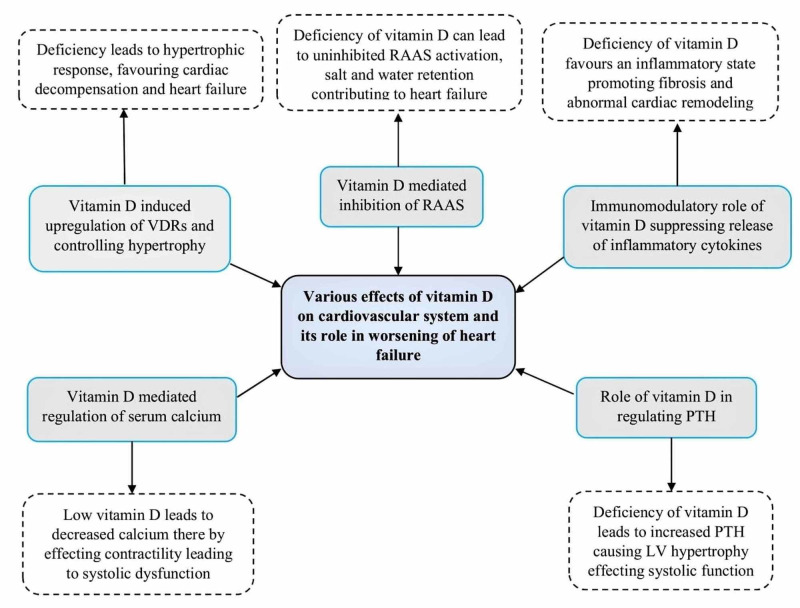
Vitamin D deficiency has become a global pandemic affecting approximately one billion people worldwide. Much attention has been paid to the association of low serum 25-hydroxyvitamin D (25(OH)D) levels and various chronic diseases, especially heart failure (HF). A clear role of vitamin D deficiency has been established, with increased mortality and morbidity in heart failures. However, previous randomized control trials have failed to show improvement in clinical outcomes with calciferol supplementation in these patients. Therefore, it is still unclear whether calciferol therapy can be added to the standard care in congestive heart failure (CHF) patients with deficiency. Hence, to evaluate the role of vitamin D supplementation in CHF patients with low serum 25(OH)D, we conducted an extensive search in the PubMed and Google Scholar databases using various combinations of keywords. All potentially eligible studies that evaluated the effects of vitamin D supplementation on clinical outcomes in HF patients were retrieved and extensively studied. We also checked the references of all eligible studies to identify additional relevant publications. In this study, we reviewed various mechanisms of vitamin D affecting the cardiovascular system and examined the impact of deficiency on heart failures in terms of mortality and hospitalizations. In conclusion, vitamin D supplementation has failed to improve the clinical outcomes in HF patients. The possible long-term benefits of supplementation cannot be excluded. Therefore, for future clinical trials, we recommend considering large sample sizes, longer follow-up durations, along with optimal dosage and appropriate dosing frequency.
维生素D缺乏已成为一场全球大流行疾病,影响着全球约10亿人。血清25-羟基维生素D(25(OH)D)水平低下与各种慢性疾病,尤其是心力衰竭(HF)之间的关联已受到广泛关注。维生素D缺乏的明确作用已经确立,心力衰竭患者的死亡率和发病率会增加。然而,先前的随机对照试验未能显示补充骨化醇可改善这些患者的临床结局。因此,对于维生素D缺乏的充血性心力衰竭(CHF)患者,是否可以在标准治疗中添加骨化醇治疗仍不清楚。因此,为了评估补充维生素D在血清25(OH)D水平低的CHF患者中的作用,我们在PubMed和谷歌学术数据库中使用各种关键词组合进行了广泛检索。检索并深入研究了所有评估补充维生素D对HF患者临床结局影响的潜在合格研究。我们还检查了所有合格研究的参考文献,以识别其他相关出版物。在本研究中,我们回顾了维生素D影响心血管系统的各种机制,并从死亡率和住院率方面研究了维生素D缺乏对心力衰竭的影响。总之,补充维生素D未能改善HF患者的临床结局。不能排除补充维生素D可能带来的长期益处。因此,对于未来的临床试验,我们建议考虑大样本量、更长的随访时间,以及最佳剂量和合适的给药频率。