School of Biological Sciences, University of Bristol, 24 Tyndall Avenue, Bristol, BS8 1TQ, UK.
Exp Appl Acarol. 2021 Jan;83(1):81-93. doi: 10.1007/s10493-020-00568-1. Epub 2020 Nov 11.
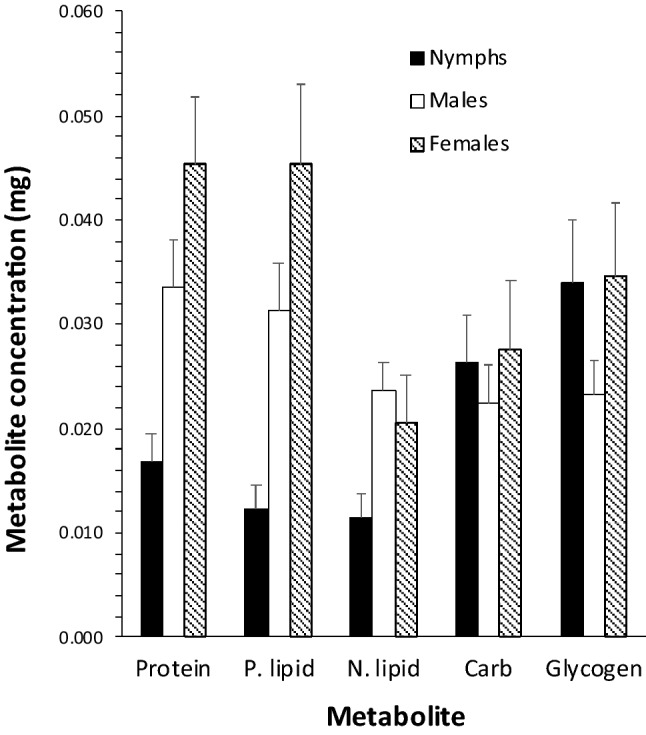
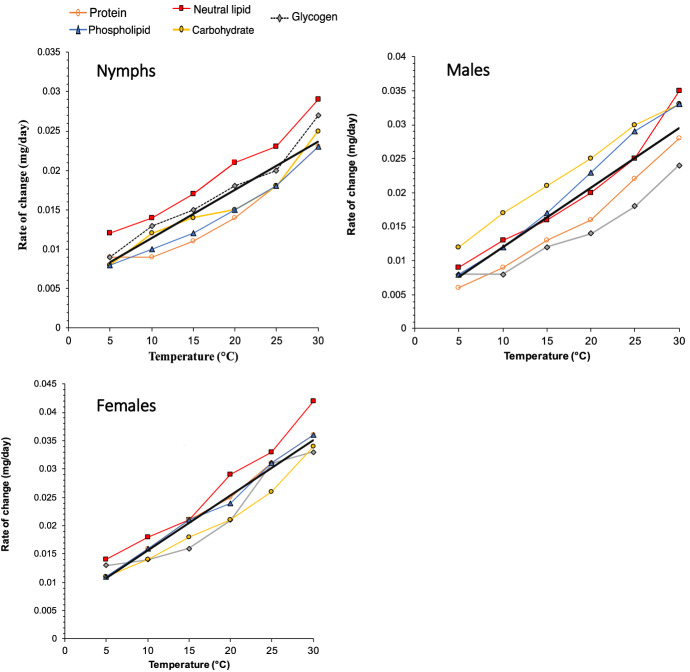
Understanding the effects of temperature on the metabolic activity and the rate of depletion of energy reserves by Ixodes ricinus can represent an important contribution to explaining patterns of tick activity and the likely impacts of environmental change on tick and tick-borne disease risk. Here, a cohort of I. ricinus nymphs, males, and females was collected and placed into incubators at temperatures of between 5 and 30 °C. The protein, carbohydrate, total lipid, neutral lipid, and glycogen levels were measured for nymphs for up to 70 days and adults up to 42 days. In nymphs, at day 0, glycogen was the most abundant metabolite followed by carbohydrate, with relatively low concentrations of protein and lipids. For males, the concentrations of different metabolites were relatively similar. In contrast, for females, concentrations of glycogen and carbohydrate were relatively low compared to those of protein and neutral lipids. Significant exponential declines in metabolite concentrations of all metabolites were detected over time for all life-cycle stages and at all temperatures. Nymphs generally showed lower rates of resource depletion than adults at all temperatures. The lower thresholds for metabolic activity were estimated to be between -10 and -5 °C. The Q values, which describe the thermal sensitivity of metabolic rate, were estimated to be relatively low (1.5 for nymphs, 1.71 for males, and 1.63 for females) compared to insects where they are typically around 2.5 (range: 1.5-3), and this is considered to be an adaptation to increase survival during the extended inter-feed intervals.
了解温度对硬蜱代谢活动和能量储备消耗率的影响,可以帮助我们更好地解释蜱的活动模式,以及环境变化对蜱和蜱传疾病风险的可能影响。在这里,我们收集了一批硬蜱若虫、雄蜱和雌蜱,并将它们放入温度在 5 到 30°C 之间的培养箱中。我们测量了若虫长达 70 天和成虫长达 42 天的蛋白质、碳水化合物、总脂质、中性脂质和糖原水平。在若虫中,在第 0 天,糖原是最丰富的代谢物,其次是碳水化合物,而蛋白质和脂质的浓度相对较低。对于雄蜱,不同代谢物的浓度相对相似。相比之下,对于雌蜱,糖原和碳水化合物的浓度与蛋白质和中性脂质相比相对较低。在所有的生命周期阶段和所有的温度下,我们都检测到所有代谢物的浓度随时间呈显著的指数下降。在所有温度下,若虫的资源消耗率通常低于成虫。代谢活性的较低阈值估计在-10 到-5°C 之间。描述代谢率热敏感性的 Q 值估计相对较低(若虫为 1.5,雄蜱为 1.71,雌蜱为 1.63),与通常在 2.5 左右(范围为 1.5-3)的昆虫相比,这被认为是一种适应,以增加在延长的非喂食间隔期间的生存能力。