From the Wellcome Trust Research Laboratory, Division of Gastrointestinal Sciences (S.N.R., N.P.N., V.T., S. Giri, I.P., S. Babji, S. Bidari, S. Senthamizh, G.K.), and the Department of Community Health (V.R.M.), Christian Medical College Vellore (T.J.K.J.), and Government Vellore Medical College (G.V.), Vellore, Kanchi Kamakoti Child Trust Hospital (B.S.), the National Institute of Epidemiology (G.K.C.P.), and the Institute of Child Health (P.D., M.J.), Chennai, Government Rajaji Hospital and Madurai Medical College, Madurai (K.M., H.B.), Coimbatore Medical College, Coimbatore (R.M., R. Gurusamy), the Indian Council of Medical Research, New Delhi (S. Giri, I.P., M.D.G.), Translational Health Science and Technology Institute, Faridabad (R.A., G.K.), Kurnool Medical College and Government General Hospital, Kurnool (S.M.), Government General Hospital and Rangaraya Medical College, Kakinada (K.B.G., B.R.), King George Hospital and Andhra Medical College, Visakhapatnam (P.P., R.P.G.), Sri Venkateshwara Medical College, Tirupati (M.B., V.M.), Sardar Valla Bhai Patel Post Graduate Institute of Paediatrics, Cuttack (S. Sathpathy, H.M.), the Institute of Medical Sciences and SUM Hospital, Bhubaneswar (M.D.), Kalinga Institute of Medical Sciences (N.K.M.) and Hi-Tech Hospital (R.K.R., P.M.), Bhubaneswar, Pandit Bhagwat Dayal Sharma Post Graduate Institute of Medical Sciences, Rohtak (G.G.), Shaheed Hasan Khan Mewati Government Medical College, Mewat (S.C.), Post Graduate Institute of Medical Education and Research, Chandigarh (M.G.), Sawai Man Singh Medical College, Jaipur (R. Gupta), Rabindranath Tagore Medical College, Udaipur (S. Goyal), Dr. Sampurnanand Medical College, Jodhpur (P.S.), Malankara Orthodox Syrian Church Medical College Hospital, Kolencherry (M.A.M.), Jawaharlal Nehru Institute of Post-graduate Medical Education and Research, Puducherry (S.K., A.S.), Mahatma Gandhi Memorial Medical College, Indore (H.J.), the Government Medical College, Guwahati, Assam (J.K.G.), King George Medical College, Lucknow (A.W.), and the Institute of Medical Sciences, Banaras Hindu University, Varanasi (V.G.) - all in India; and the Centers for Disease Control and Prevention, Atlanta (J.E.T., U.D.P.).
N Engl J Med. 2020 Nov 12;383(20):1932-1940. doi: 10.1056/NEJMoa2002276.
A three-dose, oral rotavirus vaccine (Rotavac) was introduced in the universal immunization program in India in 2016. A prelicensure trial involving 6799 infants was not large enough to detect a small increased risk of intussusception. Postmarketing surveillance data would be useful in assessing whether the risk of intussusception would be similar to the risk seen with different rotavirus vaccines used in other countries.
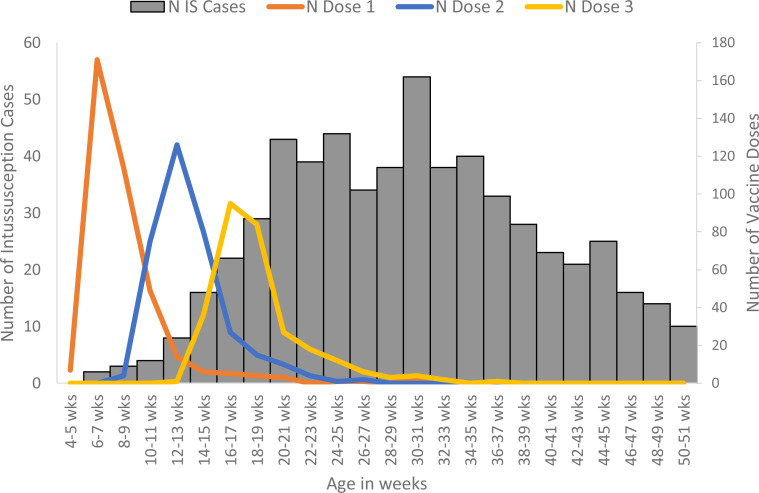
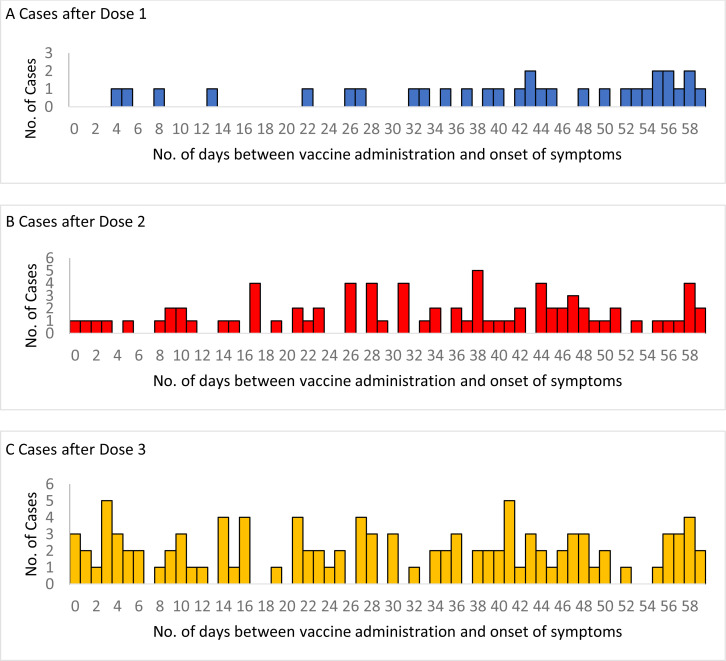
We conducted a multicenter, hospital-based, active surveillance study at 27 hospitals in India. Infants meeting the Brighton level 1 criteria of radiologic or surgical confirmation of intussusception were enrolled, and rotavirus vaccination was ascertained by means of vaccination records. The relative incidence (incidence during the risk window vs. all other times) of intussusception among infants 28 to 365 days of age within risk windows of 1 to 7 days, 8 to 21 days, and 1 to 21 days after vaccination was evaluated by means of a self-controlled case-series analysis. For a subgroup of patients, a matched case-control analysis was performed, with matching for age, sex, and location.
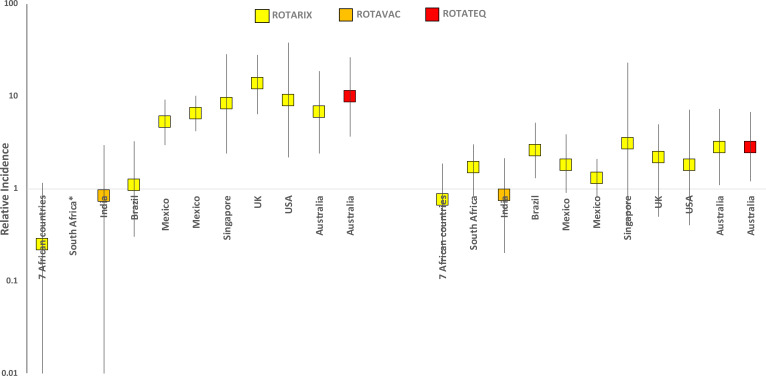
From April 2016 through June 2019, a total of 970 infants with intussusception were enrolled, and 589 infants who were 28 to 365 days of age were included in the self-controlled case-series analysis. The relative incidence of intussusception after the first dose was 0.83 (95% confidence interval [CI], 0.00 to 3.00) in the 1-to-7-day risk window and 0.35 (95% CI, 0.00 to 1.09) in the 8-to-21-day risk window. Similar results were observed after the second dose (relative incidence, 0.86 [95% CI, 0.20 to 2.15] and 1.23 [95% CI, 0.60 to 2.10] in the respective risk windows) and after the third dose (relative incidence, 1.65 [95% CI, 0.82 to 2.64] and 1.08 [95% CI, 0.69 to 1.73], respectively). No increase in intussusception risk was found in the case-control analysis.
The rotavirus vaccine produced in India that we evaluated was not associated with intussusception in Indian infants. (Funded by the Bill and Melinda Gates Foundation and others.).
2016 年,印度将三剂口服轮状病毒疫苗(Rotavac)纳入了全民免疫计划。涉及 6799 名婴儿的上市前试验规模不够大,无法发现肠套叠风险略有增加。上市后监测数据将有助于评估肠套叠的风险是否与在其他国家使用的不同轮状病毒疫苗的风险相似。
我们在印度的 27 家医院进行了一项多中心、基于医院的主动监测研究。符合放射学或手术确认肠套叠的布莱顿 1 级标准的婴儿被纳入研究,并通过疫苗接种记录确定轮状病毒疫苗接种情况。通过自我对照病例系列分析评估 28 至 365 天龄婴儿在接种后 1 至 7 天、8 至 21 天和 1 至 21 天的风险窗口内肠套叠的相对发病率(风险窗口内的发病率与所有其他时间的发病率相比)。对于患者的亚组,进行了匹配的病例对照分析,并按年龄、性别和地点进行匹配。
从 2016 年 4 月至 2019 年 6 月,共纳入了 970 例肠套叠婴儿,其中 589 例 28 至 365 天龄婴儿纳入了自我对照病例系列分析。第一剂后肠套叠的相对发病率在 1 至 7 天的风险窗口为 0.83(95%置信区间[CI],0.00 至 3.00),在 8 至 21 天的风险窗口为 0.35(95%CI,0.00 至 1.09)。第二剂和第三剂后的结果相似(分别在相应的风险窗口中为 0.86[95%CI,0.20 至 2.15]和 1.23[95%CI,0.60 至 2.10],1.65[95%CI,0.82 至 2.64]和 1.08[95%CI,0.69 至 1.73])。病例对照分析未发现肠套叠风险增加。
我们评估的印度生产的轮状病毒疫苗与印度婴儿的肠套叠无关。(由比尔和梅琳达盖茨基金会及其他机构资助)。