Department of Oncology, Affiliated Zhongshan Hospital, Dalian University, Dalian, People's Republic of China.
Department of Gynecology, The 2nd Affiliated Hospital of Dalian Medical University, Dalian, People's Republic of China.
Technol Cancer Res Treat. 2020 Jan-Dec;19:1533033820971669. doi: 10.1177/1533033820971669.
Evidence has been shown that long noncoding RNAs (lncRNAs) play an important role in the development of cervical cancer. Recently, lncRNA DARS-AS1 was shown to be dysregulated in several cancer types, but the role of DARS-AS1 in cervical cancer remains unclear.
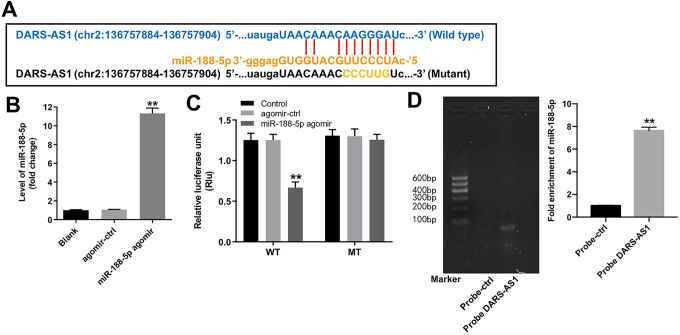
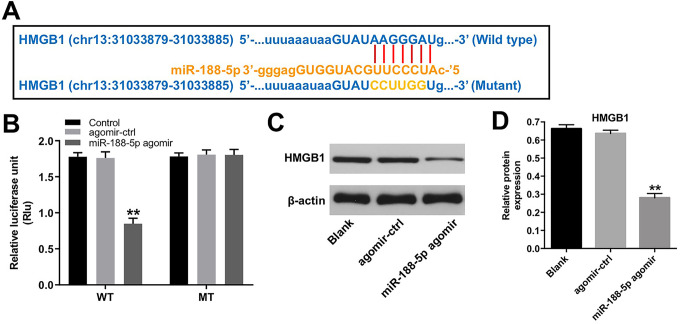
Immunofluorescence staining, flow cytometry and transwell invasion assays were used to determine proliferation, apoptosis and invasion in cervical cancer cells, respectively. The dual luciferase reporter system assay was performed to assess the interaction between DARS-AS1, miR-188-5p, and high mobility group box 1 (HMGB1) in cervical cancer cells.
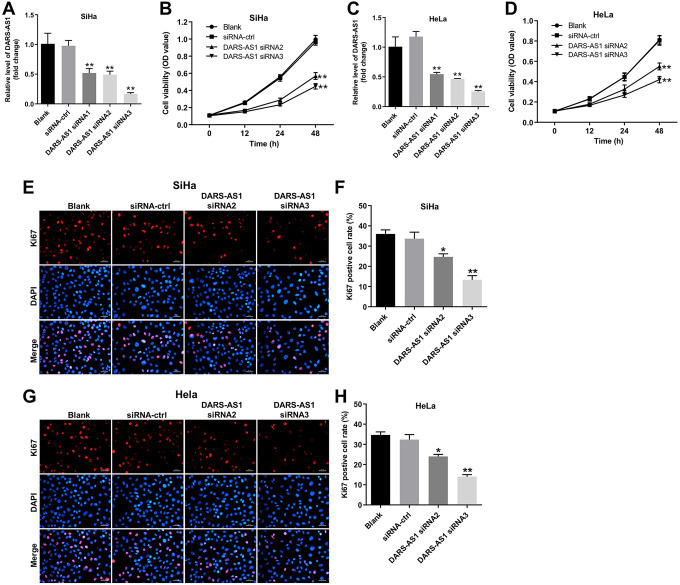
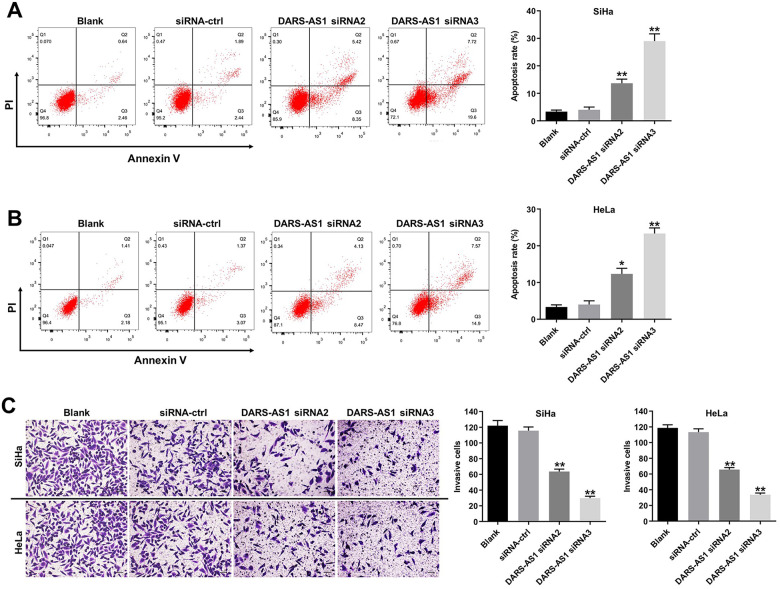
Downregulation of DARS-AS1 markedly inhibited the proliferation and invasion of cervical cancer cells. Moreover, DARS-AS1 knockdown obviously induced the apoptosis of SiHa and HeLa cells. Meanwhile, luciferase reporter assay identified that miR-188-5p was the potential miRNA binding of DARS-AS1, and HMGB1 was the potential binding target of miR-188-5p. Mechanistic analysis indicated that downregulation of DARS-AS1 decreased the expression of HMGB1 by acting as a competitive "sponge" of miR-188-5p.
In this study, we found that DARS-AS1 knockdown suppressed the growth of cervical cancer cells via downregulating HMGB1 via sponging miR-188-5p. Therefore, DARS-AS1 might serve as a potential target for the treatment of cervical cancer.
有证据表明,长非编码 RNA(lncRNA)在宫颈癌的发展中发挥着重要作用。最近,lncRNA DARS-AS1 在几种癌症类型中表现出失调,但 DARS-AS1 在宫颈癌中的作用尚不清楚。
免疫荧光染色、流式细胞术和 Transwell 侵袭实验分别用于确定宫颈癌细胞的增殖、凋亡和侵袭。双荧光素酶报告系统实验用于评估宫颈癌细胞中 DARS-AS1、miR-188-5p 和高迁移率族蛋白 B1(HMGB1)之间的相互作用。
下调 DARS-AS1 明显抑制了宫颈癌细胞的增殖和侵袭。此外,DARS-AS1 敲低明显诱导了 SiHa 和 HeLa 细胞的凋亡。同时,荧光素酶报告实验鉴定出 miR-188-5p 是 DARS-AS1 的潜在 miRNA 结合物,HMGB1 是 miR-188-5p 的潜在结合靶标。机制分析表明,下调 DARS-AS1 通过作为 miR-188-5p 的竞争性“海绵”来降低 HMGB1 的表达。
在这项研究中,我们发现 DARS-AS1 敲低通过海绵 miR-188-5p 下调 HMGB1 抑制了宫颈癌细胞的生长。因此,DARS-AS1 可能成为治疗宫颈癌的潜在靶点。