Division of Infectious Diseases, University of North Carolina at Chapel Hill, Chapel Hill, North Carolina, 27599, USA.
Department of Community Health, Faculty of Medicine, Mbarara University of Science & Technology, Mbarara, Uganda.
BMC Infect Dis. 2020 Nov 11;20(1):835. doi: 10.1186/s12879-020-05568-5.
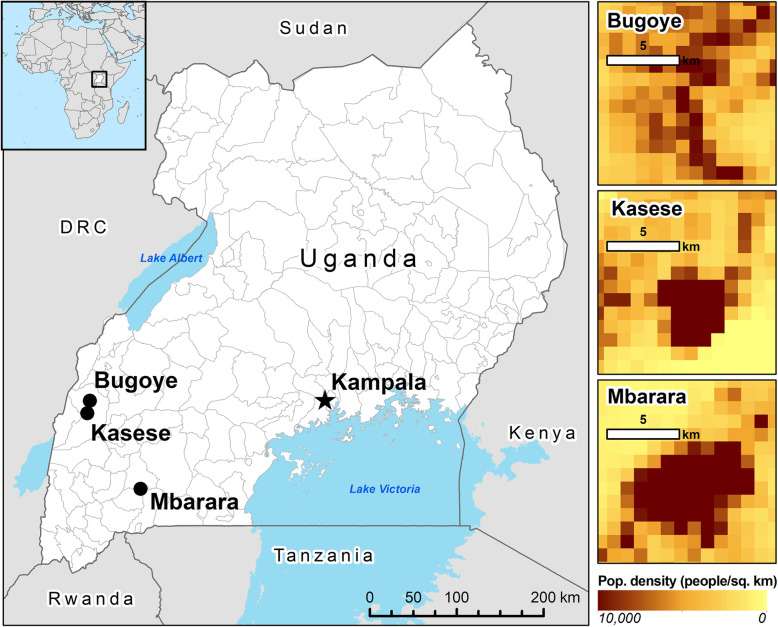
The spatial distribution and burden of dengue in sub-Saharan Africa remains highly uncertain, despite high levels of ecological suitability. The goal of this study was to describe the epidemiology of dengue among a cohort of febrile children presenting to outpatient facilities located in areas of western Uganda with differing levels of urbanicity and malaria transmission intensity.
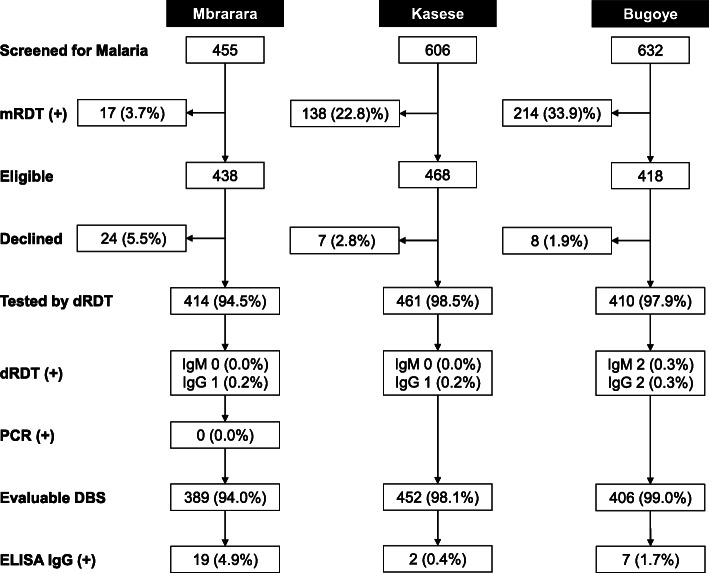
Eligible children were first screened for malaria using rapid diagnostic tests. Children with a negative malaria result were tested for dengue using a combination NS1/IgM/IgG rapid test (SD Bioline Dengue Duo). Confirmatory testing by RT-PCR was performed in a subset of participants. Antigen-capture ELISA was performed to estimate seroprevalence.
Only 6 of 1416 (0.42%) children had a positive dengue rapid test, while none of the RT-PCR results were positive. ELISA testing demonstrated reactive IgG antibodies in 28 (2.2%) participants with the highest prevalence seen at the urban site in Mbarara (19 of 392, 4.9%, p < 0.001).
Overall, these findings suggest that dengue, while present, is an uncommon cause of non-malarial, pediatric febrile illness in western Uganda. Further investigation into the eocological factors that sustain low-level transmission in urban settings are urgently needed to reduce the risk of epidemics.
尽管生态适宜性很高,但撒哈拉以南非洲的登革热空间分布和负担仍然高度不确定。本研究的目的是描述乌干达西部门诊就诊的发热儿童中登革热的流行病学情况,这些地区的城市化和疟疾传播强度存在差异。
首先使用快速诊断检测对合格儿童进行疟疾筛查。对疟疾结果为阴性的儿童使用 NS1/IgM/IgG 联合快速检测(SD Bioline Dengue Duo)进行登革热检测。在部分参与者中进行 RT-PCR 确认检测。使用抗原捕获 ELISA 来估计血清流行率。
在 1416 名儿童中,只有 6 名(0.42%)儿童的登革热快速检测呈阳性,而 RT-PCR 结果均为阴性。ELISA 检测显示 28 名(2.2%)参与者的 IgG 抗体呈反应性,在姆巴拉拉市的城市点观察到最高的流行率(392 名中的 19 名,4.9%,p<0.001)。
总的来说,这些发现表明,在乌干达西部,虽然存在登革热,但它是儿童非疟疾性发热的罕见原因。迫切需要进一步调查维持城市低水平传播的生态因素,以降低流行的风险。