The Australian Centre for Public and Population Health Research, Faculty of Health, University of Technology Sydney, Sydney, Australia.
BMC Pregnancy Childbirth. 2020 Nov 11;20(1):682. doi: 10.1186/s12884-020-03339-3.
sub-Saharan African Low and Lower-Middle Income Countries (sSA LLMICs) have the highest burden of maternal and perinatal morbidity and mortality in the world. Timely and appropriate maternal referral to a suitable health facility is an indicator of effective health systems. In this systematic review we aimed to identify which referral practices are delivered according to accepted standards for pregnant women and newborns in sSA LLMICs by competent healthcare providers in line with the needs of pregnant women.
Six electronic databases were systematically searched for primary data studies (2009-2018) in English reporting on maternal referral practices and their effectiveness. We conducted a content analysis guided by a framework for assessing the quality of maternal referral. Quality referral was defined as: timely identification of signal functions, established guidelines or standards, adequate documentation, staff accompaniment and prompt care by competent healthcare providers in the receiving facility.
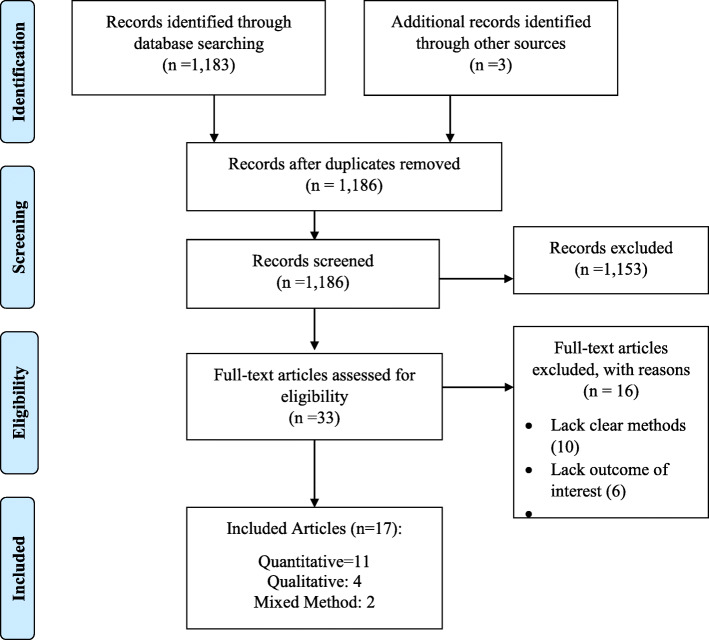
Seventeen articles were included in the study. Most studies were quantitative (n = 11). Two studies reported that women were dissatisfied due to delays in referral processes that affected their health. Most articles (10) reported that women were not accompanied to higher levels of care, delays in referral processes, transport challenges and poor referral documentation. Some healthcare providers administered essential drugs such as misoprostol prior to referral.
Efforts to improve maternal health in LLMICs should aim to enhance maternity care providers' ability to identify conditions that demand referral. Low cost transport is needed to mitigate barriers of referral. To ensure quality maternal referral, district level health managers should be trained and equipped with the skills needed to monitor and evaluate referral documentation, including quality and efficiency of maternal referrals.
Systematic review registration: PROSPERO registration CRD42018114261 .
撒哈拉以南非洲低收入和中低收入国家(sSA LLMICs)是全球孕产妇和围产期发病率和死亡率最高的地区。及时、适当的孕产妇向合适医疗机构转诊是有效卫生系统的一个指标。在这项系统评价中,我们旨在确定符合孕产妇需求的合格医疗保健提供者按照公认的标准为孕妇和新生儿提供的转诊实践。
系统地检索了 6 个电子数据库,以寻找 2009 年至 2018 年期间以英文发表的关于孕产妇转诊实践及其效果的原始数据研究。我们根据评估孕产妇转诊质量的框架进行了内容分析。优质转诊被定义为:及时识别信号功能、建立指南或标准、充分的文件记录、工作人员陪同以及接收机构的合格医疗保健提供者的及时护理。
研究共纳入 17 篇文章。大多数研究为定量研究(n=11)。有两项研究报告称,由于转诊流程延迟影响了妇女的健康,她们对此感到不满。大多数文章(10 篇)报告称,妇女没有被陪同到更高层次的医疗机构,转诊流程延迟,交通困难和转诊文件记录不良。一些医疗保健提供者在转诊前给孕妇使用了米索前列醇等基本药物。
为改善中低收入国家的孕产妇健康而进行的努力应旨在提高产科护理提供者识别需要转诊的条件的能力。需要低成本的交通来减轻转诊障碍。为了确保优质的孕产妇转诊,应培训地区一级的卫生管理人员并为其配备所需的技能,以监测和评估转诊文件,包括孕产妇转诊的质量和效率。
系统评价注册:PROSPERO 注册 CRD42018114261。