Schneider Lisa K, Anestis Konstantinos, Mansour Joost, Anschütz Anna A, Gypens Nathalie, Hansen Per J, John Uwe, Klemm Kerstin, Martin Jon Lapeya, Medic Nikola, Not Fabrice, Stolte Willem
Deltares, Delft, Netherlands Deltares Delft Netherlands.
Université Libre de Bruxelles, Bruxelles, Belgium Université Libre de Bruxelles Bruxelles Belgium.
Biodivers Data J. 2020 Oct 23;8:e56648. doi: 10.3897/BDJ.8.e56648. eCollection 2020.
An important functional trait of organisms is their trophic mode. It determines their position within food webs, as well as their function within an ecosystem. For the better part of the 20 century, aquatic protist communities were thought to consist mainly of producers (phytoplankton) and consumers (protozooplankton). Phytoplankton cover their energy requirements through photosynthesis (phototrophy), while protozooplankton graze on prey and organic particles (phagotrophy). However, over the past decades, it was shown that another trophic group (mixoplankton) comprise a notable part of aquatic protist communities. Mixoplankton employ a third trophic mode by combining phototrophy and phagotrophy (mixotrophy). Due to the historical dichotomy, it is not straightforward to gain adequate and correct information on the trophic mode of aquatic protists. Long hours of literature research or expert knowledge are needed to correctly assign trophic modes. Additionally, aquatic protists also have a long history of undergoing taxonomic changes which make it difficult to compare past and present literature. While WoRMS, the World Register of Marine Species, keeps track of the taxonomic changes and assigns each species a unique AphiaID that can be linked to its various historic and present taxonomic hierarchy, there is currently no machine-readable database to query aquatic protists for their trophic modes.
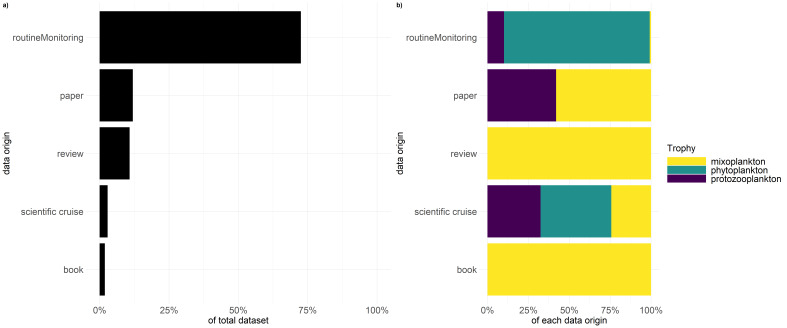
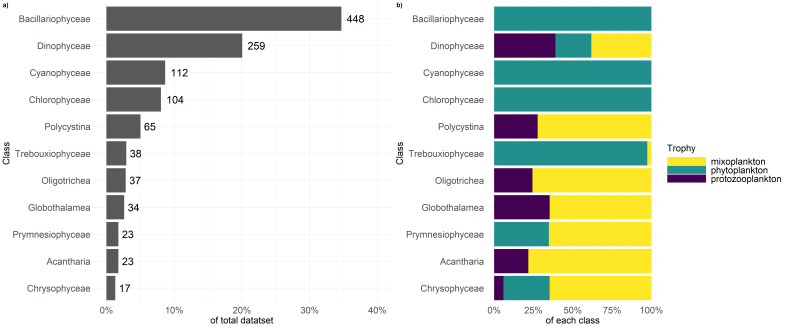
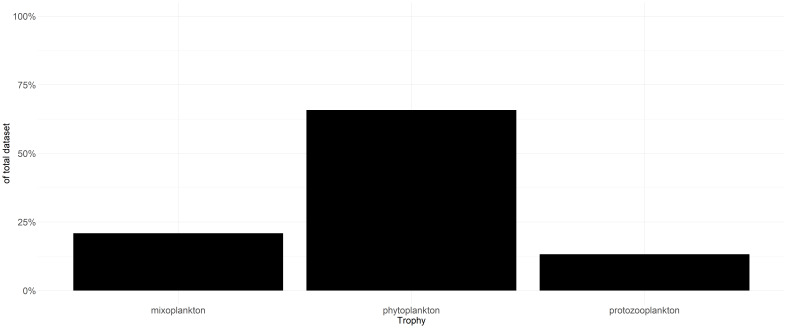
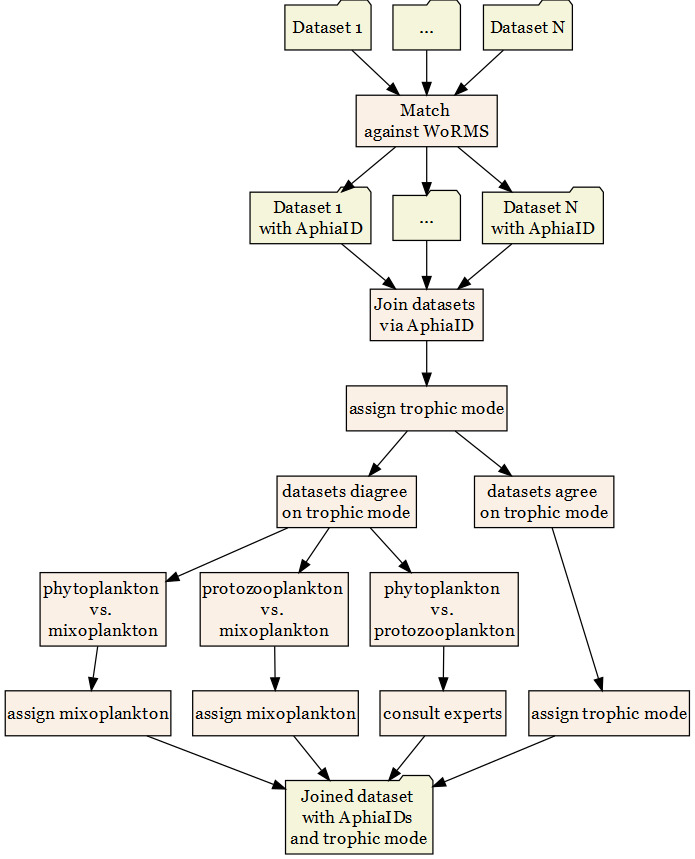
This paper describes a dataset that was submitted to WoRMS and links aquatic protist taxa, with a focus on marine taxa, to their AphiaID and their trophic mode. The bulk of the data used for this dataset stems from (routine) monitoring stations in the North Sea and the Baltic Sea. The data were augmented and checked against state-of-the-art knowledge on mixoplankton taxa by consulting literature and experts. Thus, this dataset provides a first attempt to make the trophic mode of aquatic protists easily accessible in both a human- and machine-readable format.
生物体的一个重要功能特性是其营养模式。它决定了生物体在食物网中的位置以及在生态系统中的功能。在20世纪的大部分时间里,水生原生生物群落被认为主要由生产者(浮游植物)和消费者(原生浮游动物)组成。浮游植物通过光合作用(光养)满足其能量需求,而原生浮游动物则以猎物和有机颗粒为食(吞噬营养)。然而,在过去几十年中,研究表明另一个营养群体(混合营养浮游生物)在水生原生生物群落中占显著比例。混合营养浮游生物通过结合光养和吞噬营养(混合营养)采用第三种营养模式。由于历史上的二分法,要获得关于水生原生生物营养模式的充分且正确的信息并非易事。需要长时间的文献研究或专家知识才能正确确定营养模式。此外,水生原生生物在分类学上也经历了长期的变化,这使得难以比较过去和现在的文献。虽然世界海洋物种登记册(WoRMS)跟踪分类学变化并为每个物种分配一个唯一的AphiaID,该ID可与其各种历史和当前的分类层次结构相关联,但目前尚无机器可读数据库来查询水生原生生物的营养模式。
本文描述了一个提交给WoRMS的数据集,该数据集将水生原生生物分类群(重点是海洋分类群)与其AphiaID和营养模式相关联。用于此数据集的大部分数据来自北海和波罗的海的(常规)监测站。通过查阅文献和咨询专家,对数据进行了扩充并对照关于混合营养浮游生物分类群的最新知识进行了核对。因此,该数据集首次尝试以人类可读和机器可读的格式使水生原生生物的营养模式易于获取。