Yao Sichen, Lin Beiru, Liu Yang, Luo Yunhe, Xu Qianqian, Huang Jiating, Yan Zhimin, Liu Xiaochuan
Wujing Community Health Service Center, Shanghai, China.
Maqiao Community Health Service Center, Shanghai, China.
Front Neurol. 2020 Oct 16;11:590406. doi: 10.3389/fneur.2020.590406. eCollection 2020.
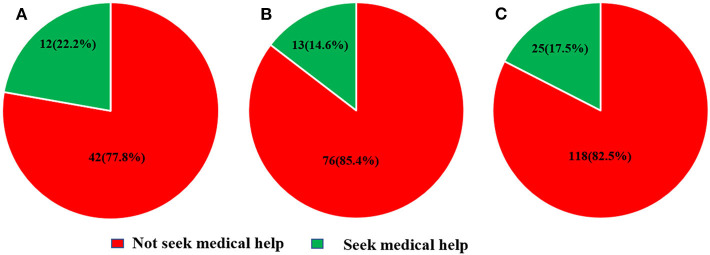
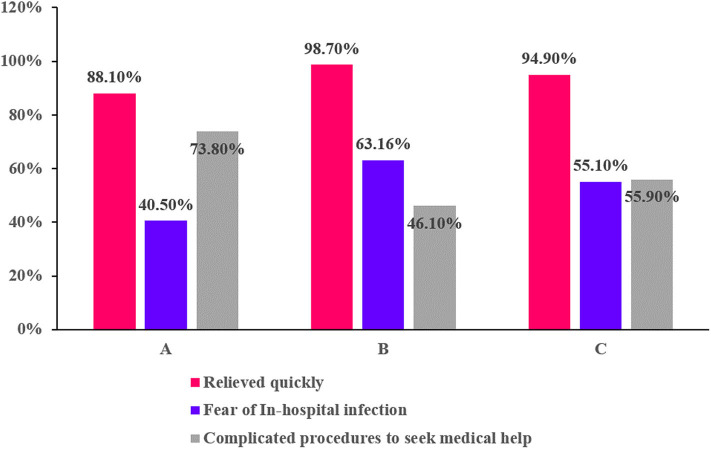
To investigate the impact of the novel coronavirus disease 2019 (Covid-19) on the behavior of those seeking medical attention for community residents suspected of having had a transient ischemic attack (TIA) during the pandemic. This was a community-based cross-sectional study with residents living in two communities located in the suburb of Shanghai. A face-to-face interview was prospectively conducted from 20 May 2020 to 30 June 2020 between community physicians and the community residents. Suspected TIA that occurred during the pandemic was identified by symptoms recalled from the community residents. The behavior of seeking medical attention after the suspected TIA was investigated. A total of 873 community residents (517 from the Wujing community and 356 from the Maqiao community) took part in face-to-face interviews. Among them, 143 (16.38%) suspected TIA cases were identified. Less than 20% of the community residents suspected of having a TIA went to the hospital during the Covid-19 pandemic. The most common reason for not seeking medical care during the pandemic was still that symptoms disappeared quickly (94.9%); however, the pandemic did have an impact on behavior. Fear of in-hospital infection (55.1%) and of complicated procedures involved in seeking medical attention during the pandemic (55.9%) made community residents hesitate to seek medical attention after the suspected TIA. Residents with a dual attack within 1 week or with aphasia or dysarthria were more likely to seek medical attention during the pandemic. Our study indicated that the Covid-19 pandemic negatively affected the behavior of those seeking medical attention among community residents with suspected TIA and this might explain part of the reduction in patients presenting with stroke or TIA observed from other reports.
调查2019年新型冠状病毒病(Covid-19)大流行期间对疑似短暂性脑缺血发作(TIA)的社区居民就医行为的影响。这是一项基于社区的横断面研究,研究对象为居住在上海郊区两个社区的居民。2020年5月20日至2020年6月30日期间,社区医生与社区居民进行了面对面访谈。通过社区居民回忆的症状来识别大流行期间发生的疑似TIA。对疑似TIA后就医行为进行了调查。共有873名社区居民(来自吴泾社区517名,马桥社区356名)参加了面对面访谈。其中,识别出143例(16.38%)疑似TIA病例。在Covid-19大流行期间,不到20%的疑似TIA社区居民前往医院就诊。大流行期间不就医的最常见原因仍然是症状迅速消失(94.9%);然而,大流行确实对行为产生了影响。对院内感染的恐惧(55.1%)以及对大流行期间就医涉及的复杂程序的恐惧(55.9%),使得社区居民在疑似TIA后就医时犹豫不决。在1周内有两次发作或有失语或构音障碍的居民在大流行期间更有可能就医。我们的研究表明,Covid-19大流行对疑似TIA的社区居民就医行为产生了负面影响,这可能解释了其他报告中观察到的中风或TIA患者减少的部分原因。