Li Qinling, Deng Yunzhen, Yin Xiangdong, Li Yingliang, Hu Lan, Yang Bin
Department of Medical Affairs, Children's Hospital of Chongqing Medical University, National Clinical Research Center for Child Health and Disorders, Ministry of Education Key Laboratory of Child Development and Disorders, Intelligent Application of Big Data in Pediatrics Engineering Research Center of Chongqing Education Commission of China, Chongqing, China.
Department of Information, Children's Hospital of Chongqing Medical University, National Clinical Research Center for Child Health and Disorders, Ministry of Education Key Laboratory of Child Development and Disorders, Chongqing Key Laboratory of Pediatric Metabolism and Inflammatory Diseases, Chongqing, China.
J Med Internet Res. 2025 Jul 21;27:e69765. doi: 10.2196/69765.
The World Health Organization (WHO) emphasizes internet IT as pivotal for optimizing health care system efficiency. Traditional bidirectional referral (TBR) systems, hindered by manual processes and information asymmetry, face challenges in pediatric care. While internet bidirectional referral (IBR) systems demonstrate effectiveness compared to TBR methods, comparative performance analyses remain remarkably scarce.
This study aims to develop a systematic and standardized bidirectional referral framework for internet hospitals and analyze the differences in core referral indicators of referral time and postreferral medical expenses between TBR (2019-2021) and IBR (2022-2024) at the Children's Hospital of Chongqing Medical University.
This study is a retrospective cohort study that includes patients aged 0-18 years with chronic diseases and complex cases in both TBR and IBR periods, while excluding emergency cases. We compared the differences between TBR and IBR across multiple dimensions, including demographic characteristics, downward-to-upward transfer ratio, core indicators (referral times and postreferral medical expenses) and referred diseases, and medical departments.
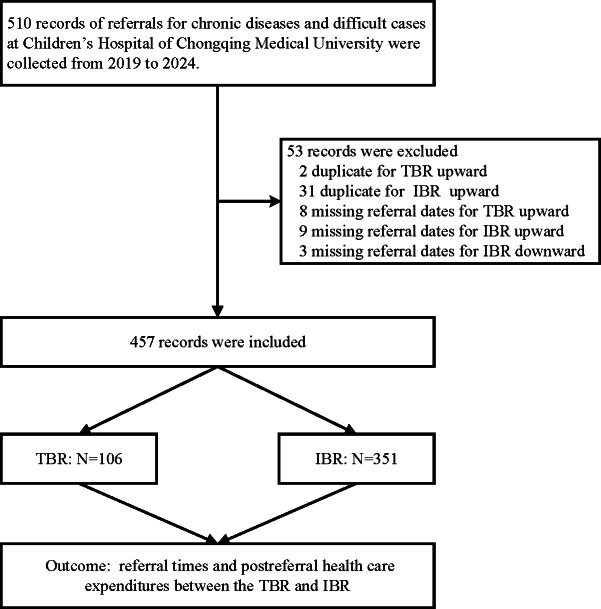
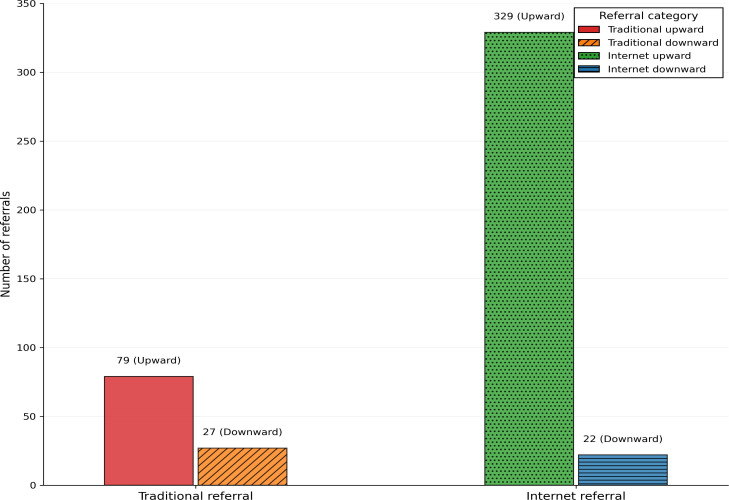
This study included a total of 457 referral cases, with 106 in the TBR group (79 upward and 27 downward, resulting in a downward-to-upward referral ratio of 34.18%) and 351 in the IBR group (329 upward and 22 downward, resulting in a downward-to-upward referral ratio of 6.69%). Compared with the TBR group, the median referral time in the IBR group was significantly shorter (0.90 d vs 2.51 d; P<.001), and the median postreferral medical expenses were lower (¥13,091.16 [US $1822.34] vs ¥8380.59 [US $1166.61]; P=.01). We observed that in both groups, the respiratory department consistently ranked as the top specialty for upward referrals, with pneumonia emerging as the most prevalent diagnosis for such transfers.
In pediatric care, the IBR system improved referral efficiency and reduced postreferral medical expenses compared with TBR methods, but there is still a low downward referral rate. While the IBR system shows promise and merits widespread adoption, further validation across diverse medical institutions and broader populations is necessary.
世界卫生组织(WHO)强调互联网信息技术对于优化医疗保健系统效率至关重要。传统双向转诊(TBR)系统受手工流程和信息不对称的阻碍,在儿科护理中面临挑战。虽然互联网双向转诊(IBR)系统与TBR方法相比已显示出有效性,但比较性能分析仍然非常稀缺。
本研究旨在为互联网医院开发一个系统且标准化的双向转诊框架,并分析重庆医科大学附属儿童医院TBR(2019 - 2021年)和IBR(2022 - 2024年)在转诊时间和转诊后医疗费用等核心转诊指标上的差异。
本研究是一项回顾性队列研究,纳入了TBR和IBR期间年龄在0至18岁的慢性病和复杂病例患者,排除急诊病例。我们比较了TBR和IBR在多个维度上的差异,包括人口统计学特征、下转上转比例、核心指标(转诊次数和转诊后医疗费用)、转诊疾病和医疗科室。
本研究共纳入457例转诊病例,TBR组106例(上转79例,下转27例,下转上转比例为34.18%),IBR组351例(上转329例,下转22例,下转上转比例为6.69%)。与TBR组相比,IBR组的中位转诊时间显著更短(0.90天对2.51天;P <.001),转诊后医疗费用中位数更低(13,091.16元[1822.34美元]对8380.59元[1166.61美元];P = 0.01)。我们观察到,两组中上转转诊的首要专科均为呼吸科,肺炎是此类转诊中最常见的诊断。
在儿科护理中,与TBR方法相比,IBR系统提高了转诊效率并降低了转诊后医疗费用,但下转转诊率仍然较低。虽然IBR系统显示出前景且值得广泛采用,但有必要在不同医疗机构和更广泛人群中进行进一步验证。