Department of General Surgery, Beijing Friendship Hospital, Capital Medical University, Beijing Key Laboratory of Cancer Invasion and Metastasis Research and National Clinical Research Centre for Digestive Diseases Beijing 100050, China.
Department of General Surgery, Beijing Ditan Hospital, Capital Medical University, Beijing 100015, China.
Dis Markers. 2020 Oct 29;2020:6289063. doi: 10.1155/2020/6289063. eCollection 2020.
Early detection appears to be the most effective approach to improve the overall survival of patients with hepatocellular carcinoma (HCC). We evaluated the potential performance of plasma methylation (mSEPT9) as a noninvasive biomarker for the diagnosis of patients with HCC.
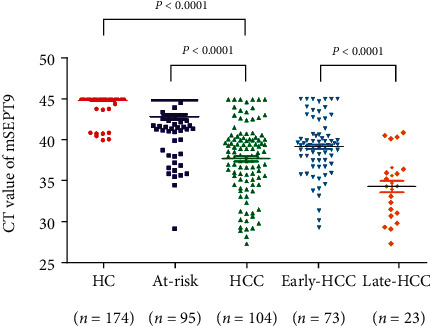
A total of 373 subjects were included, and the group consisted of 104 HCC patients, 95 with an at-risk disease, and 174 healthy controls (HC). The methylation of mSEPT9 was determined using methylation-specific fluorescence quantitative PCR. The diagnostic performance of plasma mSEPT9 for HCC was assessed in a single-blind manner.
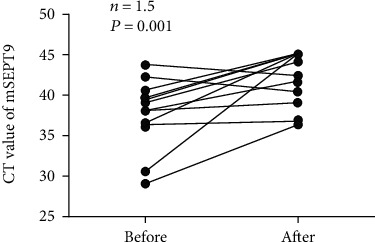
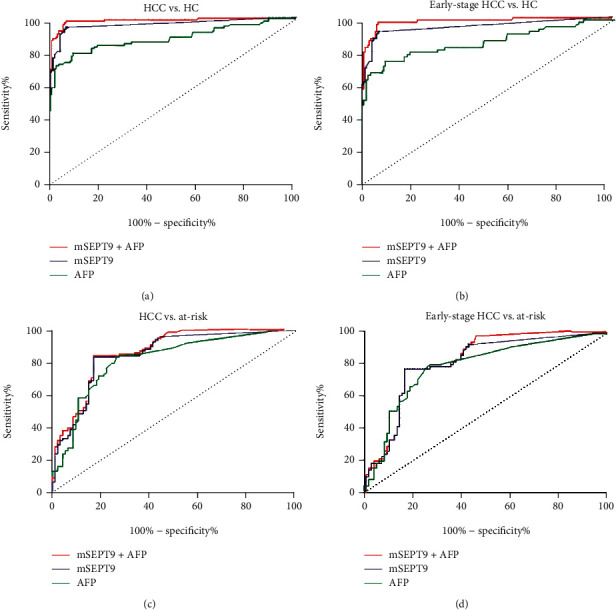
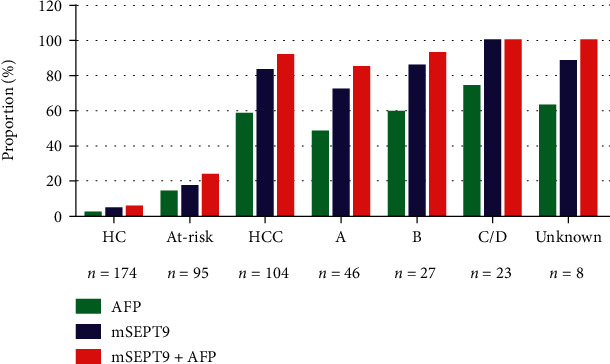
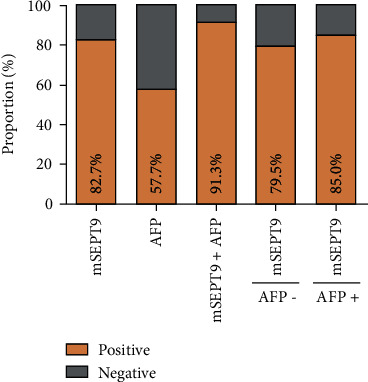
The receiver operating characteristic (ROC) curve showed that plasma mSEPT9 can be used to detect and discriminate HCC with an area under the ROC curve (AUROC) of 0.961, a sensitivity of 82.7%, and specificity of 96.0% from HC. These results showed that plasma mSEPT9 had better diagnostic performance than serum alpha fetoprotein (AFP) (AUROC 0.881, sensitivity 57.7%, and specificity 98.3%). Similar results were noted in the detection of early-stage HCC. When combined with serum AFP, the sensitivity increased to 91.3% and 87.7% for the detection of HCC and early-stage HCC,respectively. Notably, the levels of plasma mSEPT9 dramatically decreased after surgery ( = 0.001).
Plasma methylation might serve as a useful and noninvasive biomarker for the diagnosis of HCC and can be used to evaluate the therapeutic efficacy of HCC treatment.
早期检测似乎是提高肝细胞癌(HCC)患者总体生存率的最有效方法。我们评估了血浆甲基化(mSEPT9)作为 HCC 患者非侵入性诊断生物标志物的潜在性能。
共纳入 373 例受试者,其中包括 104 例 HCC 患者、95 例高危疾病患者和 174 例健康对照(HC)。采用甲基化特异性荧光定量 PCR 测定 mSEPT9 的甲基化。以盲法评估血浆 mSEPT9 对 HCC 的诊断性能。
受试者工作特征(ROC)曲线显示,血浆 mSEPT9 可用于检测和区分 HCC,其 ROC 曲线下面积(AUROC)为 0.961,对 HC 的敏感性为 82.7%,特异性为 96.0%。这些结果表明,血浆 mSEPT9 的诊断性能优于血清甲胎蛋白(AFP)(AUROC 0.881,敏感性 57.7%,特异性 98.3%)。在早期 HCC 的检测中也观察到了类似的结果。当与血清 AFP 联合检测时,检测 HCC 和早期 HCC 的敏感性分别提高至 91.3%和 87.7%。值得注意的是,手术后血浆 mSEPT9 水平显著下降(= 0.001)。
血浆甲基化可能是 HCC 诊断的一种有用的非侵入性生物标志物,并可用于评估 HCC 治疗的疗效。