Olij Branko F, Kemler Ellen, Valkenberg Huib, Stam Christine, Gouttebarge Vincent, Verhagen Evert
VeiligheidNL, Amsterdam, the Netherlands.
Amsterdam Collaboration on Health and Safety in Sports (ACHSS), Amsterdam UMC, Amsterdam, the Netherlands.
BMJ Open Sport Exerc Med. 2020 Oct 14;6(1):e000811. doi: 10.1136/bmjsem-2020-000811. eCollection 2020.
We aim to describe time trends of severe sports-related emergency department (ED) visits in the Netherlands, from 2009 to 2018.
Data were extracted from the Dutch Injury Surveillance System by age, gender, sports activity and injury diagnosis, from 2009 to 2018. Absolute numbers and time trends of severe sports-related ED visits were calculated.
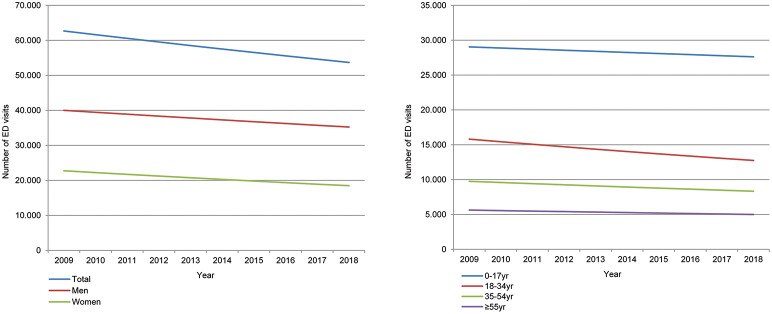
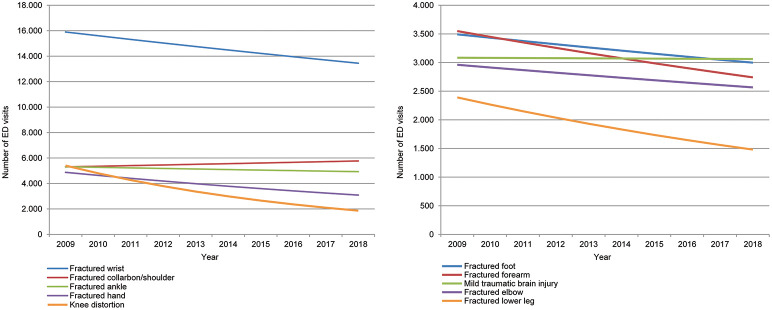
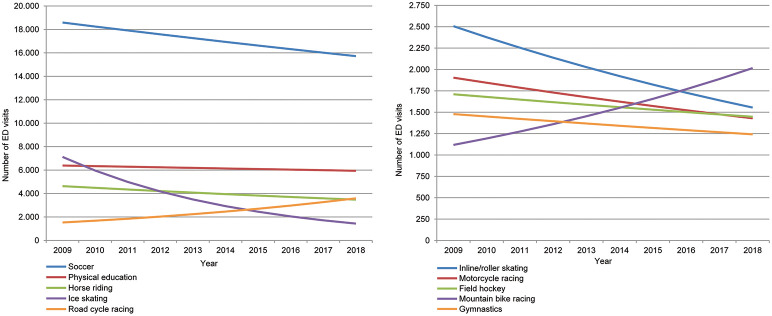
Between 2009 and 2018, the overall numbers of severe sports-related ED visits in the Netherlands have significantly decreased by 14% (95% CI -19% to -9%). This trend was seen among men (-12%; 95% CI -18% to -6%), women (-19%; 95% CI -26% to -11%) and individuals aged 18-34 years (-19%; 95% CI -28% to -10%). The number of ED visits has significantly decreased over time in soccer (-15%; 95% CI -24% to -6%), ice-skating (-80%; 95% CI -85% to -73%) and in inline/roller skating (-38%; 95% CI -55% to -15%). This was not the case in road cycle racing (+135%; 95% CI +85% to +198%) and mountain bike racing (+80%; 95% CI +32% to+146%). In terms of sports injury diagnoses, the number of fractured wrists (-15%; 95% CI -24% to -5%), fractured hands (-37%; 95% CI -49% to -21%), knee distortions (-66%; 95% CI -74% to -55%), and fractured lower legs (-38%; 95% CI -55% to -14%) significantly decreased over time.
Our study shows a promising reduction in the number of severe sports-related ED visits across most age groups and sports activities. As the number of ED visits increased in road cycle and mountain bike racing, it is important to find out what caused these increases. Furthermore, it is essential to determine trends in exposure hours and to evaluate and implement injury prevention programmes specific for these sports activities.
我们旨在描述2009年至2018年荷兰与运动相关的严重急诊科就诊的时间趋势。
从荷兰伤害监测系统中提取2009年至2018年按年龄、性别、体育活动和损伤诊断的数据。计算与运动相关的严重急诊科就诊的绝对数量和时间趋势。
2009年至2018年期间,荷兰与运动相关的严重急诊科就诊总数显著下降了14%(95%CI -19%至-9%)。这种趋势在男性(-12%;95%CI -18%至-6%)、女性(-19%;95%CI -26%至-11%)和18 - 34岁个体(-19%;95%CI -28%至-10%)中均有体现。足球(-15%;95%CI -24%至-6%)、滑冰(-80%;95%CI -85%至-73%)和直排轮滑/轮滑(-38%;95%CI -55%至-15%)的急诊科就诊人数随时间显著下降。公路自行车赛(+135%;95%CI +85%至+198%)和山地自行车赛(+80%;95%CI +32%至+146%)则不然。在运动损伤诊断方面,手腕骨折(-15%;95%CI -24%至-5%)、手部骨折(-37%;95%CI -49%至-21%)、膝关节扭伤(-66%;95%CI -74%至-55%)和小腿骨折(-38%;95%CI -55%至-14%)的数量随时间显著下降。
我们的研究表明,大多数年龄组和体育活动中与运动相关的严重急诊科就诊人数有望减少。由于公路自行车赛和山地自行车赛的急诊科就诊人数增加,找出导致这些增加的原因很重要。此外,确定暴露时间的趋势并评估和实施针对这些体育活动的 injury prevention programmes 至关重要。 (注:这里injury prevention programmes 未准确对应中文术语,可根据实际情况调整,比如“预防损伤计划” )