Wang Changzheng, Zhang Hongmei, Cao Xiaocui, Deng Rongrong, Ye Yi, Fu Zhongxiao, Gou Liyao, Shao Feng, Li Jin, Fu Weiyang, Zhang Xiaomei, Ding Xiao, Xiao Jianping, Wu Chuanjian, Li Tao, Qi Huan, Li Chengbin, Lu Zhongxin
Department of Laboratory Medicine, The Second Clinical Medical College, Yangtze University, Jingzhou, China.
Department of Laboratory Medicine, the Central Hospital of Wuhan, Tongji Medical College, Huazhong University of Science and Technology, Wuhan, China.
Ann Transl Med. 2020 Oct;8(19):1230. doi: 10.21037/atm-20-6090.
The global mortality rate for coronavirus disease 2019 (COVID-19) is 3.68%, but the mortality rate for critically ill patients is as high as 50%. Therefore, the exploration of prognostic predictors for patients with COVID-19 is vital for prompt clinical intervention. Our study aims to explore the predictive value of hematological parameters in the prognosis of patients with severe COVID-19.
Ninety-eight patients who were diagnosed with COVID-19 at Jingzhou Central Hospital and Central Hospital of Wuhan, Hubei Province, were included in this study.
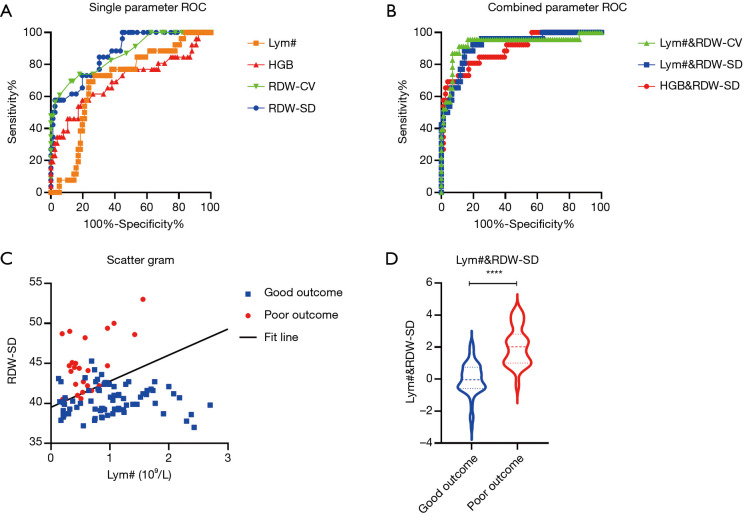
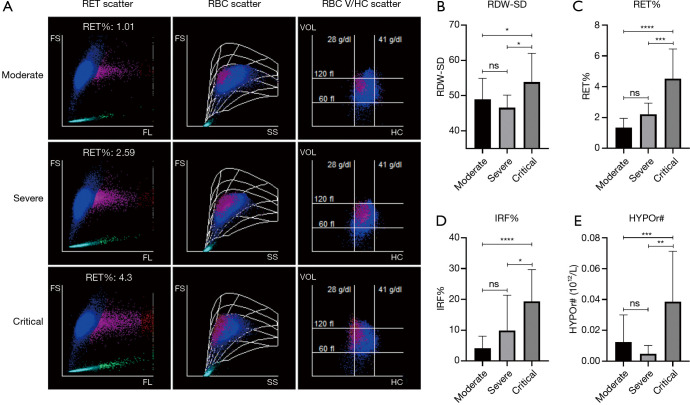
The median age of the patients was 59 [28-80] years; the median age of patients with a good prognosis was 56 [28-79] years, and the median age of patients with a poor outcome was 67 [35-80] years. The patients in the poor outcome group were older than the patients in the good outcome group (P<0.05). The comparison of hematological parameters showed that lymphocyte count (Lym#), red blood cells (RBCs), hemoglobin (HGB), hematocrit (HCT), mean corpuscular volume (MCV), and mean corpuscular hemoglobin (MCH) were significantly lower in the poor outcome group than in the good outcome group (P<0.05). Further, the red cell volume distribution width-CV (RDW-CV) and red cell volume distribution width-SD (RDW-SD) were significantly higher in the poor outcome group than in the good outcome group (P<0.0001). Receiver operating characteristic (ROC) curves showed RDW-SD, with an area under the ROC curve (AUC) of 0.870 [95% confidence interval (CI) 0.796-0.943], was the most significant single parameter for predicting the prognosis of severe patients. When the cut-off value was 42.15, the sensitivity and specificity of RDW-SD for predicting the prognosis of severe patients were 73.1% and 80.2%, respectively. Reticulocyte (RET) channel results showed the RET level was significantly higher in critical patients than in moderate patients and severe patients (P<0.05), which may be one cause of the elevated RDW in patients with a poor outcome.
In this study, the hematological parameters of COVID-19 patients were statistically analyzed. RDW was found to be a prognostic predictor for patients with severe COVID-19, and the increase in RET may contribute to elevated RDW.
2019年冠状病毒病(COVID-19)的全球死亡率为3.68%,但危重症患者的死亡率高达50%。因此,探索COVID-19患者的预后预测指标对于及时进行临床干预至关重要。我们的研究旨在探讨血液学参数在重症COVID-19患者预后中的预测价值。
本研究纳入了湖北省荆州市中心医院和武汉市中心医院确诊为COVID-19的98例患者。
患者的中位年龄为59[28-80]岁;预后良好患者的中位年龄为56[28-79]岁,预后不良患者的中位年龄为67[35-80]岁。预后不良组患者的年龄大于预后良好组患者(P<0.05)。血液学参数比较显示,预后不良组的淋巴细胞计数(Lym#)、红细胞(RBC)、血红蛋白(HGB)、血细胞比容(HCT)、平均红细胞体积(MCV)和平均红细胞血红蛋白含量(MCH)均显著低于预后良好组(P<0.05)。此外,预后不良组的红细胞体积分布宽度-CV(RDW-CV)和红细胞体积分布宽度-SD(RDW-SD)显著高于预后良好组(P<0.0001)。受试者工作特征(ROC)曲线显示,RDW-SD的曲线下面积(AUC)为0.870[95%置信区间(CI)0.796-0.943],是预测重症患者预后最显著的单一参数。当截断值为42.15时,RDW-SD预测重症患者预后的敏感性和特异性分别为73.1%和80.2%。网织红细胞(RET)通道结果显示,危重症患者的RET水平显著高于中症患者和重症患者(P<0.05),这可能是预后不良患者RDW升高的原因之一。
本研究对COVID-19患者的血液学参数进行了统计学分析。发现RDW是重症COVID-19患者的预后预测指标,RET升高可能导致RDW升高。