Kawahara Daisuke, Ozawa Shuichi, Yokomachi Kazushi, Higaki Toru, Shiinoki Takehiro, Saito Akito, Kimura Tomoki, Nishibuchi Ikuno, Takahashi Ippei, Takeuchi Yuuki, Imano Nobuki, Kubo Katsumaro, Mori Masayoshi, Ohno Yoshimi, Murakami Yuji, Nagata Yasushi
Radiation Therapy Section, Division of Clinical Support, Hiroshima University Hospital, Hiroshima, 734-8551, Japan.
Departments of Diagnostic Radiology and Radiology, Hiroshima University, Hiroshima, 734-8551, Japan.
BJR Open. 2019 Jul 8;1(1):20180045. doi: 10.1259/bjro.20180045. eCollection 2019.
The aim of the current study is to evaluate the effectiveness of reduction metal artifacts using kV-CT image with the single-energy based metal artefact reduction (SEMAR) technique by single-energy reconstruction, monochromatic CT and rED reconstructed by dual-energy reconstruction.
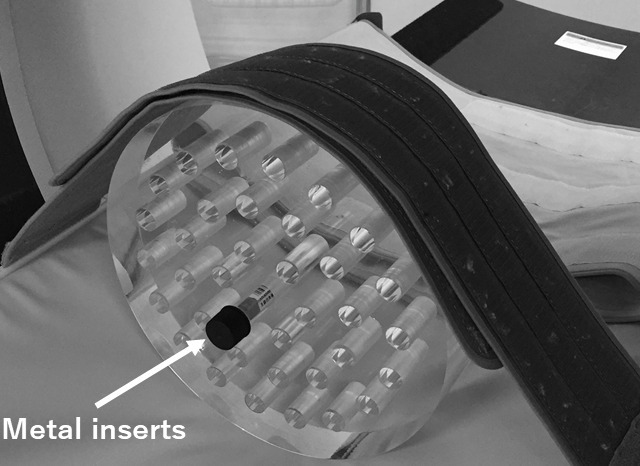
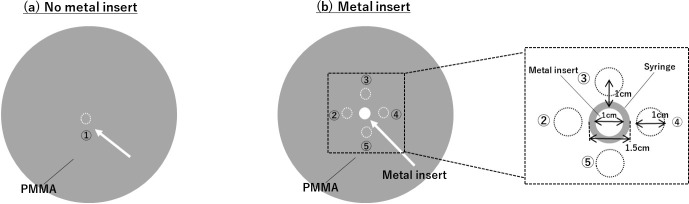
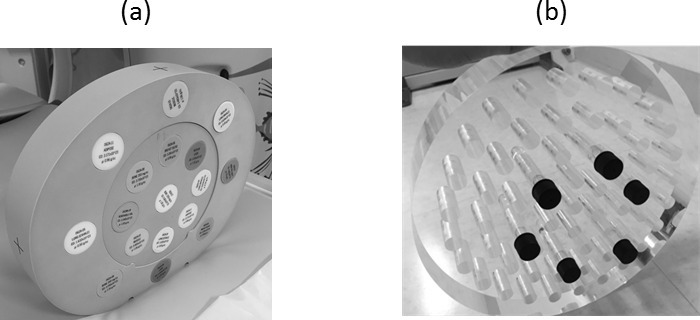
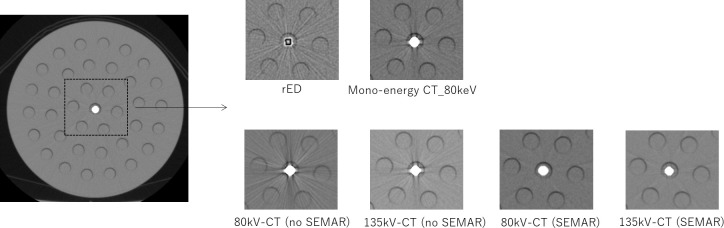
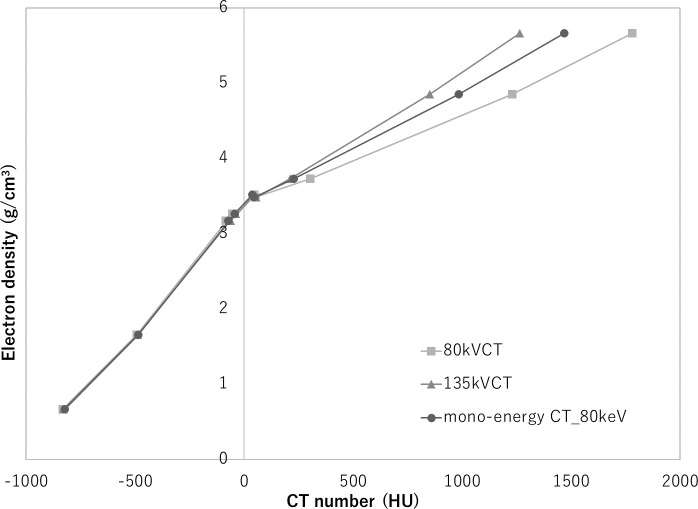
Seven different metal materials (brass, aluminum, copper, stainless, steel, lead and titanium) were placed inside the water-based PMMA phantom. After DECT-based scan, the artefact index (AI) were evaluated with the kV-CT images with and without SEMAR by single-energy reconstruction, and raw-data based electron density (rED), monochromatic CT images by dual-energy reconstruction. Moreover, the AI with evaluated with rED and the converted ED images from the kV-CT and monochromatic CT images.
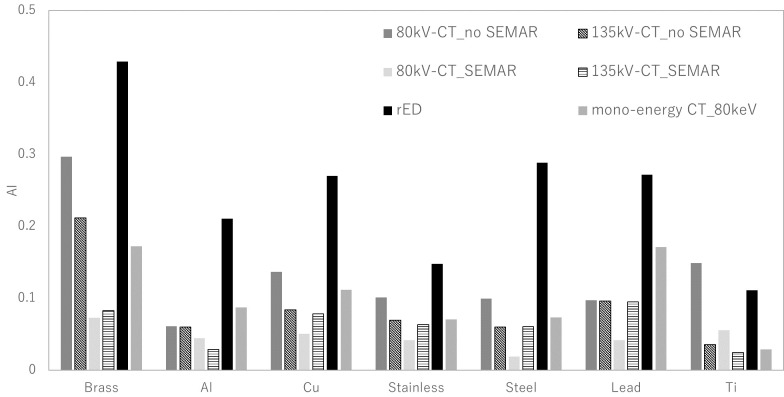
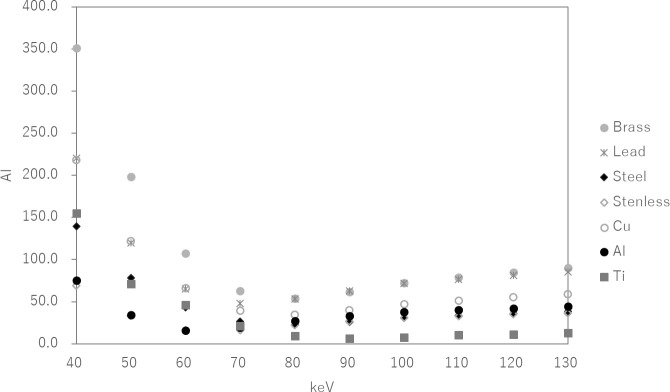
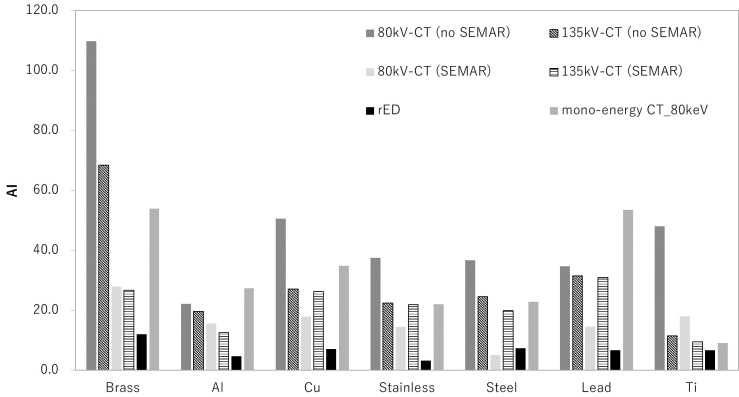
The minimum average value of the AI with all-metal inserts was approximately 80 keV. The AI without SEMAR was larger than that with SEMAR for the 80 kV and 135 kV CT images. In the comparison of the AI for the rED and ED images that were converted from 80 kV and 135 kV CT images with and without SEMAR, the monochromatic CT images of the PMMA phantom with inserted metal materials at 80 keV revealed that the kV-CT with SEMAR reduced the metal artefact substantially.
The converted ED from the kV-CT and monochromatic CT images could be useful for a comparison of the AI using the same contrast scale. The kV-CT image with SEMAR by single-energy reconstruction was found to substantially reduce metal artefact.
The effectiveness of reduction of metal artifacts using single-energy based metal artefact reduction (SEMAR) technique and dual-energy CT (DECT) was evaluated the electron density conversion techniques.
本研究旨在通过单能重建、单色CT以及双能重建的rED重建,利用基于单能金属伪影减少(SEMAR)技术的kV-CT图像评估减少金属伪影的有效性。
将七种不同的金属材料(黄铜、铝、铜、不锈钢、钢、铅和钛)放置在水基PMMA体模内。基于双能CT扫描后,通过单能重建,利用有无SEMAR的kV-CT图像评估伪影指数(AI),以及基于原始数据的电子密度(rED)、双能重建的单色CT图像。此外,利用rED以及从kV-CT和单色CT图像转换而来的电子密度(ED)图像评估AI。
所有金属植入物的AI最小平均值约为80 keV。对于80 kV和135 kV CT图像,未使用SEMAR时的AI大于使用SEMAR时的AI。在比较有无SEMAR的80 kV和135 kV CT图像转换而来的rED和ED图像的AI时,80 keV下插入金属材料的PMMA体模的单色CT图像显示,使用SEMAR的kV-CT显著减少了金属伪影。
从kV-CT和单色CT图像转换而来的ED可用于使用相同对比尺度比较AI。发现通过单能重建使用SEMAR的kV-CT图像可大幅减少金属伪影。
利用基于单能金属伪影减少(SEMAR)技术和双能CT(DECT)减少金属伪影的有效性通过电子密度转换技术进行了评估。