
双侧髋关节假体下肢 CT 血管造影中金属伪影的减少:一项实验性体模研究。
Reduction of metal artefacts from bilateral hip prostheses during lower extremity computed tomography angiography: an experimental phantom study.
机构信息
Department of Medical Imaging, Faculty of Health Professions, Al-Quds University, Jerusalem, Palestine.
Department of Medical Imaging, Faculty of Allied Medical Sciences, Arab American University, Jenin, Palestine.
出版信息
J Med Radiat Sci. 2024 Sep;71(3):421-431. doi: 10.1002/jmrs.797. Epub 2024 Jun 28.
INTRODUCTION
Image quality reduction due to metallic artefacts is a significant challenge during vascular computed tomography (CT) imaging of the lower extremities in patients with hip prostheses. This study aims to analyse various reconstruction algorithms' ability to reduce metal artefacts due to two types of hip prostheses during lower extremity CT angiography examinations.
METHODS
A pelvis phantom was fabricated with the insertion of a tube filled with contrast media to simulate the femoral artery, and the phantom was then CT scanned with and without hip prostheses. Multimodal images were acquired using different kilovoltage peak (kVp) settings and reconstructed with different algorithms, such as filtered back projection (FBP), iterative reconstruction (iDose), iterative model-based reconstruction (IMR) and orthopaedic metal artefact reduction (O-MAR). Image quality was assessed based on image noise, signal-to-noise ratio (SNR) and Hounsfield unit (HU) deviation.
RESULTS
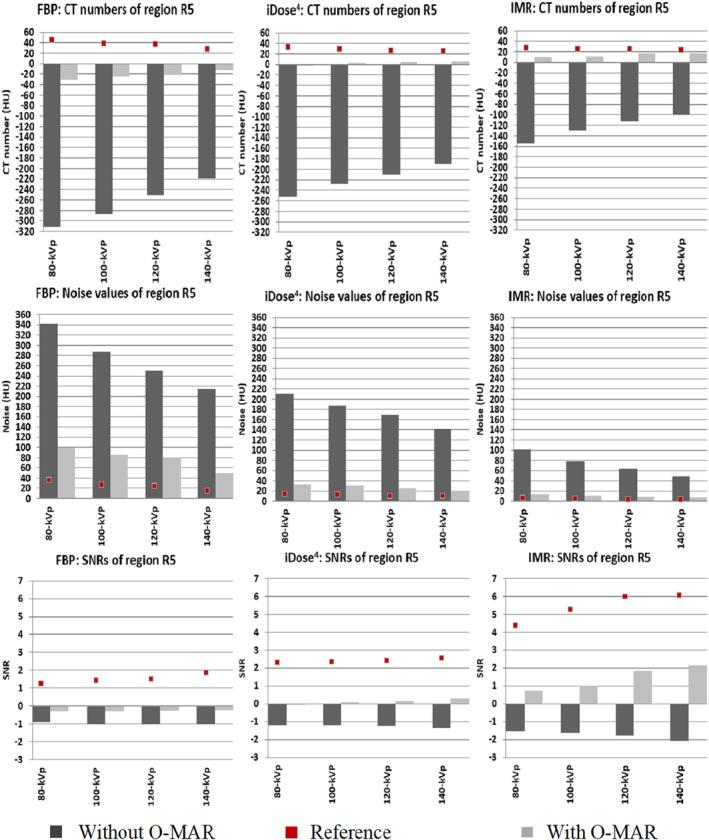
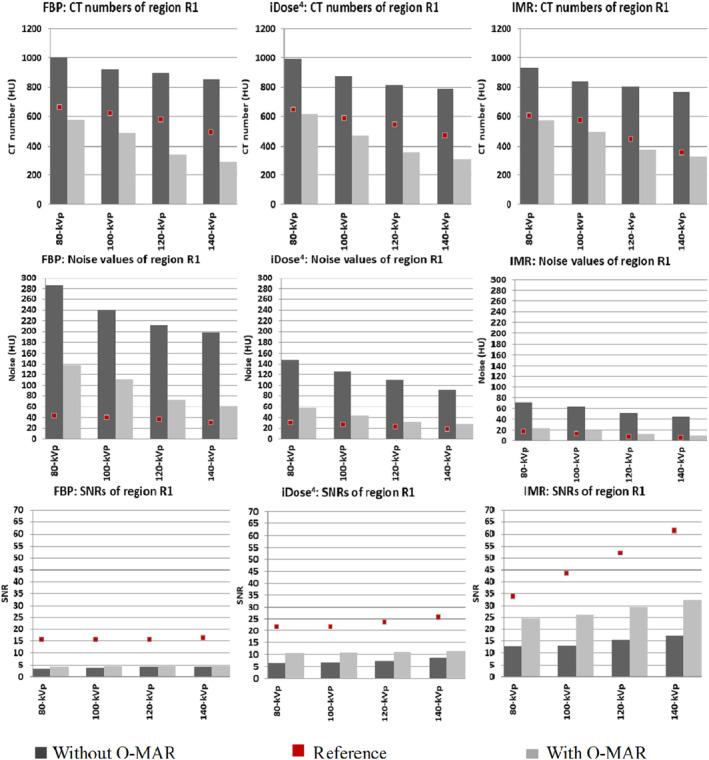
The IMR approach significantly improved image quality compared to iDose and FBP. For the vascular region, O-MAR improves SNR by 5 ± 1, 23 ± 5 and 42 ± 9 for FBP, iDose and IMR respectively, and improves HU precision towards the baseline values by 49% and 83% for FBP and IMR, respectively. The noise reduction was 71% and 89% for FBP and IMR, and 57% for iDose. O-MAR greatly enhances SNR corrections among the most severe artefacts, with 29 ± 1 and 43 ± 4 for FBP and IMR, compared to iDose by 37 ± 7.
CONCLUSION
IMR combined with O-MAR could improve the CT angiography of the lower extremities of patients with a hip prosthesis.
简介
在髋关节假体患者下肢的血管 CT 成像中,由于金属伪影导致的图像质量降低是一个重大挑战。本研究旨在分析两种髋关节假体在下肢 CT 血管造影检查中不同重建算法减少金属伪影的能力。
方法
使用插入充满对比剂的管的骨盆模型来模拟股动脉,并对带有和不带髋关节假体的模型进行 CT 扫描。使用不同的千伏峰值 (kVp) 设置采集多模态图像,并使用不同的算法进行重建,例如滤波反投影 (FBP)、迭代重建 (iDose)、迭代模型重建 (IMR) 和矫形金属伪影减少 (O-MAR)。根据图像噪声、信噪比 (SNR) 和亨氏单位 (HU) 偏差评估图像质量。
结果
与 iDose 和 FBP 相比,IMR 方法显著提高了图像质量。对于血管区域,O-MAR 分别使 FBP、iDose 和 IMR 的 SNR 提高 5±1、23±5 和 42±9,使 HU 精度向基线值提高 49%和 83%,对于 FBP 和 IMR,噪声降低分别为 71%和 89%,对于 iDose 为 57%。O-MAR 大大提高了最严重伪影的 SNR 校正,FBP 和 IMR 分别为 29±1 和 43±4,而 iDose 为 37±7。
结论
IMR 结合 O-MAR 可改善髋关节假体患者下肢 CT 血管造影。


 Zotero 插件